

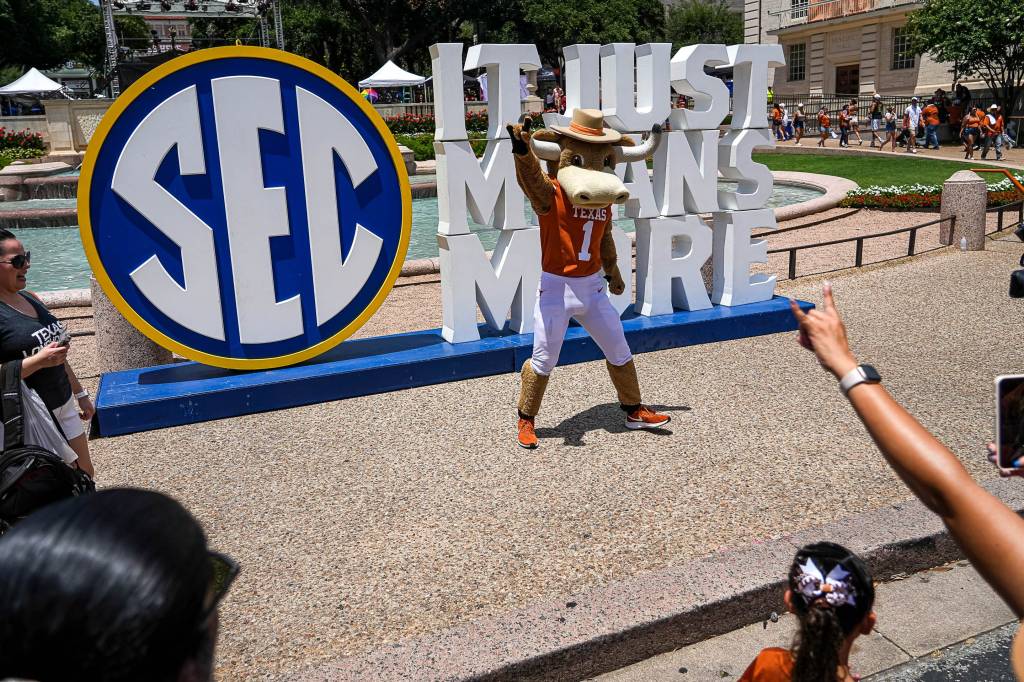
The world is changing! Well, the world of Division I college athletics, to be more specific. July 1 marks the beginning of the new athletic calendar year for the NCAA and this year is significant as the drastic changes of conference realignment will finally go into effect*.
Over the past few years, we’ve seen bombshell realignment announcements that have changed college athletics’ geography and power structure. Leagues like the SEC and Big Ten have consolidated more power to become even bigger behemoths at the top of the Division I food chain. Meanwhile, leagues like the Big 12 and ACC have had to scramble for survival while the Pac-12, as we knew it, bit the dust. As is often the case, these changes reverberate all the way down to Group of Five conferences seeing an altering of their membership ranks.
Below, I’ll give a rundown of all the conference realignment moves taking place this year and will give a visual representation of these leagues through maps provided by SportsLeagueMaps.com. And I’m sticking with Division I FBS football leagues, so apologies to those who wanted insight into the Southland and NEC leagues in FCS.
*The Big Ten and Big 12’s new members will officially join in August for those who are sticklers about technicalities.
Power Four
SEC

Number of schools: 16
New members: Oklahoma Sooners, Texas Longhorns
Departing members: None
Oklahoma and Texas are joining the Southeastern Conference, adding two more “blue blood” football programs to the juggernaut league. This all began in July 2021 when the Brent Zwerneman of the Houston Chronicle reported that the two schools had reached out to the SEC about joining the league. Just over a week later, both had officially accepted invitations to join. They were initially slated to join in 2025 but reached an agreement to leave the Big 12 a year early by paying a combined $100 million exit fee.
The famed Red River Rivalry is now an SEC product and the long-dormant rivalry between Texas and Texas A&M will be renewed. Now at 16 programs, the SEC has gotten rid of divisions and the conference title game will be played by the two teams with the highest win percentage in conference play. The powerful becomes even more powerful.
Big Ten

Number of schools: 18
New members: Oregon Ducks, UCLA Bruins, USC Trojans, Washington Huskies
Departing members: None
Nearly a year after the SEC made their bombshell move, the Big Ten announced a seismic shift of its own in June 2022 with the approval of UCLA and USC as new members. The addition of these two prestigious Los Angeles schools struck a critical blow to an already weakened Pac-12, and just over a year later in August of 2023, Oregon and Washington followed suit.
The Big Ten now spans coast-to-coast, completing a total transformation of a league that was once exclusively based in the Midwest. With the addition of these West Coast schools, the league now has representation either in or near the metros of New York City, Detroit, Chicago, Minneapolis, Seattle, and Los Angeles. Like the SEC, it has also scrapped divisions and the conference title game will be played by the two teams with the highest win percentage in conference play. Historical powers like Michigan and USC will now share a conference, but this also means we’ll also get awkward matchups like UCLA-Maryland under the Big Ten banner.
Big 12

Number of schools: 16
New members: Arizona Wildcats, Arizona State Sun Devils, Colorado Buffaloes, Utah Utes
Departing members: Oklahoma Sooners, Texas Longhorns
Oklahoma’s and Texas’ departures were a near-death blow to the Big 12 and the league had to act quickly for its own survival. Just a few months after that announcement, the league replenished its ranks by adding Cincinnati, Houston, UCF, and BYU, all of whom became official members in 2023. In August of that same year, the conference acted as the aggressors when poaching Arizona, Arizona State, Colorado, and Utah from the Pac-12.
This move marks a return to the Big 12 for founding member Colorado, who previously departed for the Pac-12 just over a decade ago. It also reunites rivals BYU and Utah in the same conference for the first time since 2010. The addition of Arizona also bolsters the league’s legitimacy in basketball, as the Wildcats will now play the likes of Kansas, Baylor, and Houston in league play. Like other leagues, this is a very weird conference geographically as it spans from Salt Lake City, Utah, to Orlando, Florida. We’ll see if the league can forge a cohesive identity over the next few years.
ACC

Number of schools: 18 (Notre Dame Fighting Irish are full members in every sport except football)
New members: California Golden Bears, SMU Mustangs, Stanford Cardinal
Departing members: None
Cal, SMU, and Stanford are joining the ACC this year, but that’s an afterthought compared to the internal crisis the conference is experiencing right now. For the sake of brevity, here’s a basic rundown of what’s happening in the Atlantic Coast Conference:
Powers like Florida State and Clemson are dissatisfied with the league’s media rights agreements as over time, it will leave them at a financial disadvantage vs. contemporaries in the SEC and Big Ten. They want out of the ACC, but are locked in until 2036 through the league’s grant of rights agreement. So, they’ve taken it upon themselves to sue the league over the GOR. If they are successful in court and can get out of the GOR, it could potentially open the floodgates for other schools like North Carolina or Virginia to follow them out the door and out of the conference.
So in the middle of fighting for its survival, the ACC has attempted to future-proof for any potential exits by adding three schools. They threw a life raft to Cal and Stanford after the Pac-12 hit the iceberg and yes, that means two schools that are near the Pacific Ocean will be calling the ATLANTIC Coast Conference home. Meanwhile, SMU, desperate to join a power conference for the first time in nearly 30 years, agreed to join the ACC while foregoing TV revenue for its first nine years in the league. This basically makes SMU the unpaid intern of the Power Four, but the school is confident that its wealthy donor base can fill in the revenue gaps.
Functionally dead, but technically still alive
Pac-12

Number of schools: 2
New members: None
Departing members: Arizona Wildcats, Arizona State Sun Devils, California Golden Bears, Colorado Buffaloes, Oregon Ducks, Stanford Cardinal, UCLA Bruins, USC Trojans, Utah Utes, Washington Huskies
An entire book can be written on the Pac-12’s collapse, detailing the mistakes made by former commissioners Larry Scott and George Kliavkoff. The inability to get wider distribution for the Pac-12 Network and the inability to sign an adequate media rights agreement ultimately doomed the conference, prompting 10 of its member schools to hit the exits this year.
While those schools were able to find safe haven in other leagues, Oregon State and Washington State have been left behind. As two small brands located in the Pacific Northwest, they were not able to take refuge in the Big Ten, Big 12, or ACC like their former contemporaries. The two schools were able to reach a financial settlement with the departing schools back in March and they will have control over decisions of the league moving forward. So yes, the Pac-12 is technically still alive, just with two members.
To fill their 2024 schedules, both OSU and WSU reached a scheduling agreement with the Mountain West Conference where they’ll effectively play an MWC slate without being eligible for the MWC title game. This could be a precursor to some sort of “reverse merger” where the MWC is absorbed under the Pac-12 banner. Meanwhile, the two schools will become affiliate members of the West Coast Conference in other sports.
Group of Five
AAC

Number of schools: 15 (Army/Navy football-only members, Wichita State Shockers does not have a football program)
New members: Army Black Knights
Departing members: SMU Mustangs
The AAC underwent massive change last year with the addition of six Conference USA schools in the aftermath of Cincinnati, Houston, and UCF departing to the Big 12. With SMU bolting for the ACC, the conference officially approved Army as a football-only member last October.
With this addition, the Army-Navy game is now under the AAC umbrella…although it will still be played as a non-conference game at the end of the year.
Conference USA

Number of schools: 10
New members: Kennesaw State Owls
Departing members: None
The AAC’s raid of Conference USA forced the league to scramble for new members last year and what you got was the weirdest league in FBS, a mishmash of leftover schools, former independents, and programs transitioning up from FCS. The conference will be welcoming another FBS newbie this season in the form of Kennesaw State, who found success in its short run in the FCS ranks.
CUSA will continue to serve as a weigh station for FBS newcomers in the future as in 2025, it will be welcoming in Delaware and Missouri State.
Sun Belt

Number of schools: 14
New members: None
Departing members: None
No changes for the Sun Belt this year and that continuity is good for a league that has leaned into regional rivalries as part of its identity.
Mountain West

Number of schools: 12 (Hawai’i Warriors are a football-only member)
New members: None (Oregon State Beavers and Washington State Cougars will have a scheduling partnership with the conference)
Departing members: None
The Mountain West Conference is staying static for the time being but as mentioned before, it has concocted a scheduling agreement with Oregon State and Washington State this season. That could end up being beneficial for teams like Boise State and San Diego State, who will try to grab the Group of Five’s bid for the 12-team College Football Playoff.
MAC

Number of schools: 12
New members: None
Departing members: None
The MAC will remain static and carries the distinction of being the league least affected by these latest rounds of conference realignment. However, it will see a change next year when UMass joins as a full member.