

Nobody wants to think about how things can go wrong with their fantasy baseball team. Spring is, after all, a time for eternal optimism, when everyone’s in the best shape of their life and all of your sleepers are bound for big years.
But here’s the thing: Things are going to go wrong. Players get hurt, or otherwise fall short of projections, every single year. Someone — someone who had big dreams in March — is going to finish in last place come September. If you’re lucky, your misses are relatively small ones; an early pick merely good instead of great, or a late-round flier fails to pan out. Other times, though, the misses are big — like, say, 2022 Bryce Harper, who played just 99 games while posting his worst OPS since 2016.
Obviously there’s no way to know for sure where those landmines are ahead of time — if there were, we’d be in Vegas right now instead of on the internet. But thinking through how things might go wrong with fantasy’s biggest names — where the stakes are highest — can still be a valuable exercise, allowing us to recognize which players are taking on more risk than others and where pitfalls might arise. That’s what this column is all about: trying to identify how things could go wrong for each of the players with an ADP inside of the first 12 picks, per early-March ADP. Hopefully this will give you a clearer sense of your priorities early in drafts. (A quick note before we get started: We’re largely ignoring injury scenarios, because they could happen to anyone and aren’t very instructive.)
2024 fantasy baseball: Who to target with your first-round pick
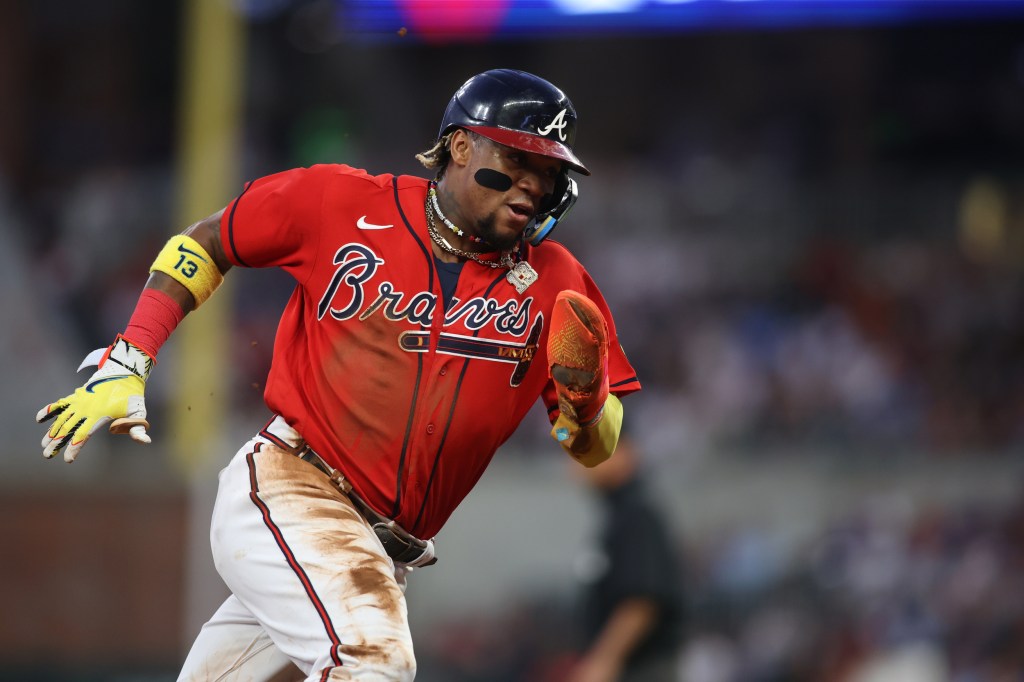
Ronald Acuna Jr., Atlanta Braves
If you’re in a standard snake draft, it’s hard to see how things could go wrong here — Acuna combines incredible plate discipline with incredible quality of contact, and he’s a remarkable athlete who just stole 73 bases last year. Setting injury to one side, he’s as foolproof as it gets: Even if you discount him 20% in every category from last season, you’d still be looking at 119 runs, 33 homers, 85 RBI, 58 steals, and a .270 average, which would be perfectly fine for the No. 1 overall pick.
If there’s a red flag here, it likely comes in auction leagues, where the bidding for his services is likely to get completely bananas. If Acuna’s going for, say, nearly a quarter of your budget, he can’t just be the best player in fantasy — he has to lap the field, and that’s obviously a very high bar with little margin for error.
Bobby Witt Jr., Kansas City Royals
Witt Jr. took a giant leap forward, one that was supported by his underlying metrics. But he’s in a tough park with a middling lineup around him, and his season was largely built on two stratospheric months — July (.979) and August (1.015) were the only two months in which he posted an OPS of .800 or better. Progress isn’t always linear, and Witt’s aggressive approach at the plate does introduce some risk, especially as the league adjusts to him. We just don’t have a very long track record here, prospect pedigree aside, and while his physical tools establish a solid floor, he could simply be very good rather than top-five.
Julio Rodriguez, Seattle Mariners
You could say much the same for Rodriguez, who’s developing into one of the streakiest players in baseball. Rodriguez’s top-line numbers looked fine last season, but he was a pretty big disappointment for the first two-thirds of it, hitting .251 with just a 27-homer pace through the end of July — and then going bananas until the end of the season. This tracks with who he is as a player: He hits the ball as hard as anyone, but he also swings as much as almost anyone, and that aggression at the plate can lead to some real volatility and cold spells. Again, he has his athleticism to fall back on — he was still on pace for nearly a 30-40 season even before Aug. 1 and that massive hot streak — but any dip in his quality of contact could lead to some ugly stretches and more of a second-round profile.
Corbin Carroll, Arizona Diamondbacks
I know I just said I was largely disregarding injury risk, but doing so in the case of Carroll would be foolish — he underwent surgery to repair a torn labrum (among other issues) in his right shoulder back when he was a prospect, costing him most of the 2021 season, and the same shoulder started barking again on two different occasions last year. It didn’t result in an IL stint, but it’s still the biggest risk in his profile, as are his good-not-great batted-ball metrics and the fact that the league seemed to adjust to him a bit in the postseason. The speed will always play, but this is the first case of real catastrophic downside.
Mookie Betts, Los Angeles Dodgers
Betts, on the other hand, is about as safe as safe gets. He hit the cover off the ball, and his results were backed up by an elite 48.5% hard-hit rate and his best average exit velocity in years. There’s simply no reason to have skepticism about his profile, except for the fact that he’s in his 30s now. The worst-case scenario here is probably that he regresses a bit back to his 2021 or 2022 form — .270ish batting average with more like 30 homers than 40 — and that’s still a very good player, albeit not quite as helpful as owners expect in the middle of the first round.
Kyle Tucker, Houston Astros
If Betts isn’t the safest first-rounder, Tucker probably is: He’s never been on the Major League IL with an injury – he’s only had two stints in 2021 on the COVID-19 IL – and 30/30 seems like a lock. The only thing is that 30/30 also might be pretty close to his ceiling, as he’s not a blazer and doesn’t tear the cover off the ball. If you want floor, Tucker’s your man, but you are giving up something in terms of upside. And that also means the margin for error is smaller: Small, fluky disappointments will hit harder here, because he doesn’t have the right-hand delta to compensate. If he hits .260 with 26 homers and 25 steals and has 170 combined runs and RBI, that’s not terrible, but it is a little flat.No
Fernando Tatis Jr., San Diego Padres
Now we’re back in the deep end of the risk pool. To recap Tatis Jr.’s injury history:
2019: Strained hamstring
2019: Stress reaction in lower back
2021: Left shoulder subluxation
2021: COVID-19
2021: Left shoulder inflammation
2022: Fractured left wrist (and later left shoulder surgery)
And that’s not even counting the suspension he served for a positive PED test, from which he came back at least a slightly diminished hitter — with his lowest average exit velocity since his rookie season and his worst expected wOBA on contact ever. I’m high on Tatis Jr. this year — in a lot of ways, he’s in the same place as Ronald Acuna was at the start of last season, and he remains prodigiously talented with a historically unprecedented track record for his age — but if we’re talking worst-case scenarios, his dip in performance and injury history are real red flags. Just about any outcome is on the table here.
Freddie Freeman, Los Angeles Dodgers
If you’re looking for nits to pick in Freeman’s profile, you’ll be at it a while. There’s really just one: He’s 34, turning 35 before the season ends. Future Hall of Famers tend to defy the aging curve better than most, but you can only hold off Father Time for so long — just ask Paul Goldschmidt, who won an MVP Award in 2022 and then seemed to have lost a step just a few months later. I wouldn’t bet against Freeman, but it can’t be disregarded either.
Spencer Strider, Atlanta Braves
To start with the obvious: He’s a pitcher, and pitchers can go sideways at a moment’s notice — among the biggest reasons why I avoid Strider and every other top starter until pick 50 or so. There are small red flags in his pitching profile — he lives on elevated fastballs, and that leads to homers which lead to worse ratios than you’d expect from a guy with his dominant stuff — but really, he’s a pitcher who throws in the upper-90s consistently. That’s a lot of strain on your elbow and shoulder, and the fact that he only has one season of even 150 innings to his name doesn’t help.
Aaron Judge, New York Yankees
He’s in his 30s now, with a body that historically doesn’t age gracefully, and he’s missed a bunch of time over the last two seasons. There really aren’t any performance risks for Judge; he probably won’t hit 60 homers again, but he’s the only player I can’t rule that out for with any degree of certainty. Still, he’s been on the IL eight times in seven years, and he’s not getting any younger — you know what you’re signing up for when you draft him, even if the upside could very well be worth it.
Trea Turner, Philadelphia Phillies
If you want the worst-case scenario here, just turn the clock back a few months: Turner struggled mightily for much of the 2023 season, hitting .242/.296/.378 with a 162-game pace of 90 runs, 16 homers, 53 RBI, and 33 steals. He made up for it with a scorching stretch run (and postseason), quelling lots of those concerns. But he’s about the only elite baserunner who didn’t take advantage of the rule changes last year, and he doesn’t do as much damage at the plate as just about everyone else on this list. Maybe his steals finally spike this year, and maybe second-half Turner is the Turner who shows up from the jump. But we’ve seen the floor here, and it’s lower than most others around him.
Juan Soto, New York Yankees
Expectations are plenty high for Soto after his move to the Yankees, and 40 homers and piles of RBI are definitely in the range of outcomes here. But Soto’s swing isn’t optimized to take advantage of pull power; he’s not particularly well-suited to take advantage of the short porch at Yankee Stadium, and if his approach falls back to 2022 — and New York’s lineup disintegrates around him as it did last year — he doesn’t have the big-time power/speed floor to fall back on.