

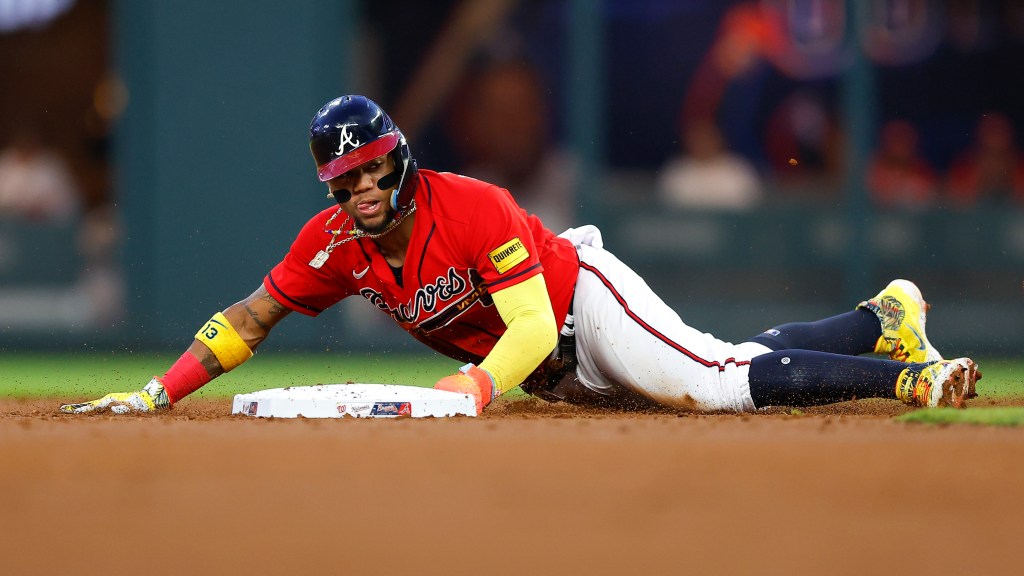
Not so long ago, stolen bases were worth their weight in fantasy baseball gold, such a precious commodity that otherwise-underwhelming speed merchants like Michael Bourn, Willy Taveras and Myles Straw managed to work their way into even the shallowest of drafts. You could have steals, or you could have the other four offensive categories, but seldom did the twain shall meet.
And then the 2023 season came along, and everything changed. MLB wanted to more action on the basepaths, and boy did they get it: The decision to increased the size of each base and limit pickoff attempts ahead of the 2023 season had a dramatic effect on the rhythm of the sport. The number of stolen bases across the league last year was the most since 1987, nearly a 40 percent increase from 2022.
Combine a loosening of the running game with a new generation of freaky do-it-all athletes, and suddenly we started seeing nigh-unprecedented stat lines. Prior to 2023, only two players had ever delivered a 30/50 season, and none since Barry Bonds way back in 1990. Ronald Acuña Jr. dropped a 40/70 season, inventing multiple new power/speed clubs all by himself. And that’s just the tip of the iceberg: Bobby Witt Jr. came within a stolen base of being the fourth 30/50 player; Corbin Carroll — a rookie, mind you — became the first player (along with Acuña) to have 25 homers and 50 steals in the same season since 2007 (Hanley Ramirez); Julio Rodriguez, put up a 32-homer, 37-steal campaign at age 22, and it felt like a footnote.
All of which is to say that the game has changed dramatically when it comes to fantasy; it’s not an exaggeration to say that owners have never had to navigate numbers like these before, numbers that flip what had been conventional wisdom on its head. Aaron Judge has hit 99 homers over his last 263 games, yet he’s being taken at the end of the first round in standard 12-team leagues right now — and it’s just very hard to make an argument that he should be higher, given the sort of five-category craziness we’re seeing from guys like Acuña Jr., Witt Jr., Rodriguez, Carroll and even other stars like Kyle Tucker, Mookie Betts and Fernando Tatis Jr.
And it’s not just the top of draft boards that have been affected. The 2023 season saw 51 players steal 20 or more bases. The last time we reached that number? 1989. Heck, the last time there were even 40 20-steal players was 2013. In 2022, there were 24. In 2021, there were just 19. So what do we as fantasy managers do about it? How does it change our approach come draft time? Let’s break it down, accounting for both head-to-head and traditional Rotisserie formats.
What it means for 5×5 Rotisserie leagues
First thing’s first: There’s Acuña Jr., and then there’s everyone else — most auction calculators have him a full $10-15 above the field, double the value of perfectly respectable four-category contributors like, say, Austin Riley.
More broadly, though, with so many players offering a meaningful number of steals in their profiles, you no longer have to sell out for them as early as you used to — and it no longer means worrying about compromising your team elsewhere. Just a few years ago, when there might be only two dozen players with 20-plus steals, it felt like the scarcity was such that owners would simply draft all the base-stealers until the base-stealers were gone, then pivot depending on need.
Stolen bases are plentiful, and you still need them — often in larger quantities than you used to. But you can wait until the middle rounds and target players like Josh Lowe, Bryson Stott or Ha-Seong Kim, all of whom offer real stolen-base juice while also not killing you anywhere else. Even less obvious candidates like Seiya Suzuki, Jordan Walker and Josh Naylor project to provide double-digit steals; they won’t win you the category, but they’ll at least keep you afloat while you focus elsewhere, flexibility that was unheard of in years past. None is being drafted inside the top 80, on average. Assuming a median of something like 150 steals in a standard league, it’s not crazy to think that you can ignore the category through the first few rounds and still feel confident in at least the sort of middle-of-the-pack finish that keeps you in the hunt provided your team is healthy in the other categories.
Of course, the flip side is that players who give you only speed, the guys like the aforementioned Bourn, Taveras and Straw, have gone from a necessary evil to an unnecessary one. It’s harder to justify spending meaningful draft capital on a guy like Oakland Athletics outfielder Esteury Ruiz, for example; he’s not going to be as impactful on his own because of the higher stolen-base threshold, and he’s only going to set you back further in everything else while your fellow owners target more balanced players. We also need to adjust our expectations, and not get sucked in by numbers that would’ve been eye-popping in 2021. Tommy Edman stole 30 bags that year, a tremendous value at the time; in 2023, however, he somehow fell to 27, and that’s a big difference given the sea change around him.
What it means for H2H leagues
Many of the same guidelines for roto apply here as well, but with a couple of caveats. Because H2H leagues accumulate only a week at a time rather than over the course of an entire season — and because they generally give you fewer lineup spots to work with — you might need to shoot a bit more for ceiling than floor when it comes to steals. With fewer lineup spots, you can’t rely on 20-steal compilers like Kim to combine to deliver a competitive steals total each week, and their slow-but-steady approach doesn’t work as well in this compressed format. Going the extra mile for a riskier option like, say, Elly De La Cruz or C.J. Abrams could make sense — or just pivot to someone who helps more in other categories and punt steals entirely.
When scoring begins anew each week, you can have a team that’s skewed more in one particular direction so long as it’s built to win more categories than not. You have more options, in other words, but you also have to be more deliberate with your strategy.