

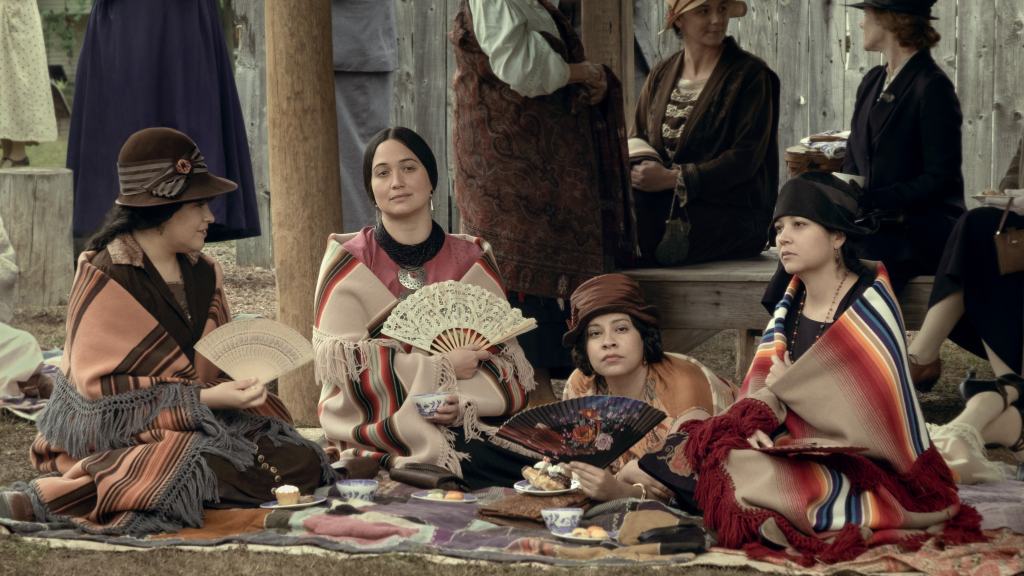
One of the most harrowing things about Martin Scorsese’s latest three-hour-and-twenty-plus minute epic, Killers of the Flower Moon, is the changes within the physical makeup of the 1920s Osage community in northeastern Oklahoma – a subtle warning to the bluntness of the actions of the outsides that take place. As more Osage members are murdered, the town is rich in culture and specific rituals, and wealth becomes progressively whiter and unidentifiable from many American cities at that time.
While Scorsese’s film looks at this specific instance of infiltration, Moon itself is based on the non-fiction novel by David Grann and is also a particular indictment of what has happened to indigenous people in the creation of the American experiment. Even as they enjoyed the oil-rich territory given to them, the ways the Osage tribe could invest in their communities were limited. Archival footage of that period is shown at the film’s beginning, showing jovial Osage families happily dancing in dresses in the finest clothing and even having white servants act as taxi drivers. However, many tribes required guardians to access their money and lacked the political power to impede what was about to happen to their vibrant town.
William King Hale (Robert De Niro)’s demeanor often feels like he’s a wolf in sheep’s clothing. He’s a wealthy cattle rancher who has engrained himself as a well-meaning part of the Osage community. Not known to many, he’s orchestrated a long game plot to obtain the head rights (or control of specific amounts of money), urging the white men of the town to marry an Osage woman. At the center is Ernest Burkhart (Leonardo DiCaprio), William’s somewhat dopey nephew who has returned from World War I.
:format(webp):no_upscale()/cdn.vox-cdn.com/uploads/chorus_asset/file/24997703/Killers_Of_The_Flower_Moon__Photo_0103.jpg)
He’s looking for a job and finds one as a driver. However, at the behest of William, he tells Ernest to go to court an Osage woman named Mollie Kyle (Lily Gladstone). It’s not exceptionally uncommon in the town. Mollie’s sisters are married to white men, but there’s a caveat that it’s more about positioning for power than love. These same dynamics play out as Ernes and Mollie spend time together. She senses his sudden interest in her is because of her wealth (“Coyote want money, she says”). There are many complications between them as Killers of the Flower Moon goes forth, but Scorsese, co-writer Eric Roth, and Osage consultants helped shape the bulk of the plot, focusing on the love story.
It’s not a star-crossed marriage tale in which Ernest suddenly reckons with his horrible actions. There are complications in that while he does care for Mollie, Ernest is even more beholden to the actions quickening the genocide against the Osage population. It all comes down to the tremendous performances of Gladstone, DiCaprio, and De Niro. De Niro’s portrayal of William (who asks people to call him King) is chilling because of how sneakily cutthroat he can be. One minute, he’s in a tribal community meeting where the heads of the town are actively condemning the murders and lending a helping hand with the Osage’s language at a funeral. The next, he’s going to a rancher to make a bomb to kill one of Mollie’s family members.
The acts are loud, vicious, and egregious, but the scariest part about this is they come from the words of a man who whispers in back alleys and shadows. Lily Gladstone accesses a fantastic range of emotions within Mollie. There’s despair, profound grief, and anger as she watches her sister get picked off one by one. Steadfastness as she urges Washington to do something about these murders and accesses her faith. Loyalty concerning her marriage to Ernest and paranoia as she moves through the looks of people who are out to get her.
:format(webp):no_upscale()/cdn.vox-cdn.com/uploads/chorus_asset/file/24997776/Killers_Of_The_Flower_Moon_Photo_0106.jpg)
It is as effective as showing how one community can be dismantled through vices, executions, and outright warping of morals as showing how these choices impact one family. DiCaprio draws on a certain aloofness when playing Ernest. He’s directionless when he arrives in Oklahoma, looking for someone with wisdom to guide him. You can see Ernest struggle with what he’s tasked to do at points – perhaps realizing he’s just a pawn in a big white supremacist game. However, the unsubstantiated claim to wealth intoxicates him. No matter how much he professes his love for Mollie, it’s not enough to loosen him from the calls of his uncle.
When help in the form of FBI agent Tom White (Jesse Plemons) comes to investigate the almost more than 20 murders that had been committed, it feels like a day late and a dollar short. Scorsese doesn’t position the FBI agents as some knights in shining armor – they are more so just following the law. Any retribution for what’s happened is fleeting because you know things like this will happen again. Adjacent to this story, radio broadcasts and newspapers show the Tulsa riots happening as a testament to what happens as minorities figure out a way to gain a step up.
Rodrigo Prieto’s camerawork makes Moon feel like it’s from another time – a lush painting in motion paired with the foreboding sense of dread within the beauty of the landscape. Jacqueline West’s costume design uniquely captures the clothing of the Osage people with accurate detail, right down to the blankets they wore across their shoulders. Killers of the Flower Moon is Scorsese’s epic western chronicling America’s original sin of an unquenchable thirst for control over the many resources people can use to escape its grip.