

One of the beautiful things about baseball is that, on any given day, you’re liable to see something totally new — even in a ballpark that’s been around for over 100 years.
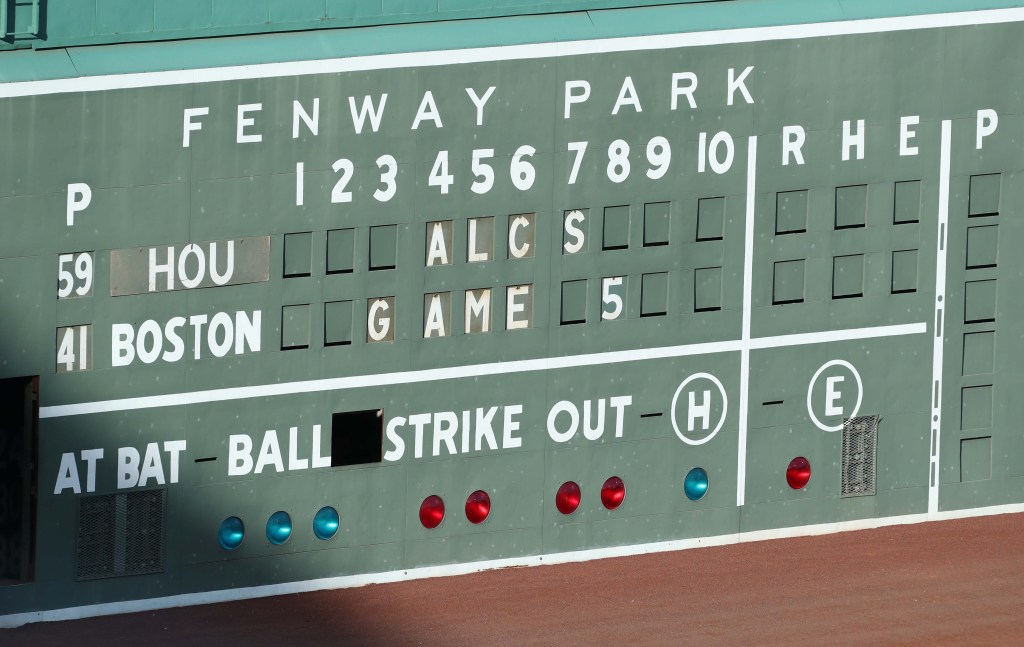
Fenway Park is not without its antiquated charm, especially when it comes to the Green Monster, still updating its big scoreboard manually after all these years. But while the Monster certainly adds some gravitas to Boston’s ballpark, it also introduces the potential for chaos. Masataka Yoshida found this out the hard way when he went back after a Kyle Isbel line drive, leapt, missed it, turned around and … found that the ball had totally disappeared. Why, you ask? Because it had gotten stuck in one of the light fixtures that the Monster uses to keep track of how many outs there are each half-inning:
I’ve never seen this happen before.
— Boston Strong (@BostonStrong_34) August 9, 2023
pic.twitter.com/i6DxPjGduw
This is Yoshida’s first year playing in Boston and just his 59th appearance in left, so we can only imagine his confusion at discovering that some of America’s ballpark fences can swallow fly balls.
Of course, this is hardly the first time the Monster has affected play in a live game. There was Manny Ramirez disappearing for a quick bathroom break, of course, and sometimes baseballs will even carom off the ladder that still hangs from the wall — a vestige of the days when Red Sox employees would have to climb up fish home-run balls out of the 23-foot-tall net that sat above and beyond the top.
The Green Monster is just about as old as Fenway, although its original incarnation bears a scarce resemblance to the iconic fence we know and love today. Ironically enough, it was first conceived as a means of keeping fans out of the park: When designing Fenway, then-Red Sox owner John Henry was concerned that some of the taller buildings on Boston’s Landsdowne Street would afford people a view of the action without having to buy a ticket. So he built a 25-foot wall to stand in their way:
:format(webp):no_upscale()/cdn.vox-cdn.com/uploads/chorus_asset/file/24841243/a1takj9jjbkcmeq0q8mf.jpeg)
It wasn’t until 1933, when a fire destroyed much of the park, that the wall — still just known as The Wall to locals — would begin to resemble something worthy of the nickname Green Monster. It was rebuilt in 1934 with a concrete base and a hand-operated scoreboard, both of which are still in use today. And 13 years later, the advertisements that had plastered the wall since its first game were removed, and it was painted the same shade of green as the rest of the ballpark — hence the nickname.