

The brilliance of They Cloned Tyrone is within the details surrounding the plot as they come together to make a timely whole. At some points during the film, there are random ads for fried chicken hair and care products. They play as overt stereotypes played to a Black neighborhood, and with good reason. Many of the things Black people have come to love have also been used against them and even held up as a tool to demean them as people. With situations throughout history like Tuskegee and phenomenons such as gentrification, there is a lot of distrust within the Black experience.
Within the 70’s style blaxploitation filter, writer/director Juel Taylor encases the film right from entry; there’s Fontaine (John Boyega), a drug dealer in a fictional neighborhood named The Glen. On a typical day, Fontaine goes to a local store, buys a 40 and a scratch-off card (where he always loses), pours a little into the cup of an old man Frog (Leon Lamar), and goes home to ask his mother if she wants food to which she always turns down. Within that monotony is tragedy – Fontaine lost his younger brother, and that grief seeps into his rigid demeanor.
Taylor and co-writer Tony Rettenmaier feel like they have They Cloned Tyrone veering into the familiar territory of a man trying to do whatever he needs for him and his family to survive. But the narrative quickly subverts your expectations. When Fontaine looks to collect money from one of his clients, Slick Charles (Jamie Foxx), a hilarious pimp that seems down on his luck, Fontaine is shot dead in an ambush. However, he awakens the following day as if the previous night’s events never happened. Besides some eerie imagery, Fontaine seems fine.
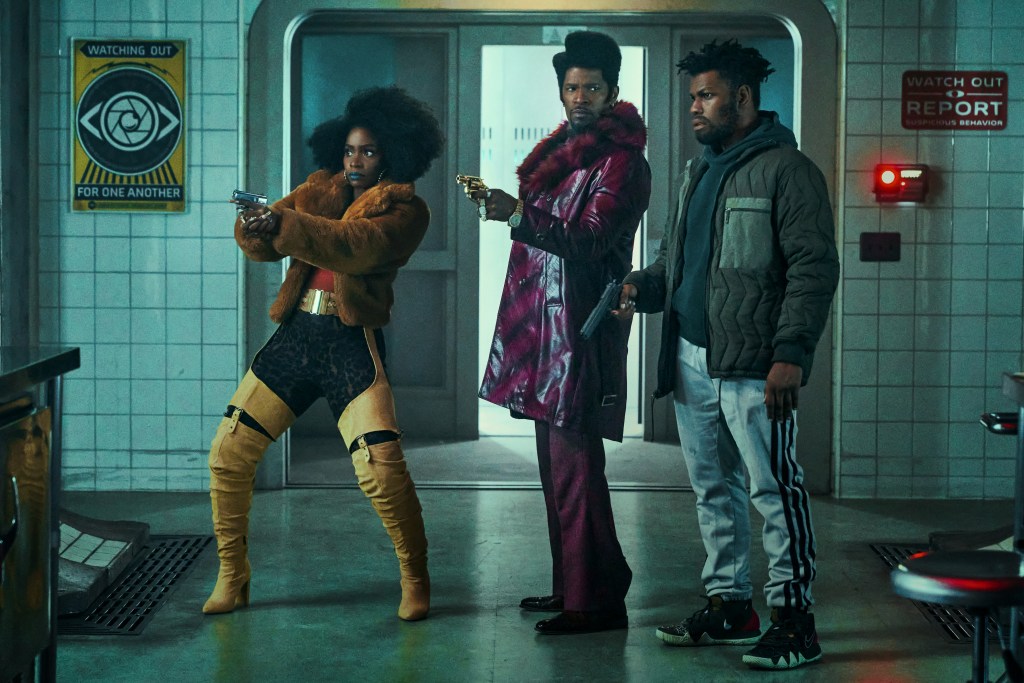
Charles and his sex worker Yo-Yo (Teyonah Parris), are terrified to see Fontaine’s sudden resurrection. So, what could it be? Does Fontaine have some healing capabilities? Is The Glenn a simulation, or are there more nefarious things happening? In one of the many hilarious scenes Boyega, Foxx, and Parris share, they go into a deserted trap house to find an elevator. Within the basement, there’s a lab with experimental equipment, a white man daunting an afro and a lab coat, an inexplicable white powdery substance, and something that shakes Tyrone to his core. It’s in that moment, and others like it, where They Cloned Tyrone further develops as a sci-fi comedy with some poignant social commentary to parallel the laughter.
:format(webp):no_upscale()/cdn.vox-cdn.com/uploads/chorus_asset/file/24812118/TCT_20210115_04304_R3.jpg)
The paranoia deepens when the trio uncovers that most of the products, the local church, the salon, and many things people in The Glen enjoy make up this multi-pronged effort to control. In a long-exposition expounding fashion, Nixon (Kiefer Sutherland), the “self-ascribed boss that works under the boss,” tells the trio the grand plan. It’s not only that Taylor wants the world to see why Black people’s paranoia and urban legends are valid given American history; it’s how stereotypes are placed upon them like a uniform. Black people can strive to be doctors, lawyers, etc., but some long-standing social systems don’t allow that to happen.
Even though The Glen doesn’t exist, it’s a metaphor for many urban cities nationwide. Lack of investment, over-policing, and overall dehumanization have left people in a cycle of poverty and pain. The sci-fi and horror genres serve as excellent platforms to confirm social strife – while it might be far-fetched for clones, it’s not too hard to think about the narrow lenses Black men and women are seen through. Ken Seng’s filters and points of view are great enough to transport you to another time and place – yet also push you into a modern spectrum if he chooses. Boyega, Foxx, and Parris help elevate the film’s premise and characterizations in the allotted time.
When Boyega’s Fontaine is steadfast in the mission, Foxx brings the jokes, and Parris complements with the witty “Nancy Drew” nature of it all. Not everything lands as intended – especially considering a last reveal and explanation. Given all the ideas, Taylor’s genre platter ends with a satisfying and thought-provoking fantasy note.