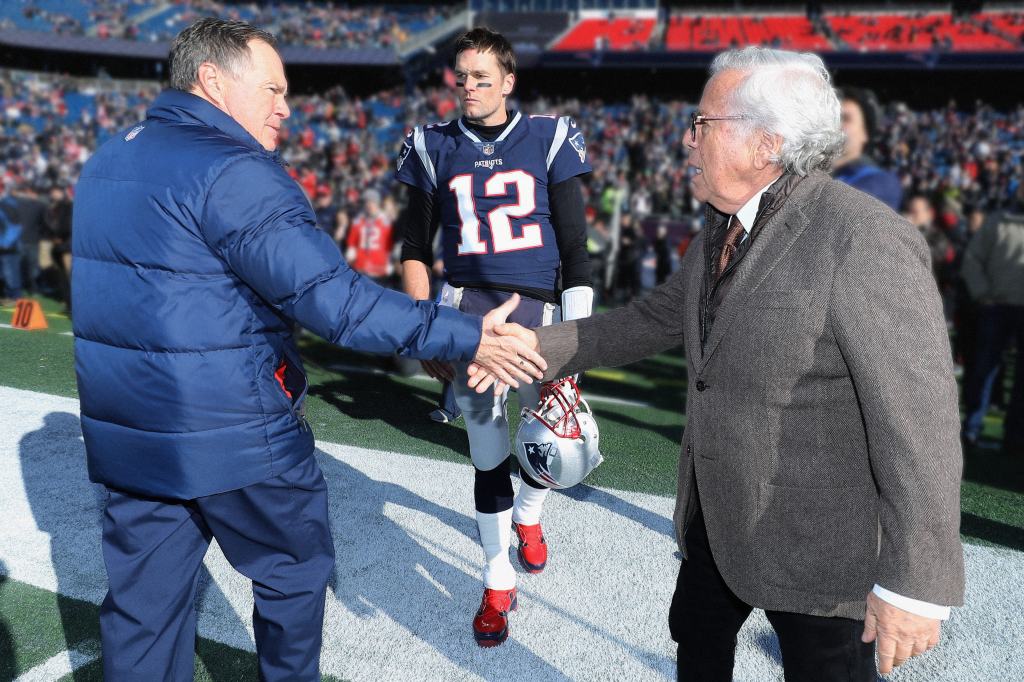
The Dynasty, Apple TV+’s new 10-part docuseries on the New England Patriots, drops on Friday and shines a new light on the nearly two decades of dominance enjoyed by Tom Brady, Bill Belichick, Robert Kraft and Co. on the gridiron.
Apple TV+ describes the docuseries as exploring “the franchise’s 20-year journey, from the unique chemistry that fueled six Super Bowl wins to the internal strife that sparked a turf war. From the owner’s suite to the locker room, the series reveals an insider’s look at the road to — and cost of — greatness.” Featuring interviews with Brady, Belichick Kraft, other key Patriots, journalists, fans and more, “the series offers unparalleled access to, and insights from, past and present Patriots players, coaches and executives.”
DraftKings Network had the opportunity to speak with director Matthew Hamachek earlier this week and he said that the docuseries will present a fascinating story about human beings just like the rest of us going through really complex situations, albeit on the biggest stage imaginable. Below is our interview, with comments edited for length and clarity.
DraftKings Network: Did you find it at all challenging to do a project like this about a team with such a recent history and in an era that involves social media where we kind of digest everything so quickly and in such a huge news cycle?
Matthew Hamachek: “Well, it’s interesting, I didn’t grow up a Patriots fan, I had my own team. But one of the things that I did know about them, from what little I saw, was that they sort of kept everybody at arm’s length, right? So yes, it’s a very modern team, but I don’t think we know all that much about the Patriots. And I think to me, that was part of the thing that I found so intriguing about telling the story is that what we’re used to seeing is Bill Belichick getting up onto the lectern and saying, “We’re on to Cincinnati” or something to that effect and giving nonanswers. And here we had an opportunity to talk to, you know, 60 or 70 plus coaches, players, league officials, executives for the team, but also the rivals … and really, in an interesting way, I think that for a team that really kept everything close to the vest, that didn’t reveal a lot, these guys were ready to talk for whatever reason for the first time for a lot of them. And, I think whether you’re a die-hard Patriot fan or somebody that knows nothing about the team or maybe even doesn’t even care about football, I think you’ll find this to be a fascinating story about human beings and these people going through really complex situations, albeit on the biggest stage imaginable.”
DKN: Did you find it interesting at all for a team with this kind of reputation, I think someone mentions in one of the later episodes of, you know, always being, no personality, that kind of thing, did you find it interesting to see so many stories come out of such an organization? You know, again, even having lived through it, I kind of forgot how many different things were going on during this period.
Hamachek: “Well, yeah, I think … you build up trust with people over time, right? So you say, “Hey, really would be interested in talking to you,” and then you explain your method of what kind of story you’re gonna try to tell, right? And in this case, what I told people is I’m here to listen because I don’t have some preconceived notion about what this story should be. I just, I want to hear what you have to say and what you think is important and every person we would talk to would tell us something else that was new and different, even about the things that I think, you know, non-Patriot fans know about like Spygate and Deflategate. It’s one thing to see those headlines and to think you understand those stories. It’s another thing to hear the people talk about them that were actually in those rooms and then to pair that with, I think we had like 35,000-plus hours of archival footage that has really never been seen before. So, in that specific instance, it was OK, it’s, it’s one thing to read an article, it’s another thing to be transported into the locker room and watch Bill Belichick address the team right after that sort of scandal broke. But then also after that, the team’s become the Evil Empire … they’ve won three in four years, that scandal breaks and they go on this undefeated run that season, one of the editors on the project sort of described it like you’re on the Death Star as the Evil Empire goes from planet to planet, destroying everybody in their path. But instead of being somber, they’re sort of celebrating and having a party as they’re doing it. And so, like I said … you might think you know the story, it’s another thing to be transported there to be able to watch these locker rooms and these intimate moments that you’ve never seen before and then hear about it from the people that are actually in the room, not a reporter who’s sort of guessing or using anonymous sources or, you know, whatever. So, it was a really interesting story to tell.”
DKN: Definitely as a Star Wars fan I appreciate the reference. One of the early episodes talks about the notion of, you know, living long enough to see yourself become a villain. Do you think that this documentary will have the ability or will potentially change anyone’s preconceived notions about the Patriots, good or bad? Or do you think people largely have kind of determined, “I hate them.” “I love them.” There’s no changing them?
Hamachek: “I can’t speak to whether or not people’s opinions can be changed anymore. But, I think the thing that you will get to see, and I say this as somebody who did not grow up a Patriots fan by any means, is that they are human beings, right? You know, the way you normally tell a documentary story is you find a very small story that nobody’s ever heard about before and you and people that nobody’s ever heard about before and you sort of build that up and you make it feel larger than life. In this instance, this is a group of people that people think they know really well because they’re constantly on their television sets and they’re, for somebody like Tom Brady, one of the biggest celebrities in the world. I think that this was an opportunity to show why they’re just like us, dealing with very common things that we all deal with, right? Which is things like feeling betrayed, feeling sort of passed over, things like that. It’s just that they’re doing it on the biggest stage imaginable. And so, I think that’s what really makes the story special and I think … as a non-Patriot fan, what I was really struck by was how revealing and charismatic and interesting all of these people were, which I never really felt like I got to meet as a fan of the NFL and sort of consume this stuff quite a bit. So that was really revelatory to me.”
DKN: It’s very interesting timing for this to come out as well with, you know, Belichick just leaving the Patriots last month. Do you think that changes the way people will see the doc or kind of re-live these moments now that they know that officially the dynasty has ended. Brady left several years ago, Belichick’s gone now, it’s whole new era in New England. Do you think this will change the way anyone watches the doc or sees the doc or receives it?
Hamachek: “I don’t know. I would say no for me because whenever I try to make a movie, I always try to make it as evergreen sort of as possible, right? I want it to be something that no matter what happens with the story after the fact, obviously, basically all stories continue onward, right? Because whether or not Bill’s there or Tom’s there, the Patriots will continue, right? And so I wanted to make something that felt like no matter what happened afterwards, this is the telling of the Patriots dynasty by the people who actually lived it. And so whether or not Bill has left doesn’t really factor all that much into, how people will view this.”
DKN: You mentioned a little bit, getting to know a little bit more of the personalities we didn’t get to see all those years. Was there anyone in particular that really kind of surprised you with kind of some of the stories that they tell or the personality they showed in their interviews with you?
Hamachek: “Well, yeah, one of them was definitely Ernie Adams, who is the director of football research. He, in New England Patriot culture, he’s the sort of mystical figure that nobody’s ever really seen before. People refer to him as the guy behind the hoodie, Bill Belichick’s longtime friend. And he was endlessly fascinating to listen to because he was there for it all and I think that he’s a great storyteller for one, that I think was there for really, really key moments throughout the entire time. And, then, you know, getting, Danny Amendola, Rob Gronkowski, Devin McCourty, all of these guys were fascinating to listen to and for them … this was stuff that had just happened to them in the last five, seven years and they were really willing to go places that I found surprising just because you know, in McCourty and Matthew Slater(‘s case) they were, they were both in the locker room while we were actually asking them these questions still. And they were so honest and so revealing about what had gone down. So, that was really surprising to me.”
DKN: When did you start working on this project?
Hamachek: “I started working on this in the spring or summer of ‘21. And it’s, you know, a 21⁄2-year journey working with myself and Jeff (Benedict), the author of the book, but then also bringing in an incredible team of filmmakers to collaborate with whether it’s, you know, Dan Koehler, who’s the editor and producer of the project, who I’ve collaborated on tons of projects with, Chris James, Miranda Johnson, Dallas Rexer, just so many talented people, who all had an incredible lift to be able to tell this large of a story with this much footage and these many interviews. So it was really a team effort on our part.”
DKN: To that end, is it hard to tell a story that spans such a long period of time? You know, you’re talking about 20 years of kind of stories. Is that hard to do?
Hamachek: “I think that one of the things that was really important for us was to tell it in a certain way. And I don’t mean that we had like this idea of what the story should be. What I mean is, I don’t think any of us wanted this to feel as if you could watch one episode and it was a completely different story and then when you came to the next one it would be this different topic altogether, right? What we wanted to do was to take this epic sort of 20-year story and make it feel like you were watching that arc over the course of 20 years. And then to use flashbacks to elucidate what you were seeing in the present-day story. And I think that makes for a much more compelling viewing experience for the audience, but it also makes it much harder and difficult to tell that story that way. So in that sense, in addition to having to begin combing through 35,000 hours of footage and find all of the buried treasure there, but then also to do 70-plus interviews. Yeah, I mean, it, it took time, but it was always fascinating because just when you thought you knew everything about, you know, the Deflategate story, somebody else would have this incredible revelation to tell you in the interview chair and then you’d sort of peel away at that onion and then there would be something else. And so it never ended.”
DKN: Was it difficult to get Coach Belichick to open up? I know he’s notoriously tight-lipped, although some say he has a bit more of an expansive kind of wit and wry humor in private. Was it hard to kind of get him engaged in opening up in this format?
Hamachek: “I mean, look, it’s interesting. Yes, everybody sort of sees the press conferences, but I point to the fact that he tells this great story about how after the ’06 loss to the Colts in the AFC Championship Game, they knew that they needed to bring in some offensive weapons and he talks about calling Randy Moss in a club. We have both Bill and Randy both bouncing off of each other while they’re telling the story. And you get to see, you know, Bill’s cracking a smile and he’s telling the story about how he calls and Randy thinks it’s a prank and he keeps hanging up on him and Bill is like, ‘Oh, I guess Randy doesn’t want to come to the Patriots after all.’ And so, yeah, I think you get to see a different side of Bill. But even when he sort of falls back into the one- or two-word answers, I think the context with which you have around him as he’s giving those, allows at times the silence and those few words to speak volumes. And I think that’s what’s different is he’s not just standing on an island on the lectern with nobody else around him. He’s surrounded by Tom, he’s surrounded by Gronk, he’s surrounded by Ty Law, he’s surrounded by Robert and it’s all of those people collectively telling the story. So, I think you’ll learn a lot.”
The Dynasty, a 10-part docuseries directed by the Emmy Award-winning Hamachek (“Tiger”) and produced by Imagine Documentaries, is based on the New York Times-bestselling book The Dynasty by Jeff Benedict. The first two episodes debut on Friday on Apple TV+, with subsequent episodes dropping weekly.