Fantasy football is all about playing the market, but dynasty formats make that same market even more complex as managers evaluate the long-term picture. Contenders and rebuilders have different priorities, and no matter where your team falls on the spectrum, tracking the ebbs and flows of player values becomes an integral part of participating in your league’s landscape. Just knowing when to buy low and sell high can be the difference between winning a ring and missing the playoffs outright.
All season long, I’ll be tracking some of the most notable risers and fallers in dynasty fantasy football on a weekly basis. All rankings provided are sourced from KeepTradeCut with recent performances, developing trends and more all playing factors in the analysis. Things change quickly in the NFL, so be sure to tune into this column for the latest updates throughout the 2026-27 campaign.
With the NFL trade deadline now in the rearview, we have a slightly longer list with plenty of movers in the wake of several big transactions. Here’s the latest edition of Dynasty Fantasy Football Stock Watch to recap some of the risers and fallers from Week 9.
Dynasty fantasy football risers from Week 9
C.J. Stroud, Houston Texans (QB14)
The Texans failed to extend their quarterback heading into the season, and now, the impasse in negotiations seems like it’ll cost the franchise a ton of cash. C.J. Stroud has to feel great about betting on himself, especially since his team will now have to back up the Brinks truck to keep him in town. He’s having an excellent bounce-back campaign, which was certainly needed after a down year last season. Houston has essentially abandoned the run game and is letting Stroud sling it – he has 2,251 passing yards and a 16-2 TD-INT ratio. He’s throwing for a career-high 281.4 yards per game, but even more encouraging is that he’s pacing for new high marks in passer rating and QBR as well, also ranking eighth among 35 qualifying QBs in EPA/dropback. He’s throwing absolute dots to a deep group of weapons and comes off a true blow-up game, racking up 384 yards and five touchdowns with one pick in Week 9 against the Chargers. After putting up video game numbers, he continues to climb up the dynasty rankings and is now QB14 despite entering the year at QB21. Hopefully, he’s here to stay.
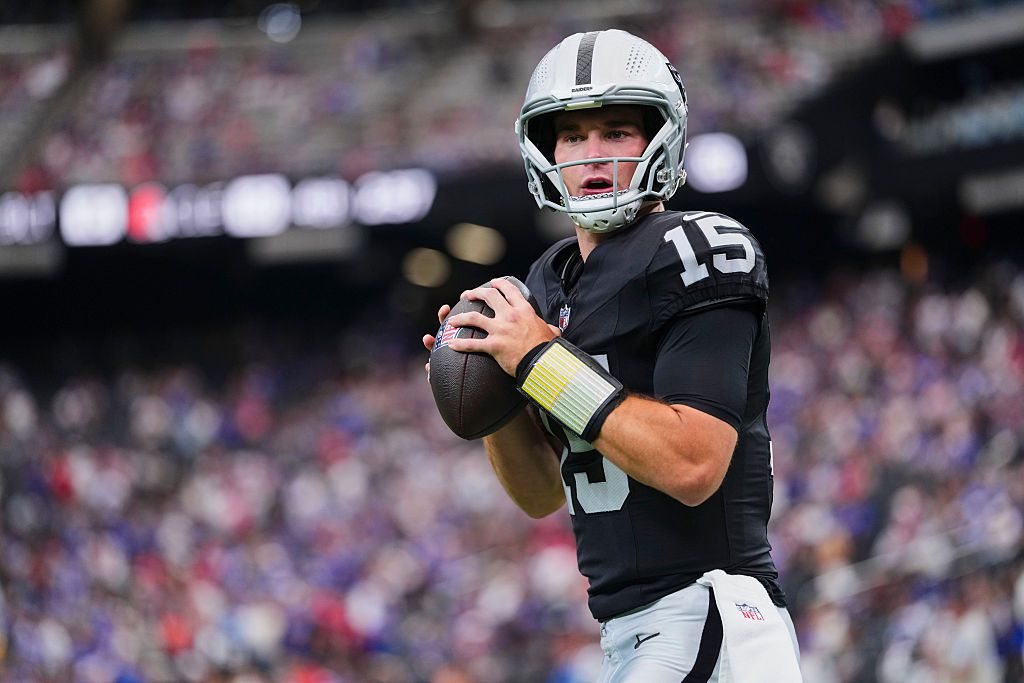
Fernando Mendoza, Las Vegas Raiders (QB12)
It was frustrating to see the Raiders use the No. 1 selection in April’s draft on a potential franchise-altering quarterback, only to play Kirk Cousins for the first nine weeks. However, the trade deadline brought a major shakeup in Sin City as the front office shipped the longtime veteran to Minnesota in exchange for a third-round pick. Aside from the reunion for Cousins and the draft capital the Raiders acquired, the best part is that they can now start Fernando Mendoza under center without controversy. The reigning Heisman Trophy winner was incredible during his title-winning season at Indiana, throwing for an FBS-leading 41 touchdowns and leading the nation in passer rating while completing 72.0% of his throws for 3,535 yards. Now, he gets to throw passes to Brock Bowers week in and week out, and he’s up two spots in the crowdsourced rankings compared to a week ago. Just getting the opportunity for steady playing time was enough to give him a bump – he’s gone 6-for-8 for 48 yards in his one relief appearance at the NFL level – but it may be important to temper expectations. Over the next three games, the Raiders face the Seahawks, Broncos and Browns. Still, it’s great that he’ll get on the field moving forward.
Jonah Coleman, Denver Broncos (RB16)
For the third straight week, Jonah Coleman is a riser at running back. This time, though, the leap is giant. He’s jumped from the RB29 to the RB16 over the last two games, and most importantly, he survived the trade deadline without the Broncos bringing in competition at his position. He led the backfield in touches over each of the last two games, but in Week 9, he saw his biggest workload yet with 17 rush attempts and four targets. He turned those in 57 yards and a touchdown on the ground while catching all four looks for 31 yards, totaling 18.8 PPR points. More impressive than his fantasy output was the opportunity share he saw, though, playing 81.5% of the snaps in that outing – the highest snap rate of any Denver halfbacks during Sean Payton’s tenure as the head coach. Granted, RJ Harvey remains on IR, but J.K. Dobbins and Tyler Badie barely even saw the field. It looks like this staff really loves the fourth-round rookie, which is understandable given that he’s 11th in EPA/attempt and 12th in explosive run rate (13.2%) among 51 qualifying RBs. Perhaps the market is overreacting slightly to Coleman’s emergence, but he’s also averaging 15.7 FPPG across the four outings in which he’s actually recorded a touch.
Dylan Sampson, Cleveland Browns (RB42)
This isn’t a production-based selection, but it is a usage-based one. Dylan Sampson isn’t a name that’ll excite fantasy managers, but over the last three weeks since he returned from IR, a notable trend has begun to take shape. In Week 7, he played 47.0% of snaps for the Browns with six carries for 45 yards, plus three catches for 32 more. In Week 8, his snap share ticked up to 56.3%, rushing just once for seven yards but catching 6-of-7 targets for 62 receiving yards. That brings us to Week 9, which saw the snap share increase again to 62.9% – he handled eight rush attempts for 21 yards and caught 3-of-6 looks for 27 additional yards. None of those stat lines are particularly great, as he’s capped out with 12.9 PPR points over this span without scoring a touchdown. However, the increase in his snap share in three consecutive weeks might mean something. The Cleveland run game isn’t particularly good and it’s clear this offense is better through the air, but the receiving chances Sampson sees are very encouraging and he may be supplanting Quinshon Judkins (more on that shortly). Sampson does have an average of 4.87 YPC and a 53.3% success rate on his limited volume, so he makes for an interesting speculative addition with a low price tag as the dynasty RB42.
Josh Downs, Kansas City Chiefs (WR38)
He’s not a big-time mover in the rankings yet, but there’s certainly an upside case for Josh Downs, who seems thrilled to have been traded from Indianapolis to Kansas City. I’d feel the same if I were set to catch passes from perhaps the greatest quarterback to ever grace this planet, but that’s neither here nor there. Downs has been a hit-or-miss player this season amidst a trade request while operating in one of the NFL’s worst offenses; the Colts rank are tied for fourth-to-last in passing success rate and seventh-to-last in points per drive. He has just 33 catches for 354 yards and one score despite seeing 57 targets, so it’s true that the wideout has underperformed with some additional opportunities. However, he’s also fifth in separation score among 113 qualifying WRs and instantly steps in as the best weapon against man coverage in this Chiefs passing attack. Over his three-and-a-half seasons in the league, Downs also ranks 13th in separation score and 30th in TPRR among 124 qualifying WRs, so he could certainly earn some looks from Mahomes. Given the upgrade when it comes to quarterback play and overall offensive quality – Kansas City is third in passing success rate and ninth in points per drive – Downs’ value should tick up in the coming weeks. The front office gave up a fourth and a fifth for the wideout and a seventh, so the investment in the 25-year-old wasn’t insignificant, either.
Dynasty fantasy football fallers from Week 9
Kyler Murray, Minnesota Vikings (QB28)
Prior to this season, it felt like the Vikings were primed to revive the career of Kyler Murray after the quarterback signed a one-year prove-it deal. After six games, it’s become clear that he’s not a great fit for Kevin O’Connell’s scheme. The former No. 1 pick has battled some injuries this season, so there is some context to consider. Still, it’s disappointing that he’s produced only 1,022 passing yards with a 5-3 TD-INT ratio and only 167 rushing yards without a touchdown on the ground. In fantasy, Murray was producing just 12.3 FPPG and wasn’t an inspiring start, but there was still a world in which he flirted with superflex value. Don’t get it twisted, he hasn’t been truly bad by any means; he just hasn’t played particularly well enough to get this offense going despite throwing to Justin Jefferson and Jordan Addison. Murray missed Week 9 due to injury as Carson Wentz drew the start, delivering an abysmal performance against the Bills on Monday Night Football that promptly inspired Minnesota to trade for Kirk Cousins. Now, the short-lived Murray era appears to be over for the Vikings, which has dropped the gunslinger to a spot as the dynasty QB28. This doesn’t mean it’s wraps on his career since he’ll be a free agent in the offseason, but the sun may be setting on Murray’s chances to get back into the mix as a regular starter for an NFL franchise.
Quinshon Judkins, Cleveland Browns (RB19)
To paraphrase Newton’s third law of motion, every action has an equal and opposite reaction. In the risers section, we discussed why Dylan Sampson might be one of the best value buys in dynasty right now with his rising snap share and passing-downs role. Well, his backfield mate Quinshon Judkins may find himself on the wrong end of that trend as his own snap share slips. The incumbent starter was a second-round pick in last year’s draft and averaged 12.1 FPPG as a rookie with 827 rushing yards and seven touchdowns. Through eight games this season, he’s posting 11.5 FPPG and has run for 385 yards and only three scores. Declining efficiency is an issue with just 3.32 YPC and the 38th-ranked success rate among 51 qualifying RBs, also falling 45th in yards after contact per attempt (1.72). He missed Week 6 due to injury, but since returning, his snap rate has declined in three straight weeks in a progression that reads 51.5%, 39.1% and 35.7%. In three games with both he and Sampson healthy, Judkins’ cumulative snap rate is just 42.0%, though he’s maintained a 55.1% share of the rush attempts. Still, this backfield seems to be shifting and both his own play and his pass-catching role aren’t heading in the right direction. If I rostered any shares, I’d be looking to trade him.
Jonathan Taylor, Indianapolis Colts (RB6)
The biggest name available on the offensive side of the ball at the trade deadline, Jonathan Taylor was pursued heavily by numerous teams but wound up staying put in Indianapolis. The star running back said he never requested a trade himself, and whether that’s true or not, it seems the Colts didn’t receive an offer they deemed worthy of parting with their best player and face of the franchise. The 27-year-old is still producing 17.1 FPPG with 876 scrimmage yards and eight touchdowns this season, and he’s producing at an above-average rate when it comes to his 12.6% explosive rush rate and his 72.9 rushing yards per game. However, the circumstances may demand we pump the brakes on the dynasty RB6. After posting double-digit fantasy points in seven of his first eight games – including four outings of 20+ points with two of 25+ points – Taylor has scored just 6.7 and 9.4 points in the last two weeks. Granted, those have come on a reduced workload of just 21 combined rush attempts as Indy likely managed his workload to keep him healthy during trade negotiations, but the club isn’t exactly incentivized to give him a massive share of touches moving forward since he may pop up as a name on the move this coming offseason. That’s more speculative, but the concrete info we do have is that this offense has been one of the worst in the NFL and just traded Josh Downs and Keenan Allen away, which leaves behind the worst receiver room in football while a return to play for Alec Pierce remains murky. The Colts clearly aren’t winning anything and are looking toward the future, so given the state of the surrounding environment, Taylor is a name to fade for the remainder of the season.
Ladd McConkey, Los Angeles Chargers (WR32)
One of the weirdest situations of Week 9 arose when Ladd McConkey was active against the Texans but ultimately didn’t play due to back spasms that he experienced during pregame workouts. The injury itself isn’t a huge concern, but in combination with the season he’s having, it’s easy to see why he’s dropped to WR32 in the dynasty rankings. McConkey burst onto the scene with 15.1 FPPG as a rookie in a debut campaign that saw him catch 82 passes for 1,149 yards and seven touchdowns. He regressed some as a sophomore with 11.3 FPPG and a 66-789-6 receiving line, but the fall-off in year three is difficult to ignore. The Georgia product is posting just 8.6 FPPG across six appearances, missing two due to injury. He’s caught more than three passes in just three of his six outings and has broken 35 receiving yards in only those three games. McConkey has also caught only one touchdown in an anemic Chargers offense that’s clearly broken at the moment – this should be considered a lost season for all parties involved. The hope for a brighter future next season is enough to make the wideout an interesting buy-low candidate in dynasty, especially if an unfortunate contender happens to roster him. However, he does seem to frequently be dealing with various bumps and bruises throughout his career and just isn’t a player you can count on right now, which has caused his stock to plummet from a preseason valuation as the dynasty WR14.
Jake Ferguson, Dallas Cowboys (TE21)
If you’ve been reading my work for a while, you know that I’ve never been high on Jake Ferguson’s talent. While the tight end has put up some respectable numbers at times through his four-and-a-half seasons with the Cowboys, he’s the type of player many fantasy managers would refer to as a PPR merchant. The former fourth-round pick did average 10.4 FPPG during his second season and posted a career-best 11.1 FPPG last year, but his yardage totals came out to only 761 and 600 in those two campaigns. Since entering the NFL in 2022, Ferguson’s YPRR mark of 1.35 sits 38th among 60 qualifying TEs and his explosive play rate of 8.9% falls 46th. This season, his numbers have totally fallen off a cliff – he’s averaging an abysmal 0.68 YPRR and is yet to record a single gain of 20+ yards. His 6.1 FPPG aren’t helping anyone, and he’s caught just 19 passes for 136 yards and four touchdowns across nine games. He’s a touchdown-or-bust play at this stage and is an afterthought in the Dallas passing attack with an 8.0% target share, but the most discouraging metrics are his snap and route shares. After recording a 68.0% snap rate and 63.0% route rate over the first six games, those same stats now come in at 30.3% and 32.0% over the last three weeks. While Ferguson has played through an injury, Brevyn Spann-Ford did receive an extension this past offseason and has a 70.7% snap share with a 48.5% route share in these last three games. It seems Ferguson may be entering obsolete territory,