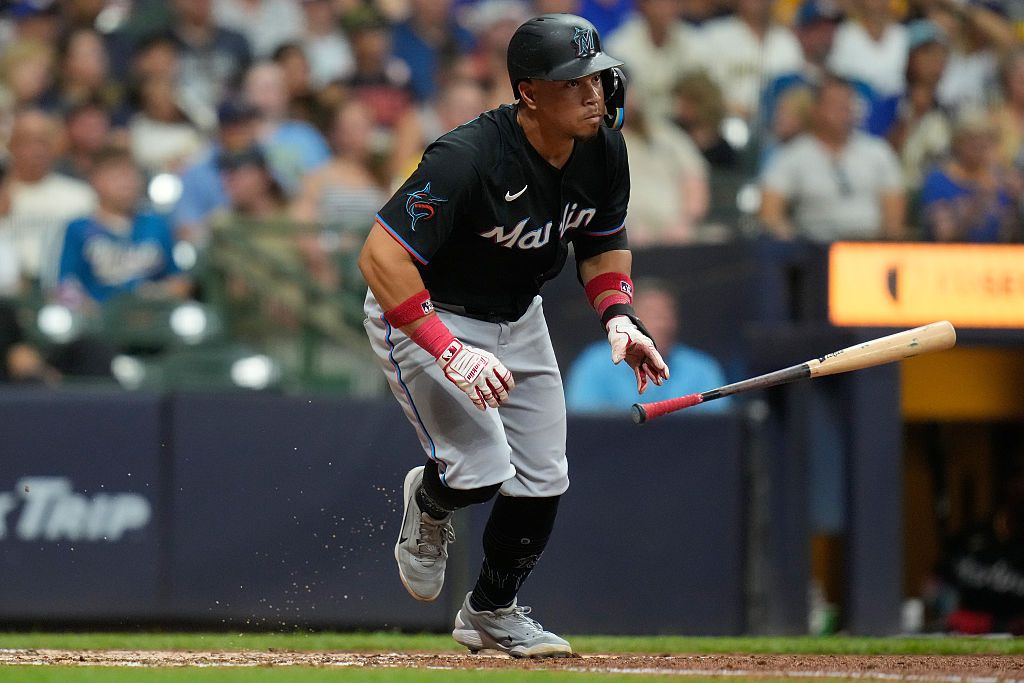
Sunday’s home run board is compact but violent: Atlanta heat, Milwaukee platoon leverage, and enough four-seam access in Toronto to keep three left-field prices alive. Truist supplies the best combination of temperature and value, placing Joc Pederson’s leadoff power against Grant Holmes’ vulnerable fastball contact. American Family brings July’s hottest bat into a direct split advantage, with Heriberto Hernández attacking a left-hander who has already surrendered eight homers to righties. Rogers Centre holds the slate’s purest barrel talent in Munetaka Murakami, whose four-seam damage can overwhelm even a difficult swing-and-miss matchup. The best hunt starts where premium exit velocity, pull-side lift, lineup volume, and a mispriced damage path meet.
As always, I’m here with a breakdown on my three favorite picks from today’s slate of games to swat one out.
Best MLB home run bets today
| Best MLB home run bets today | Odds | Why I like the pick |
|---|---|---|
| Joc Pederson | +410 | Pederson gets Holmes from the leadoff spot in 90-degree Truist Park heat with 16 HR, 14 against righties, an .812 OPS, 91.9 mph EV, 49.2% hard-hit rate, 11.5% barrels, .453 xSLG, .411 xwOBAcon, and three HR, a 95.5 mph EV, 70% hard contact, 30% barrels, and 30% pull barrels across 10 batted balls against sliders and four-seamers versus Holmes’ 3.61 ERA but 4.58 xERA, .416 xSLG allowed, 90.7 mph EV allowed, 43.4% hard contact allowed, 8.9% barrels allowed, and slider/four-seam/sinker combination featuring a four-seamer surrendering a .495 SLG, .477 xSLG, and 50.5% hard-hit rate to create a direct lift-side lane for Pederson’s left-handed power. |
| Heriberto Hernandez | +325 | Hernández gets Gasser from the second lineup spot with a .286/.375/.762 July slash line, five HR and five doubles in 48 plate appearances this month, a .253/.341/.582 line, .923 OPS, .329 ISO, and seven HR in 91 plate appearances against lefties, a 92.1 mph EV, 50.3% hard-hit rate, 12.3% barrels, .501 xSLG, .441 xwOBAcon, and three HR, a 93.5 mph EV, 60% hard contact, 30% barrels, and 20% pull barrels across 10 four-seam batted balls against Gasser’s 5.24 ERA, 5.28 FIP, 1.94 HR/9, 10 HR allowed in 46⅓ innings, eight HR allowed to righties, 6.06 ERA against right-handed bats, .492 xSLG allowed on his sinker, and .696 xSLG allowed on his changeup. |
| Munetaka Murakami | +310 | Murakami gets Yesavage from the second lineup spot with 20 HR, a .910 OPS, a .253/.385/.591 slash line, .976 OPS, and 16 HR in 187 plate appearances against righties, a 93.9 mph EV, 114.1 mph maximum EV, 58.5% hard-hit rate, 19.2% barrels, .500 xSLG, .502 xwOBAcon, and four HR, a 99.6 mph EV, 70% hard contact, 40% barrels, and 70% fly balls across 10 batted balls against four-seamers and splitters versus a Yesavage arsenal throwing those pitches 75.3% of the time, including a four-seamer allowing a .391 SLG and .365 xSLG, with Murakami’s elite four-seam production—a .671 SLG, .600 xSLG, .437 xwOBA, and 60.9% hard-hit rate—providing the damage path through Yesavage’s otherwise difficult splitter and slider combination. |
In-depth analysis below.
Top MLB home run props today: analysis
Joc Pederson to hit a home run (+410)
Joc Pederson’s meeting with Grant Holmes offers a direct collision between a left-handed fastball hunter and a starter whose underlying contact numbers are less convincing than his 3.61 ERA. Pederson enters with 16 home runs, a .239/.337/.475 slash line, 91.9 mph average exit velocity, 49.2% hard-hit rate, 11.5% barrel rate and .453 expected slugging percentage. Fourteen of his homers have come against right-handed pitching.
Pederson has been particularly dangerous against four-seamers, producing a .571 slugging percentage, .587 xSLG and 62.5% hard-hit rate. Holmes throws his four-seamer 32.1% of the time, and that pitch has allowed a .495 SLG, .477 xSLG and 50.5% hard contact. His sinker has also been vulnerable, carrying a .498 xSLG allowed.
Against sliders and four-seamers—which comprise 69.5% of Holmes’ arsenal—Pederson owns three homers, a 95.5 mph average EV, 70% hard-hit rate, 30% barrel rate and 30% pull-barrel rate across 10 qualifying batted balls. His 28.9% projected HR probability translates to approximately +246 fair odds. At +410, the market requires only a 19.6% hit rate, creating a 9.3-percentage-point projection gap and 47.4% expected return.
Holmes’ slider is the primary obstacle: Pederson whiffs approximately 40% against sliders, while Holmes generates a 39.8% whiff rate with the pitch. Still, Pederson is leading off after homering Saturday, Atlanta should approach 90 degrees, and Holmes owns a 4.58 xERA with a .416 xSLG allowed. At +410, Pederson is the best price-adjusted HR bet of the three.
Heriberto Hernandez to hit a home run (+325)
Heriberto Hernández receives the slate’s cleanest platoon matchup against Milwaukee left-hander Robert Gasser. Hernández has punished left-handed pitching for a .253/.341/.582 slash line, .923 OPS, .329 ISO and seven home runs in only 91 plate appearances. His overall contact profile supports the split: 92.1 mph average exit velocity, 50.3% hard-hit rate, 12.3% barrel rate, .501 expected slugging percentage and .441 xwOBA on contact.
His form has accelerated in July. Hernández is batting .286/.375/.762 this month with five homers and five doubles across 48 plate appearances. Against four-seamers, Hernández owns three home runs, a 93.5 mph average EV, 60% hard-hit rate, 40% BLAST rate, 30% barrel rate and 20% pull-barrel rate across 10 qualifying batted balls. His broader four-seam profile includes a .618 xSLG and 64.7% hard-hit rate.
Gasser owns a 5.24 ERA, 5.28 FIP and 10 home runs allowed in 46⅓ innings—a 1.94 HR/9. Eight of those homers have been hit by right-handed batters, who own a .268 average and have driven his split ERA to 6.06. Gasser’s sinker has allowed a .492 xSLG, while his changeup carries a .696 xSLG.
The complication is Gasser’s 28% sweeper usage. Hernández has produced only a 26.7% hard-hit rate against sweepers, and Gasser has held opponents to a .282 xSLG with his version. Nevertheless, Hernández bats second, owns the superior platoon split and carries a 31.2% projected HR probability—approximately +221 fair value. The +325 price requires a 23.5% hit rate and offers a projected 32.6% expected return, making Hernández a strong second play behind Pederson.
Munetaka Murakami to hit a home run (+310)
Munetaka Murakami owns the most explosive raw contact profile of the three candidates. He has produced 20 home runs with a 93.9 mph average exit velocity, 114.1 mph maximum EV, 58.5% hard-hit rate, 19.2% barrel rate, .500 expected slugging percentage and .502 xwOBA on contact. Against right-handed pitching, Murakami is batting .253/.385/.591 with a .976 OPS and 16 home runs in 187 plate appearances.
The pitch-specific numbers are monstrous. Against four-seamers and splitters, Murakami has four homers, a 99.6 mph average EV, 70% hard-hit rate, 40% BLAST rate, 40% barrel rate and 70% fly-ball rate across 10 qualifying batted balls. Those pitches comprise 75.3% of Trey Yesavage’s arsenal. Murakami specifically owns a .671 SLG, .600 xSLG, .437 xwOBA and 60.9% hard-hit rate against four-seamers.
The problem is generating contact. Yesavage has limited opponents to an 88.5 mph average EV, 35.3% hard-hit rate and 5.5% barrel rate. His splitter has allowed a .113 average, .183 SLG and .271 xSLG while producing a 39.7% whiff rate. His slider generates another 36.9% whiffs. Murakami carries a 33.2% strikeout rate, whiffs 54.7% against sliders and has struck out nine times in 22 plate appearances since returning from his hamstring injury.
There are positive recovery signals: Murakami recorded batted balls of 109.2 and 102 mph during the first two games of this series. However, his projected HR probability is only 18.7%, equivalent to approximately +435 fair odds. At +310, the required probability rises to 24.4%, creating a projected -23.3% expected return. The power case is undeniable, but this is the most expensive and least efficient ticket of the three.