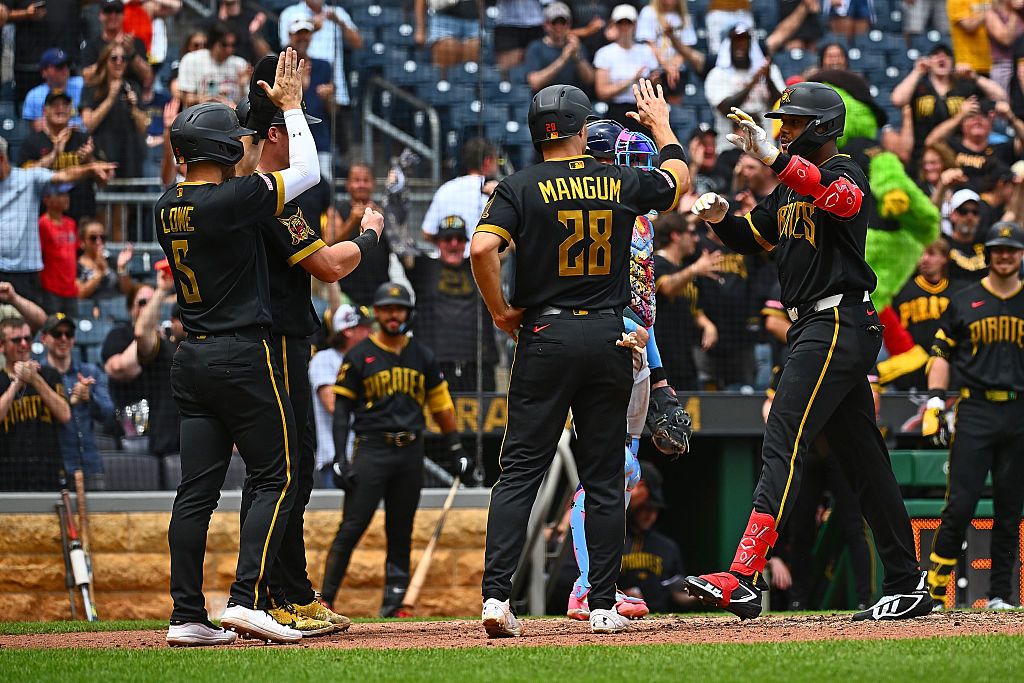
The Pirates reached the All-Star break at 50-47, then gave Pittsburgh one final reason to take them seriously. They swept Milwaukee at PNC Park and closed Sunday with a 14-5 win, scoring 10 runs in the fourth inning. The afternoon completed their first winning first half since 2016 and left them two games from a Wild Card place. Pittsburgh also owns a +44 run differential, which supports a 52-45 expected record and suggests a better team than its standing.
The market remains considerably less convinced. Pittsburgh is priced around +240 to make the playoffs, an implied probability of 29.4%. Several public projection systems place the Pirates between 36% and 42%, with the division offering little practical help. Milwaukee holds a 9½-game advantage, so Pittsburgh’s October case runs almost entirely through the National League Wild Card race.
There is enough evidence to believe the Pirates belong in that race. Their offense has undergone one of baseball’s largest one-year transformations, while Paul Skenes and Braxton Ashcraft have supplied, for the most part, high-end starting pitching. Jared Jones has returned from elbow surgery with his velocity intact. The remaining doubts are concentrated in familiar places: relief pitching, defense, health, and an organization deciding how seriously to treat present, albeit cautious, optimism.
Follow my handle @dansby_edits for more betting plays.
Pirates first half: a breakdown
Pittsburgh finished 2025 last in runs, home runs, slugging percentage, and OPS, with an 82 wRC+. That offense has been replaced almost completely. The Pirates scored 516 runs before the break and hit 125 homers, eight more than last season’s total. Their 111 wRC+ ranks second in MLB and represents baseball’s largest year-over-year increase.
The improvement runs through the entire lineup. Pittsburgh’s position players have produced 15.6 fWAR after generating 6.6 throughout 2025. Nine hitters have reached 1.0 fWAR, while seven own an .800 OPS across at least 100 plate appearances. The Pirates have hit .263/.342/.426 with a .338 wOBA, 88 steals, and a 9.5% walk rate.
Some of that production will recede. Pittsburgh’s .263 average sits above a .247 expected mark, while its .426 slugging percentage exceeds a .408 expected figure. Its .338 wOBA also stands above a .326 xwOBA. The underlying contact remains strong enough to sustain an above-average offense. Pittsburgh owns a 40.7% hard-hit rate and 8.5% barrel rate, with 1,015 balls struck at least 95 mph.
The lineup still misses too many pitches. Its 27.3% whiff rate and 82.5% zone-contact rate both trail league averages. Pittsburgh also puts 44.7% of its contact on the ground. The Pirates have overcome those weaknesses through power, walks, speed, and an order capable of extending innings.
Bryan Reynolds has returned to the center of that offense. He entered the break hitting .283/.400/.477 with 14 homers, 62 walks, and a 143 wRC+. His .385 wOBA exceeds a .369 expected mark, but his 90.9 mph average exit velocity and 47.3% hard-hit rate support the performance. Reynolds has also produced a +13 run value against four-seam fastballs after finishing last season at -2. His .348 BABIP should fall, though his 23.1% chase rate gives him protection when fewer balls find grass.
Brandon Lowe and Ryan O’Hearn have relieved Reynolds of carrying the middle of the order alone. Lowe has hit .246/.316/.487 with 21 homers and 2.7 fWAR. His .344 wOBA nearly matches a .339 expected mark, while a 12.5% barrel rate supports the power. O’Hearn owns a .288/.351/.487 line with 16 homers, 63 RBI, and a 128 wRC+. His season included a three-homer, franchise-record 10-RBI afternoon and the first curtain call of his career. His .363 wOBA exceeds a .333 expected mark, though a 44.9% hard-hit rate should preserve useful production.
Oneil Cruz had made substantial progress before fracturing two metacarpals in his left hand. He was hitting .264/.350/.472 with 14 homers, 21 steals, and a 124 wRC+. His .357 wOBA almost perfectly matches a .358 expected mark, supported by a 96.0 mph average exit velocity. Cruz also improved against breaking pitches and left-handed pitching, two weaknesses that had previously limited him. His 37.8% whiff rate and 34.6% strikeout rate remain severe, but Pittsburgh can accept them beside this level of damage.
Spencer Horwitz offered a calmer form of pressure before suffering a hamstring strain. He hit .280/.386/.455 with 10 homers and a 133 wRC+, walking exactly as often as he struck out. His 15.2% whiff rate, 92.7% zone-contact rate, and 20.0% chase rate distinguish him inside this lineup. Endy Rodríguez also carried supported improvement before a glute strain. His .260/.388/.470 line accompanies a .366 expected wOBA, 92.4 mph average exit velocity, and 12.7% barrel rate.
Esmerlyn Valdez produced the first half’s most startling arrival. He has hit .309/.371/.713 with 10 homers across 105 plate appearances. His 92.1 mph average exit velocity, 52.6% hard-hit rate, and 29.8% barrel rate confirm exceptional power. The current pace cannot survive a 37.9% whiff rate and 36.2% strikeout rate. His .374 expected wOBA still describes a dangerous hitter after the inevitable correction.
Nick Gonzales and Jake Mangum have helped Pittsburgh survive those injuries, though both depend heavily upon batting average. Gonzales has hit .308/.370/.391 with a 113 wRC+, but his 85.8 mph average exit velocity and 2.6% barrel rate offer little power. Mangum owns a .310/.364/.389 line with 18 steals and excellent speed. His .335 wOBA stands well above a .291 expected mark, accompanied by an 84.6 mph average exit velocity and 62.8% ground-ball rate.
Konnor Griffin’s injury removed one of Pittsburgh’s best athletes. The 20-year-old hit .276/.332/.404 with five homers, 20 steals, and 1.2 fWAR. His sprint speed ranks in baseball’s 99th percentile, while his baserunning had produced +5.7 runs. Griffin tore the sagittal band in his left ring finger and will spend six weeks in a splint. He cannot return before early September, with no guarantee that his timing or hand strength will immediately follow.
The rotation lacks the lineup’s depth, but its leading starters have pitched well enough for October. Paul Skenes owns a 3.57 ERA, 2.88 FIP, and 29.5% strikeout rate. Opponents carry a .276 wOBA against a .258 expected mark and a .203 expected average. His four-seam velocity has fallen from 98.8 mph to 96.9, yet the pitch still carries a +11 run value. His sweeper has allowed a .155 expected wOBA, while his changeup generates a 37.9% whiff rate. His return to elite form is crucial for a second-half surge.
Braxton Ashcraft has developed into a legitimate second starter. He owns a 3.49 ERA, 3.32 FIP, 27.8% strikeout rate, and 5.9% walk rate. His .283 expected wOBA allowed, 37.2% chase rate, and 6.0% barrel rate support the breakout. His workload now deserves more concern than his performance, since he has already entered unfamiliar innings.
Jared Jones returned from internal-brace surgery with his best pitches intact. His 4.37 ERA sits beside a 3.67 FIP, 27.1% strikeout rate, and 32.7% whiff rate. His fastball has averaged 99 mph, while his slider remains above 90. Pittsburgh has limited his pitch counts more successfully than opposing hitters have limited his stuff.
Jones threw six perfect innings against Atlanta before leaving after 77 pitches. The bullpen then lost the perfect game and eventually the contest. Pittsburgh handled its young starter responsibly, and its weakest unit made that decision costly.
Pirates relievers carry a 4.48 ERA, fourth worst in the National League, with 17 blown saves in 34 opportunities. Dennis Santana owns a 5.80 ERA, 5.23 FIP, 11.7% walk rate, and 1.56 HR/9. His .345 wOBA allowed closely matches a .341 expected figure. Gregory Soto has pitched better than several conspicuous failures suggest, with a .274 wOBA allowed and 35.4% hard-hit rate. His 10.4% walk rate still makes narrow leads difficult to trust.
Mason Montgomery supplies the group’s strongest strikeout profile. He has fanned 34.8% of opposing hitters with a 2.91 FIP and 31.5% whiff rate. His 9.3% barrel rate preserves some volatility, but he remains Pittsburgh’s most convincing late-inning arm. The bullpen’s failures help explain why a club with a 52-45 expected record reached the break at 50-47.
Second-half outlook
Pittsburgh begins the second half two games from a Wild Card and 9½ behind Milwaukee. The division would require both an extraordinary Pirates run and a substantial Milwaukee collapse. The remaining schedule also offers little assistance. Pittsburgh’s opponents own a combined .509 winning percentage, giving the club baseball’s seventh-hardest second half.
The Pirates return against Cleveland and the Yankees before hosting the Cubs. Those series begin a 16-game period before the August 3 trade deadline. Cherington will have several chances to judge the roster, but the weaknesses are already sufficiently clear.
The offense should decline from its first-half pace without losing its larger improvement. Reynolds and Lowe have strong expected-stat support, while Cruz, Horwitz, and Rodríguez should return during the first several weeks. O’Hearn, Gonzales, Mangum, and Valdez will probably give back some of their current production. Pittsburgh has enough depth to survive those corrections unless several occur at once.
Cruz began swinging in Florida on July 7 and is expected near the end of the month. The activation date will offer only the first part of the medical answer. Fractured metacarpals can affect grip strength, bat speed, and a hitter’s willingness to release the barrel. His early exit velocity will provide a useful measure of how completely the power has returned.
Horwitz should return sooner from his hamstring injury, although recurrence remains possible. His plate discipline gives him a route toward immediate value without requiring maximum lower-body force. Rodríguez is expected later in July, but catching complicates his recovery. Squatting, blocking, running, and throwing will test the glute more thoroughly than batting practice can.
Griffin should be considered a possible September addition rather than a dependable part of the second-half projection. His earliest return date leaves limited time for a rehab assignment. Any setback could end his regular season, while even a healthy return may bring reduced timing and power.
The rotation can keep Pittsburgh in the race if its innings remain available. Skenes threw 187⅔ innings last season and carries no obvious shutdown concern. Ashcraft is moving into unfamiliar territory but can reach a normal starter’s workload with careful management. Jones will remain more restricted following elbow surgery.
Those abbreviated Jones starts increase the importance of the bullpen. Five excellent innings still leave Pittsburgh asking its weakest unit for 12 outs. The current construction can survive that demand occasionally. It will struggle to do so every fifth day through September.
Bubba Chandler and Mitch Keller offer far less stability behind the leading three starters. Chandler carries a 4.77 ERA, 4.58 FIP, and 13.1% walk rate. His contact prevention has remained respectable, but his command has prevented his velocity from becoming a consistent advantage.
Keller owns a 5.14 ERA, 4.47 FIP, and only a 17.4% strikeout rate. His expected numbers are worse than the results, including a .354 xwOBA, .289 xBA, and .454 xSLG. His sinker has allowed a .433 expected wOBA and 54.7% hard-hit rate. The cutter and sweeper have also become liabilities.
Left-handed hitters own an .831 OPS against Keller, compared with .575 for right-handed hitters. Pittsburgh has discussed using an opener to alter his first trip through a lineup. That may reduce the damage without restoring the pitches that made him a dependable starter.
A rotation addition would protect several parts of the roster. Another competent starter could reduce Jones’ burden, soften Ashcraft’s workload, and keep weaker relievers out of close games. The bullpen still represents the most urgent deadline need.
Soto, Montgomery, Brandon Eisert, and eventually Evan Sisk provide several capable left-handed options. Pittsburgh lacks an equivalent right-hander for high-leverage work. Santana has pitched himself out of that trust, while the upper minors offer velocity without dependable command.
Wilber Dotel should return from a lat strain after progressing through his rehabilitation assignment. His velocity gives the bullpen another useful trait, though his contact numbers remain poor. Hitters have produced a 52.9% hard-hit rate and 93.4 mph average exit velocity against him. Dotel can help without becoming the late-inning answer.
Sisk produced a 2.23 ERA, 3.02 FIP, and 28.3% strikeout rate before developing elbow inflammation. A healthy return would deepen the group. Pittsburgh should avoid constructing its deadline around the healthiest possible outcome for every injured reliever.
Cherington has already made several smaller moves. Pittsburgh traded a competitive-balance selection and Jaden Woods for Jacob Gonzalez and Eisert. Gonzalez provides shortstop depth while Griffin heals, and Eisert adds another capable left-handed reliever.
The Pirates also acquired Robert Hassell III from Washington for cash considerations and players to be named later. Hassell was once one of baseball’s most prominent prospects and a central part of Washington’s return for Juan Soto. Injuries, limited power, and stalled development eventually pushed him from the Nationals’ roster.
Hassell was hitting around .215 with a .593 OPS at Triple-A. His major-league career includes a .223 average and .572 OPS. Pittsburgh acquired a 24-year-old center fielder with speed, former prospect pedigree, and a modest financial cost.
He should begin at Indianapolis. His current performance does not justify an immediate major-league role, although his position gives the acquisition practical value. Griffin remains unavailable, Cruz is an uncertain center fielder, and Mangum’s offensive production carries serious regression risk.
Hassell does not solve Pittsburgh’s outfield defense by himself. The Pirates have produced -27.4 defensive runs, while their outfield carries a minus-12 fielding run value. They accepted weaker gloves while constructing a much better lineup. That trade has improved the team, though September will expose every poor route and late break.
Gonzalez, Eisert, and Hassell make Pittsburgh better equipped to survive another injury. None changes the club’s postseason probability by much. The next acquisition should improve the major-league roster rather than supply another tolerable alternative.
The farm system offers several possible contributors, though no obvious second-half star. José Urquidy owns a 3.67 ERA at Indianapolis with 67 strikeouts and 14 walks across 73⅔ innings. His command makes him the most credible internal rotation option if Keller falters or Jones requires additional rest.
Thomas Harrington carries a 6.52 Triple-A ERA and cannot be treated as reliable depth. Antwone Kelly has touched 100 mph, but his command remains unfinished. Hunter Barco possesses greater prospect status and recently developed elbow inflammation. Testing found no new damage to his reconstructed ligament, although his timetable remains unclear.
Ronny Simon has hit .306/.399/.444 with 24 steals at Indianapolis and could fill a flexible bench role. Jhostynxon Garcia offers right-handed outfield depth. Termarr Johnson’s .193/.331/.299 line provides little support for an immediate promotion during a playoff race. Seth Hernandez and Edward Florentino remain part of Pittsburgh’s future rather than its current solution.
The most valuable reinforcements will arrive from the injured list and trade market. Pittsburgh should not expect one prospect promotion to repair the bullpen or settle the rotation. Cherington’s willingness to use major-league talent in a trade may become the deadline’s most difficult question.
Valdez’s emergence has allowed O’Hearn to play more first base, which could make Horwitz available. That possibility deserves restraint. Horwitz remains under club control through 2028 and projects as one of Pittsburgh’s strongest on-base hitters. A reliever would work far fewer innings and carry greater year-to-year volatility.
Trading Horwitz could make sense for a controllable starter or a high-end reliever. It would be difficult to justify for a modest bullpen improvement. Pittsburgh has spent years searching for hitters who control the strike zone. It should understand the value of the one already on its roster.
Betting landscape
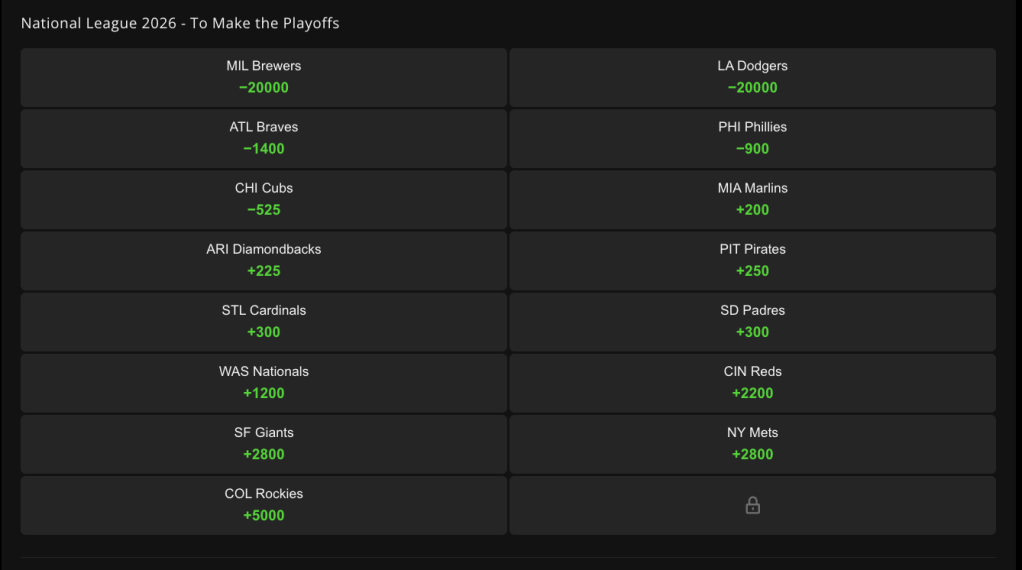
The Pirates have done enough to deserve serious investment. Their +44 run differential supports the record, and their offense should remain above average after regression. Skenes and Ashcraft give them two excellent starters, while Jones can provide valuable innings under medical supervision. Cruz, Horwitz, and Rodríguez should return to a lineup that has already survived without them.
The case against Pittsburgh remains substantial. The schedule is difficult, Griffin may contribute little during the regular season, and the outfield defense can give back runs. Keller has become a liability, Jones cannot carry a normal workload, and the bullpen has already lost too many games created elsewhere.
I place Pittsburgh’s postseason probability around 38%. That estimate remains below FanGraphs and above the more conservative market assessment. It credits the +44 run differential, supported offensive improvement, returning hitters, and Skenes’ expected numbers. It also accounts for the bullpen, defensive weakness, workload concerns, and likely regression from several hitters.
A 38% probability produces a fair price near +163. The available +240 price leaves a considerable margin for an imperfect second half.
Best bet: Pittsburgh Pirates to make the playoffs at +250. I project an 84-78 finish and a narrow Wild Card berth. The wager remains playable to +200, with a consequential pitching addition strengthening the case before August 3.