

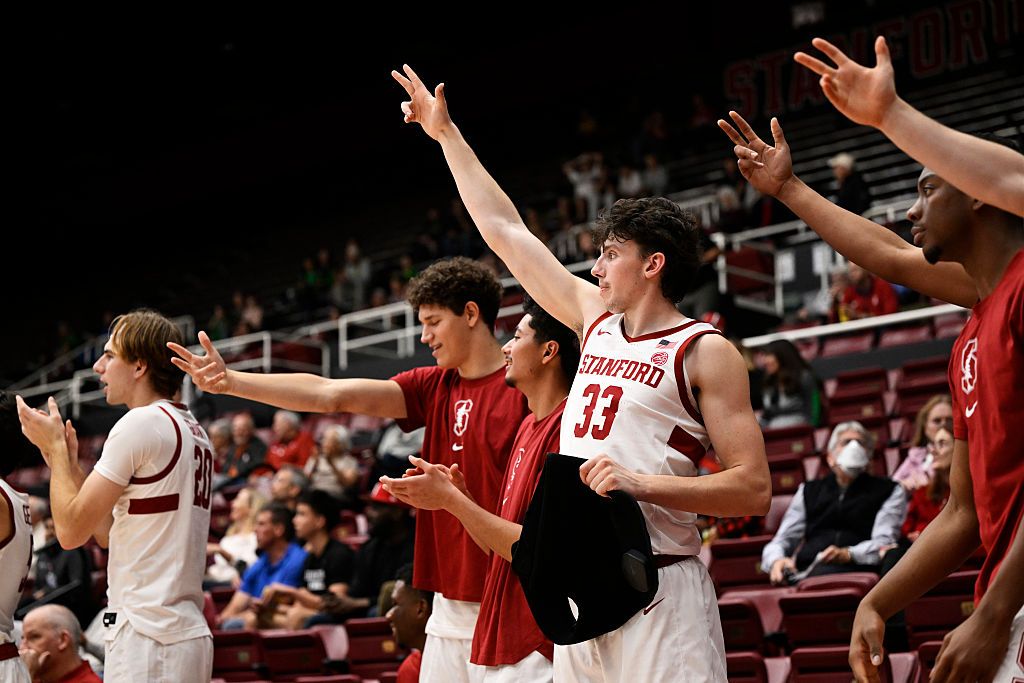
Stanford arrives at 20-12 with an offense that found real rhythm late in the year, while West Virginia comes in at 18-14 having spent the last month living inside low-possession, grind-it-out games. That makes this quarterfinal less about raw talent than about whose version of tournament basketball can actually take hold in Las Vegas. Below is my preview, prediction, and pick for today’s Crown Tournament college basketball game between the West Virginia Mountaineers and the Stanford Cardinal.
Here’s how I’ll play it. I’ll be pumping out these predictions for individual games all season, with plenty of coverage here on DraftKings Network. Follow my handle @dansby_edits for more betting plays.
West Virginia vs. Stanford prediction, preview
Stanford’s identity is offense with structure. The Cardinal average 76.0 points, shoot 35.6% from three, and make 9.2 threes per game while turning it over just 10.6 times. Over the last ten, that has held steady—76.2 points on 47.0% shooting with real perimeter volume. West Virginia pushes the game the other direction. The Mountaineers allow just 64.8 points per game, hold opponents to sub-49% eFG, and sit top-15 nationally in opponent two-point percentage. They also suppress the free-throw lane, ranking top-50 in opponent FTA rate. The pace layer reinforces it: Stanford plays around 66 possessions, West Virginia closer to 63, and the first-half splits are even tighter—West Virginia allows just 30.2 points before halftime. This is a game that naturally wants to shrink.
The player layer explains how each side tries to win that tug-of-war. Ebuka Okorie is the best offensive piece on the floor, a 22.8-point scorer with a 31% usage rate and a true primary-creator profile—he can generate a shot late in the clock against anyone. Benny Gealer is the swing factor next to him, a 41.6% three-point shooter with a 63.5% true shooting mark and the kind of spacing gravity that can turn one Okorie drive into two made threes. West Virginia answers with a more distributed core. Honor Huff brings 15.8 points and 3.4 made threes per game with a clean 57% true shooting profile, while Brenen Lorient is the interior stabilizer at 52.9% from the field with a strong block rate and efficient usage. Jasper Floyd ties it together as a 22% assist-rate guard with a 4.5% steal rate—he can tilt possessions defensively even if the offense stalls. The difference is style: Stanford leans on a top-end creator and shooting; West Virginia leans on balance and resistance.
Stanford vs. West Virginia pick, best bet
The Cardinal have multiple recent games in the 70s and 80s, Okorie has gone for 30-plus repeatedly down the stretch, and Gealer has already shown he can flip a game with a seven-three eruption. If Stanford gets clean looks early, this can turn into a pace-up script where West Virginia is forced to chase, and that is not the Mountaineers’ preferred environment. Stanford also plays its best offensive basketball after halftime, which adds late-game scoring risk if the game stays within a possession or two.
But the more reliable shape is still the one West Virginia imposes. The Mountaineers’ defense is not just good in a general sense—it is good in the exact ways that keep totals down. They limit clean twos, they keep opponents off the line, and they drag games into half-court possessions where every trip matters. Stanford’s defensive profile quietly helps that outcome as well. The Cardinal allow a 51.5% two-point rate and a high free-throw rate, which gives West Virginia a path to score—but not an explosive one. The Mountaineers sit near the bottom of the country in scoring and free-throw percentage, so even when they get to their preferred spots, the return is often modest rather than spiking the total.
The setting reinforces it. Neutral floor, tournament rotation tightening, every possession carrying more weight—those are the conditions where West Virginia’s identity tends to win out, even if it does not always show up in the final result column. This is a game where one team wants to stretch it and the other wants to suffocate it, and the suffocation profile is the one backed by more stable, repeatable numbers.
Best bet: under 135.5 (-108 to -112 range). Playable to 133.5. Stanford’s offense gives this real volatility, but the sturdier expectation is a compressed, stop-start game that lives in the mid-to-high 60s rather than the mid-70s. The way it dies is simple—Okorie gets downhill, Gealer hits multiple threes, and West Virginia contributes just enough interior scoring to push both teams into the 70s. But more often, this plays as a possession game shaped by West Virginia’s defense.
Projected score: Stanford 68, West Virginia 64.
Best bet: West Virginia vs. Stanford u135.5 total points (-110)
Tail it with me in the DKN Betting Group here!

