Let’s just roll right into the regularly-scheduled programming here for fantasy football, shall we? We’ve already gotten concerning(/as of this morning, kinda reassuring?) news re. Christian McCaffrey’s “calf” (it’s his Achilles tendonitis, folks); we’ve seen an A.J. Brown dud; we’ve seen Jaydon Blue be a healthy scratch. Best laid plans, man. They’re toast already. But never toast are the Five Lists of Five, which feel a bit more important already before even the main slate of Week 1. We need to hunt for stashes, dart throws, breakouts, and, probably most importantly, running back sleepers.
The refrain remains the same—All I want is for you to be better than your friends. You’re going to be surrounded by them on Sunday, probably. How sweet would it be if you could be sure you’ve checked every box possible that might guarantee you a resounding victory this week? Some kick-your-feet-up insights? I’ve got some.
I know my audience. The smoke-break audience. The quick-scan-of-the-phone-on-the-way-to-the-fridge audience. The give-me-as-much-info-as-possible-as-fast-as-possible audience. I’m a man of the people.
And so: the Five Lists of Five series. Think of these as byte-sized, two-minutes-to-yourself lists to scan during your weekend as you foam at the mouth for any competitive fantasy edge. As much relevant analysis as I can fit into, like, ~250 words per player.
Below: Top five sleeper wide receivers for Week 1. These are guys ranked the WR3-5 ECR range that could make the leap already to weekly-winning WR2 performances.
Here are the other offerings from my 2025 Fantasy Football Five Lists of Five: Week 1 edition:
- Top five sleeper running backs for 2025 fantasy football Week 1
- Top five players to stash for Week 1 of 2025 fantasy football
- Top five WR/CB matchups to target in 2025 fantasy football Week 1
- Top five must-start players for Week 1 of 2025 fantasy football
Follow my handle @dansby_edits for all preseason and fantasy draft kit content—as well as plenty of NFL betting goodies—all summer long. All my other fantasy football draft kit content is at the bottom of this list!
Top five sleeper WRs in 2025 fantasy football Week 1
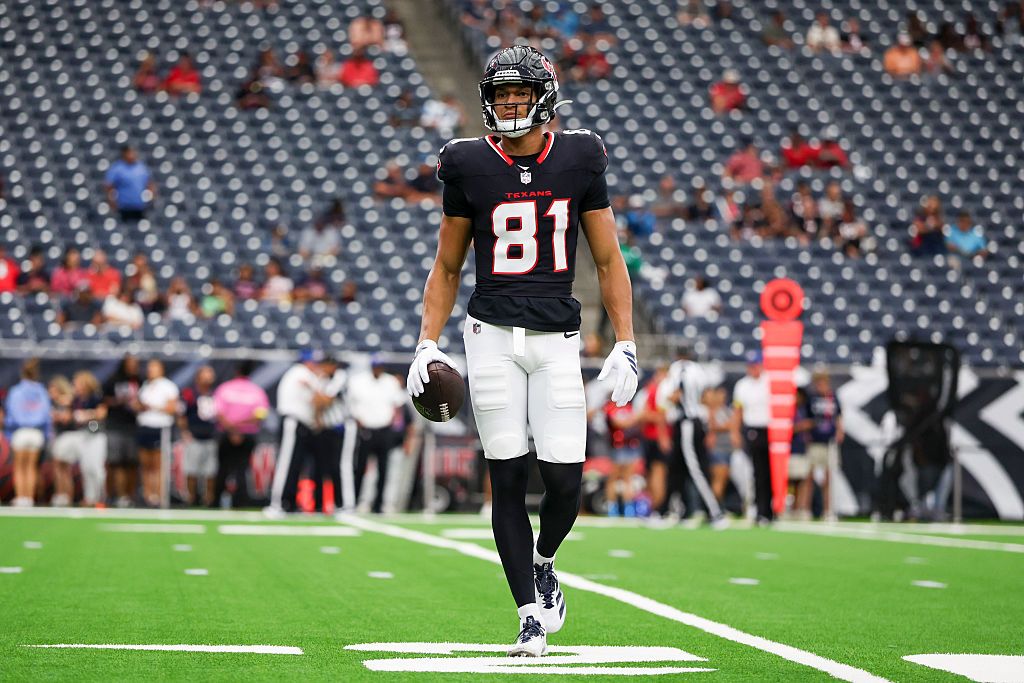
Jayden Higgins, WR, Texans (ECR Week 1 Ranking: WR60)
The Texans didn’t draft Higgins to sit, and Dell’s injury just cleared the runway. At 6’4”/210 with a 4.44 forty and 38-inch vertical, Higgins is a classic boundary separator who pairs size with sneaky acceleration. At Iowa State, he commanded a 33% dominator rating and converted 58% of contested looks, thriving on digs, curls, and deep crossers. His collegiate yards per route run (~2.1) hinted at a player who could translate quickly with an accurate quarterback.
Preseason usage confirmed it: Higgins ran routes on 74% of C.J. Stroud’s dropbacks with the starters and earned targets on 22% of those routes. That’s sticky usage, especially in a Houston offense that ran 70%+ of its snaps from three-WR sets last year. With Nico Collins commanding CB1 attention, Higgins inherits exploitable matchups on the Rams’ CB2/CB3s. LA finished 28th in EPA allowed per play on intermediate throws last season and ranked bottom-10 in success rate vs boundary receivers. That’s where Higgins wins.
Expect 6–8 targets in Week 1, with a legitimate shot at red-zone work — Stroud trusted him on fades and back-shoulders in August. If he maintains even his collegiate YPRR baseline, 70 yards with touchdown equity is firmly in play. Higgins is no longer just a deep stash; he’s playable right away as a flex sleeper in PPR leagues.
Jordan Whittington, WR, Rams (WR116)
Let’s just hit one of 2024’s favorites right off the bat, huh? Jordan Whittington may have quietly positioned himself as the Rams’ most dependable slot muscle in Year 2. After posting 44 receptions for 442 yards and two touchdowns across 14 games last season (on only 302 offensive snaps), he showed he belongs on the field—even as a rookie behind superstars Kupp and Nacua. That’s roughly 1.46 yards per route run, and when ignoring garbage-time targets, his route efficiency was elite for a developmental receiver.
In camp, that early promise carried over: he logged 68% slot snaps with the first team and drew third-down volume with Stafford on vertical crossers and short sticks. The Rams thrive on slot motion and scheme-intensive route combinations—exactly Whittington’s wheelhouse. His 2.25 YPRR vs zone in college tested his vision and separation; his contested-catch rate (78%) showcased his hands and concentration.
Now, imagine Week 1 against Houston—a defense that allowed a league-high 76% catch rate to slot WRs last year. With Puka likely jarred up on one side and defenses tilting downfield, and new acquisition Davante Adams shredding short WR2 routes, Whittington should command slot volume underneath: expect 2-4 targets, 30–50 yards, and real RAC upside. With his college YAC per reception clocked at 6.8 yards, he’s the kind of reliable, high-floor flex who can break off a home run against Mismatches. In PPR formats, he’s already deliverable Week 1 and offers sneaky WR3 upside if schemed properly. Freight train with glue hands: that’s Whittington.
Dont’e Thornton, WR, Raiders (WR89)
Thornton is the exact archetype you chase when mining for volatile upside: 6’4”, 205, with true 4.3 speed. His preseason usage was promising — 82% of snaps outside, almost exclusively as a vertical X, and he hauled in 91% of his targets. The route tree is still condensed (43% curls, with posts and digs filling most of the rest), but the Raiders are scripting his touches for splash. That’s the key: curated routes, curated for points.
The matchup works in his favor. Christian Gonzalez is out, and the main defensive focus will shade to Jakobi Meyers and Brock Bowers in the passing game. That should leave a solid tree of routes for Thornton against New England’s CB2/3s, who collectively allowed a 65% completion rate and 7.8 yards per attempt in coverage last year. Thornton’s college profile showed a 70% success rate vs man coverage and a 52% contested-catch win rate — enough evidence that when you isolate him, he can win. In preseason, QBs both looked to him on designed verticals and comebacks, a sign of trust for a raw player. Geno Smith will do that.
Volume won’t be high — Thornton may only see 3–5 looks in Week 1 — but the volatility is the play. His career collegiate aDOT sat north of 14.0, and even one connection in that range changes your week. With Jakobi Meyers’ trade status hanging, Thornton is also a stash with clear upward mobility. For now, he’s a DFS dart and deep-league flex option who can deliver 60–70 yards and a touchdown on one splash play. Few WR5s carry that kind of ceiling.
Isaac TeSlaa, WR, Lions (WR80)
TeSlaa is an ultra-deep sleeper with one elite trait: contested-catch dominance. At Augustana, he commanded a 30% target share and converted 72% of contested looks—traits that Cater well to Detroit’s condensed red-zone offense. The Lions ranked second in NFL red-zone trips last season, and TeSlaa’s blocking has earned him situational snaps. That’s the ticket: stay on the field, then leak into scoring plays.
Week 1 brings a tougher opponent than you’d love — it’s Green Bay, but the Packers’ secondary is in flux: Jaire Alexander departed in the offseason, and injuries have rocked the depth at cornerback Inside the 20-yard line, their corners allowed a 69% completion rate last year, just below league average. TeSlaa’s 21% red-zone target rate in camp shows Detroit trusts his role. He may see 20–25 routes this week; if even two come inside the 20, he can pay off.
Given his 6’4” frame and ability to post up smaller defenders, the projection holds: 2–3 catches, around 30 yards, and touchdown equity. In deep-league PPR or best-ball formats, he fits as the kind of overlooked red-zone stash that can ride into relevance if he converts one scoring touch. He’s not startable in shallow formats yet, but the logic holds strong for the right roster.
Keon Coleman, WR, Bills (WR42)
Coleman’s rookie year confirmed Buffalo’s plan: make him Josh Allen’s boundary scorer. He logged a 74% wide alignment rate and ran routes on 85% of Allen’s dropbacks, finishing with 732 yards and 6 TDs. The underlying usage matters more: 19 red-zone targets (second on the team), a 42% contested catch win rate overall, and a 75% win rate in tight red-zone situations. Those traits translate directly into Week 1.
Baltimore’s secondary is strong up top with Marlon Humphrey, but Coleman will spend much of his day on CB2/CB3s — matchups Buffalo schemed to isolate late last year. Coleman’s 1.78 yards per route run in 2024 came on a route tree tilted toward slants, fades, and posts. That matches up against the Ravens’ Cover-3/Cover-6 rotations, where size on the outside consistently finds seams. Expect 5–7 targets and a 15–20% target share baseline. If he converts even one of the 1–2 end-zone fades that Allen inevitably gives him, Coleman lands in WR2 territory instantly.
Think of him as Buffalo’s new Gabe Davis archetype, but with better ball skills and higher catch consistency. The volatility is baked in, but the ceiling is clear. In Week 1, Coleman has a live path to 60–70 yards and a score, making him playable beyond just deep leagues.