Hello, and happy gardening season to all you autumn turf sickos! Since we’ve last hit a round of the Fantasy Football Five Lists of Five, the Philadelphia Eagles won the Super Bowl, Rory McIlroy got his career Grand Slam, and the 2025 NFL Draft has come and gone! I worked with my wonderful senior editorial colleague Meghan Townsley on covering and evaluating the draft in live fashion; feel free to check out my grades and analyses here. Having said that, the live-grading exercise was but a broader introduction to what many of us really care about: which rookies are worth drafting for 2025 fantasy football? Are there any poised to be fantasy superstars right away? Is it likely that the overall trend of rookie wide receivers breaking out in year one can continue with this class? Will those who seem like fantasy contributors actually be ones to fade? Just how high should we be drafting Ashton Jeanty? etc.
So many questions! So here we are with your bridge episode Five Lists of Five, in which we’ll focus solely on rookies! We obviously have zero regulation data on any of these players, so I’ll be referencing a variety of projection models, independent film study, and NCAA stats to hype these guys up.
If you’re a follower of the program, you know that my typical bellwether for this five-of-five content is: byte-size. Smoke-break length stuff. Quick-hitters to give you a weekly advantage over your friends. Who, as you know, I want nothing more than for you to demolish. We’re going a bit—not much—more longform this time, seeing as it’s a bridge episode. Stylistic freedom, auteurial flourishes, experimental angles. All the necessary bells and whistles to get us fired up for prime drafting season, which’ll start in just about two weeks’ time.
Let’s get to it. This column will focus on my top five rookie wide receivers poised for fantasy football breakout seasons in 2025.
Five rookie wide receivers due to become fantasy stars in 2025
A note on Travis Hunter and Tet McMillan:
I already wrote them up in depth for my Top five surefire NFL rookies to target in 2025 fantasy football drafts column, so check out all my analysis over there. Hunter and McMillan are, of course, first up on the list to have breakout seasons at the wide receiver position. Having said that, I wanted to focus on analysis for five players with less marquee pedigrees than Travis and Tet. And so:
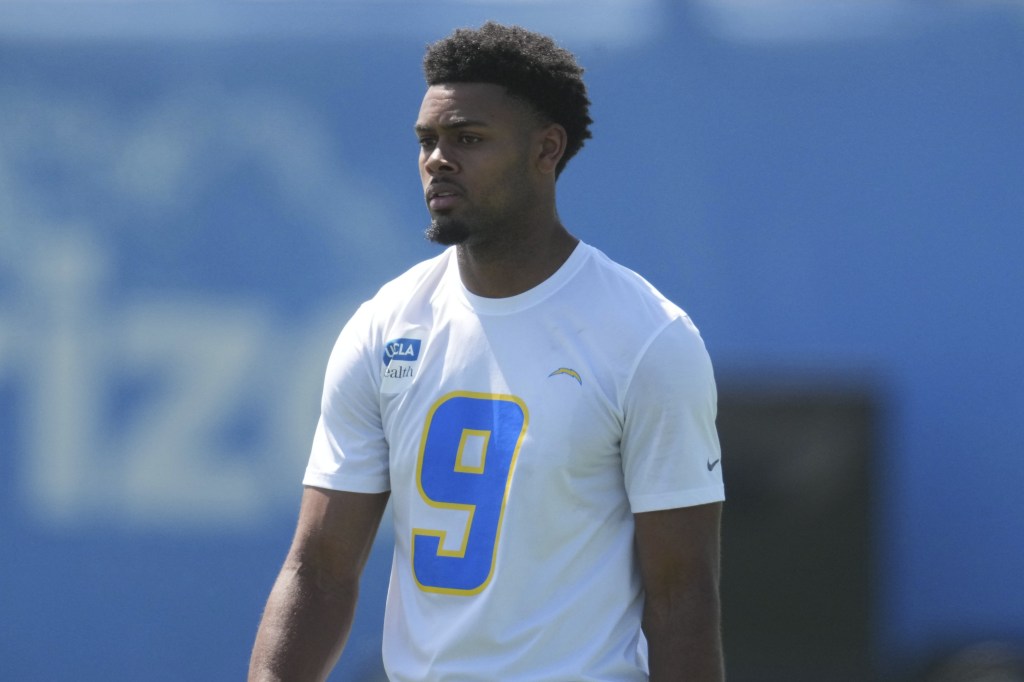
Tre Harris, Los Angeles Chargers (ADP 101.0)
Tre Harris is the breakout playmaker you’ve been waiting for in 2025 fantasy drafts. The 6-2, 205-pound Ole Miss alumnus combines physicality, polish and production in a way that few Day 2 receivers ever do. Over his college career, Harris averaged a stunning 3.01 yards per route run—the only FBS receiver this year to crack the 3.00 mark—while hauling in 3,525 yards on 327 targets and grading out at a 92.2 receiving score.
What really separates Harris is his consistency against single coverage, where he ranked second among all prospects in YPRR (4.91), owned a 95.3 receiving grade and converted 25% of his routes into first downs or TDs. He wasn’t afraid to play outside, lining up on the perimeter for nearly 79% of his snaps and proving he can beat press with crisp footwork and natural hands. When the Chargers inked Justin Herbert to a megadeal, they made it clear they needed a boundary speedster who could stretch the field—and Harris checks every box on that wish list.
On deep throws (20+ yards), Harris racked up 675 yards—sixth-best in Power 5 football over the past two seasons—even after missing significant time in 2024 with injury. His contested-catch success rate on those bombs was a robust 75%, and he hauled in 29 total receiving TDs (0.15 per route run). In short, when you need a big play, Tre Harris is the guy.
Landing in Los Angeles under Greg Roman and QB Justin Herbert, Harris will step into the Z-receiver role vacated by Joshua Palmer. Herbert’s arm coupled with Roman’s balanced attack should unleash Harris early—and often—especially on vertical concepts. At his projected ADP in the early third round, Tre Harris offers immediate boom-or-bust upside: a weekly WR3 floor with true WR1 upside whenever those deep shots connect. If you’re building around superstar QBs and daring college breakouts, locking in Tre Harris this spring could be the difference between a middling roster and a championship contender.
Kyle Williams, New England Patriots (ADP 118.5)
Kyle Williams burst onto the scene in 2024, saving his best work for his final collegiate season at Washington State. After three years at UNLV, he exploded for 1,198 receiving yards and 14 touchdowns, showcasing a rare blend of crisp route-running and explosive yards-after-catch. His 5-11, 190-pound frame doesn’t leap off the page, but his tape reveals an instinctive feel for leverage, a violent release against press and effortless hands in traffic. Williams converted 73.3% of his one-on-one matchups into positive plays (75th percentile) and thrived under contact, beating press at a 73.5% clip (82nd percentile).
He owns elite efficiency on quick-strike routes—86.8% success on slants, 88.2% on curls and 83.9% on outs—turning sharp breaks into immediate gains. On deeper patterns, he can’t often out-run true burners, but he flashes smooth stem points and a savvy understanding of leverage, leading to quality contested catches and dangerous separation when defenders sink too deep. Across 34 games, Williams averaged 75.9 yards per game, avoided 1.18 tackles per contest and earned an 80.4 PFF receiving grade. His bowl-game finale cemented his rise, piling up 172 yards on 10 catches against Syracuse, including several double-move beauties and juke-line after the catch.
Landing in New England under Josh McDaniels, Williams joins a crowded receiver room but carries a more polished, multifaceted skill set than most Day 3 picks. And, frankly, it’s not as if Demario Douglas, Kayshon Boutte, or Ja’Lynn Polk present much on-paper bottlenecking. He steps into an offense that values versatile route-runners and precise quick-game threats, catching passes from one of the league’s most accurate passers. As a late-round fantasy target, Williams brings a safe floor as a chain-mover and the upside for game-breaking performances. In PPR formats, he projects as a reliable WR3 with weekly value and the upside to outproduce his draft slot. He’s an ideal sleeper poised to deliver consistent production and surprise breakout touches throughout 2025.
And, seeing as his fate is tied to that of Drake Maye’s, feel free to project Williams’ ADP aligned with your projected ceiling for Maye and the Patriots’ passing attack.
Matthew Golden, Green Bay Packers (ADP 78.0)
Matthew Golden exploded onto everyone’s radar with a 4.29-second 40 at the Combine, but his film—and the data—prove he’s more than just a burner. In three seasons he lined up off the line 30.7% of the time, giving him room to build speed into crisp digs (80.6% success rate), posts (77.3%) and outs (78.6%) against zone coverage, where he posted an elite 82.5% success rate (77th percentile). Even in man-to-man he still managed a solid 68.5% success mark (44th percentile), flashing the ability to stem inside breaks and beat defenders on go routes (63% success) despite going vertical on just 12.7% of his reps.
With 19 contested targets charted in our sample, Golden won an eye-popping 83.3% of those opportunities, tracking the ball superbly and high-pointing in tight quarters. Yes, he dropped a handful of catchable throws (7.4% drop rate), but that’s well outweighed by his ability to explode through contact and rack up YAC—he broke multiple tackles on 25% of his in-space catches.
Finishing his Texas career at just 1.85 yards per route run (24th percentile), Golden’s situational splits tell the story: 2.54 YPRR when lined up in the slot (90th percentile), 2.10 YPRR vs. zone (71st percentile) and 1.46 vs. man coverage. His overall PFF receiving grade of 74.6 (31st percentile) underlines the raw edges left to sharpen—but the Packers can finesse them.
Green Bay hasn’t drafted a first-round receiver in more than two decades, and with Christian Watson rehabbing his knee and Romeo Doubs and Jayden Reed serving complementary roles, Golden steps into Matt LaFleur’s system with a real shot to stretch the field and command vertical targets. Pair him with Jordan Love’s cannon arm and you’ve got a rookie poised to carve out Week 1 playing time. His combination of track speed, contested-catch prowess and advanced route precision makes him one of 2025’s most exciting deep-leash plays, even in the mid-to-late rounds of fantasy drafts.
Luther Burden III, Chicago Bears (ADP 114.5)
Luther Burden’s talent has never been in question; what remains is whether he can translate it into consistent NFL production. At Missouri, he dominated the slot as a sophomore, posting a 3.29 yards per route run and earning a 91.0 PFF grade. Even as his raw numbers dipped in 2024, Burden still managed a strong 2.32 YPRR and an 80.2 receiving grade, flashing elite quick‐game prowess—90.9% success on outs, 84.2% on curls and a perfect 100% on screens. Defenses seldom saw those opportunities coming, and he turned each into chunk gains with violent run‐after-catch bursts and a 25% broken-tackle rate.
In one‐on‐one matchups, Burden converted 71.2% of his reps (68th percentile) and showed the separation chops to win outside, despite running 83% of his snaps from the slot. He’s deceptively strong at the catch point—hauling in contested looks—and his hands are rock solid, with a sub-2% drop rate. Yet questions linger: can he sustain that elite quick-game impact? Will he ever consistently create on vertical stems? And, critically, how will he carve out targets in Chicago’s crowded receiver room?
Landing in a Bears offense led by Ben Johnson—who turned Amon-Ra St. Brown into a PPR machine—gives Burden a clear path to early snaps in 11 personnel. D.J. Moore and Rome Odunze figure to absorb the X-wide workload, leaving the slot role ripe for Burden’s skill set. Even if he starts as the third or fourth option, his unique ability to explode on quick breaks and bully defenders after the catch makes him a prime WR3/flex target in PPR leagues.
Dynasty managers should pounce on Burden’s second‐round ADP: he offers a safe floor as a chain‐mover and a sky-high ceiling as a YAC game-changer. If Johnson unlocks more of his contested-catch and downfield potential, Burden could outproduce his draft slot and emerge as one of 2025’s most exciting breakouts.
Emeka Egbuka, WR, Tampa Bay Buccaneers (ADP 96.0)
Emeka Egbuka arrives in Tampa Bay with one of the clearest transition profiles in this rookie class. He ran a 4.50-second forty and posted a 98.5 speed score (71st and 68th percentiles, respectively), showing enough burst to threaten downfield while his short-area quickness and route-running savvy make him a natural fit inside. He broke out early at Ohio State (age 19.9) and finished his college career with a 26.1% dominator rating and a 24.9% target share—both more than solid marks for a true secondary option in a superstar-powered passing game.
His route-level charts tell a familiar story: elite efficiency on slants (87.5% success), outs (78.6%), flats (82.6%) and screens (100%), all while running those looks on roughly 5–14% of his routes. He showed a 47.4% success on nine-routes (verticals) but only ran them 9% of the time, cementing him as a short-to-intermediate workhorse more than a pure deep threat. Defenses rewarded him for it, playing zone on 55% of his snaps—but he still posted an 83.6% success rate there (82nd percentile) compared to a respectable 68.1% against man coverage (42nd percentile) and an 81.3% clip when pressed (92nd).
Across three seasons he averaged 26.7 routes per game, 68.6 receiving yards, and logged a PFF receiving grade north of 80 in two of those campaigns. He beat the first tackler 58% of the time but generated just 6.7% multi-tackle breaks, indicating there’s room to grow after the catch. He lined up in three-wide sets roughly 80% of snaps, slot snaps specifically near 74%, and ran 71% of his routes against zone coverage—usage patterns that mirror his new role in Tampa Bay’s likely subpackage-heavy offense.
On the depth chart he slots in behind Mike Evans and Chris Godwin but ahead of Jalen McMillan, giving him a clear path to five–to-seven targets per game in three-receiver looks. Tampa’s passing game coordinator loves his slot-to-perimeter versatility, and Baker Mayfield’s willingness to feed his first read sets up nicely for a polished route-runner who uncovers quickly underneath. With Evans entering a contract void year in 2026 and Godwin returning from a major ankle injury, Egbuka brings the upside of inheriting immediate volume and the floor of a first-round investment in a position coachable for “dirty work,” downhill blocking and all.
Best-ball players take note: his ADP around 93.5 in Underdog drafts undervalues a rock-solid route technician who should outproduce that draft slot over the back half of the season. Talent transcends situation, and Egbuka’s combination of draft capital, archetype fit, and dependable per-route production make him a candidate for a quietly impactful rookie campaign and a candidate to outperform consensus rookie wide receiver finishes.
Honorable mention
Not normally a thing we hand out around here in Five Lists of Five, but, as mentioned above—experimental angles!
Jayden Higgins, WR, Houston Texans (ADP 99.0)
Jayden Higgins oozes upside at 6-foot-4, 214 pounds with a 33-inch catch radius and enough track speed to rip off splits in the 4.47s. After transferring from Eastern Kentucky, he immediately became Iowa State’s alpha target—averaging 34.2 receiving yards per game on 90% route participation in 2024—and capped his Cyclone career with back-to-back 1,000-yard seasons. His PFF receiving grade jumped from 86.6 to 90.5, and he finished with a career 2.80 yards per route run (91st percentile), including 3.00 YPRR lining up in the slot (96th percentile) and 2.73 YPRR out wide (71st percentile).
Despite an NFL-average 58.6% success rate vs. man coverage, Higgins ambushed zone (78.6% success, 46th percentile) by consistently finding soft spots over the middle on curls (83.3% success), slants (71.2%) and digs (68.2%). He only ran nine routes (19% of his sample) more than 15 yards downfield—yet he still posted 56.9% success on go routes and smothered screen chances (100% success). His contested-catch rate (66.7%) and the way he shields defenders off the line showcase true alpha-receiver traits: he plays bigger than his frame, adjusts to underthrown balls and exploits defender over-pursuit for YAC splashes.
Houston tabbed him 34th overall to pair with Nico Collins, creating a daunting perimeter duo. With Christian Kirk now in the slot and John Metchie III battling for snaps, Higgins slots in as the X-receiver who can threaten the seam and punish soft-coverage schemes. Under Nick Caley’s Rams-inspired playbook, Higgins should step into three-receiver sets early, commanding 25–30% of Houston’s targets.
His blend of size, contested-catch savvy and intermediate route mastery makes him one of 2025’s best Day-2 values. He may not be a pure burner, but C.J. Stroud will love lofting curl-to-curl-flat concepts into Higgins’ grasp. In best-ball formats and dynasty start-ups, he profiles as a high-floor, high-ceiling WR3 who could easily flirt with WR2 production by Year 2.