

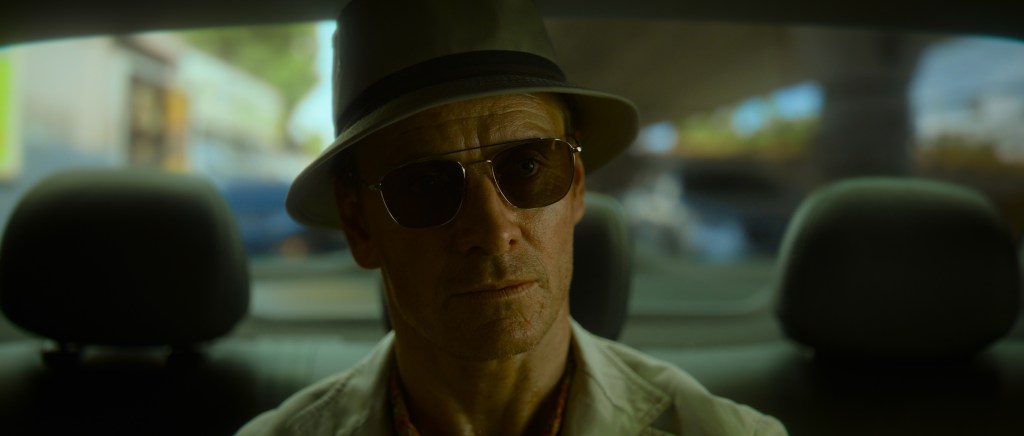
This review was originally published as part of DraftKings Network’s 2023 New York Film Festival coverage. It is now out on Netflix.
The aura given by the unnamed hitman (played by Michael Fassbender) we first meet at the top floor in a WeWork building in Paris as he surveys the next contracted target is of sterile preciseness. He sleeps in a fold-out chair with a portable heater, has a “work” playlist full of The Smiths songs, and does a measured yoga routine. Everything down to his heart rate must be right before he does the job. Fassenbender’s narration throughout The Killer would also make you believe this man takes nothing for granted in these jobs (the rules echoed throughout the film echo these sentiments exactly). He sometimes even provides some humor, noting that he no longer books AirBnb’s because of nanny cams.
But David Fincher’s adaptation of French novels doesn’t begin during just another day in the life of a successful contract killer. It’s this particular time, even with all the man’s implementation of his system, his aim is slightly a centimeter off with the hotel across the street. His sudden, sparse note of anxiety melds into a high-speed motorcycle escape as he discards many of his tools of the trade. At that point, you chalk it up to mistakes happening and eventually circling to this target. However, many aliases and a hideaway deep in the Dominican Republic can’t save him from potential consequences.
:format(webp):no_upscale()/cdn.vox-cdn.com/uploads/chorus_asset/file/25007324/MATZ_R1_48_20230510u_v16_DoVi_20230830.0125940.jpg)
The job of a hitman is exceptionally lonely, and much of the film sees Fassenbender’s character acting as an almost machine-like unit with a smirk and crack of the neck here and there. There’s also the aspect of inescapable paranoia. When traveling, the killer sees a well-tailored man who looks to be following him and even elects to take a flight the day after to avoid him. In moments like this, Fassbender gives this role slightly more emotionality. Otherwise, the enormous amount of tunnel vision is his guiding light. Upon returning home, the hitman finds his house broken into and discovers his girlfriend has been brutally beaten.
One of the principles is to “fight the only battle you’re paid to fight.” It’s hard for the assassin to turn away from someone who’s undoubtedly made things personal. In a six-chapter sequence, writer Andrew Kevin Walker turns this into a procedural story chronicling the day in the life of a contract killer to a globe-trotting quest for vengeance. For all his insistence to not feel empathy, the assassin undoubtedly feels it here, and it leads him down some particular roads he may not have followed if it was just a simple target.
Fincher allows the madness to attach to his main character and rattle him. Although he’s undoubtedly one of the best in his line of work, the personal nature of this quest leads this assassin to allow some improvisation. His boss, Hodges (Charles Parnell), an office worker named Dolores (Kerry O’Malley), and an expert killer (played by Tilda Swinton) all try to throw different modes of emotionality to trip up Fassbender’s character. There are some slight indications of discretion, expertly defined to Fassbender’s physicality – but he’s a man on a murderous clean-up mission, and nothing will deter him from completing the mission.
It could boil down to hysteria, and the narration also hints at this. While The Killer’s abrupt nature settles into the methodical leanings of how a single man thinks of every possibility, one particular fight sequence shakes us out of that. Cinematographer Erik Messerschmidt captures it inside a dimly lit house in Florida that is fast, frenzied and adds a camera shake to mimic every crushing blow and crackle of a wall. This scene serves as a contrast and elevates the tempo of the entire film. The score by Trent Reznor and Atticus Ross is metallic and sometimes minimalistic, as much as the main character of The Killer is. It enhances the experience as the music acts as a pot for the ingredients to come together.
Why does this assassin elect to do what he does when it feels certain he can get out at any point? Indeed, he knows the risks to the few people he loves, but this whole ordeal has a hidden element of worthiness. Where would all these outhouses, passports, and weapons bags go if he didn’t do what he did? The question arises within the entertaining measurements of someone who slowly lets exactness go.
