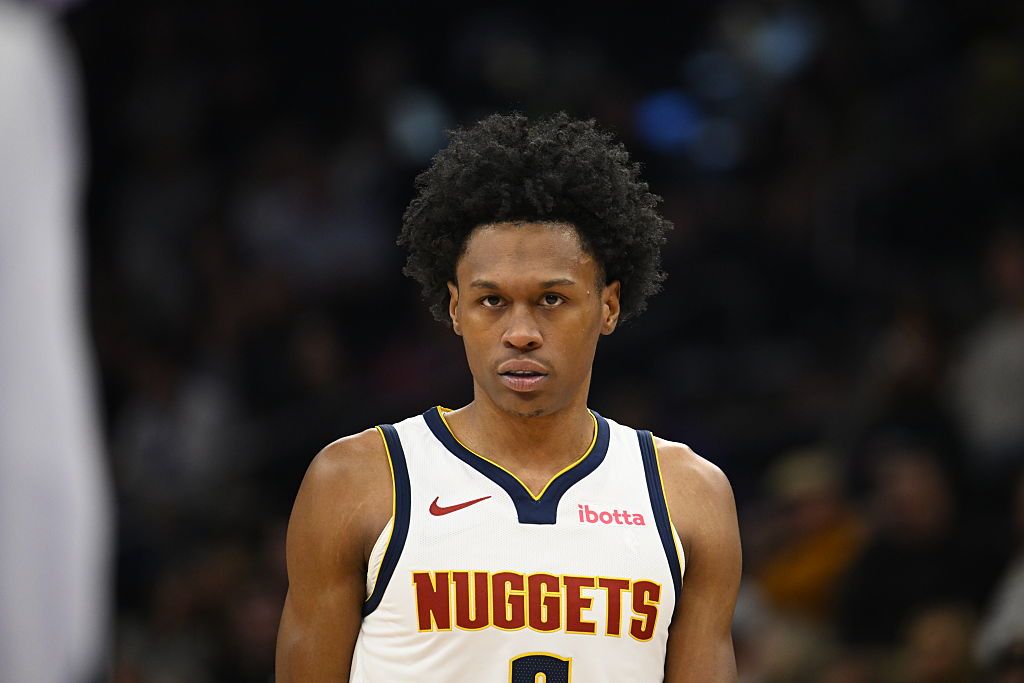
There are only so many dominoes left to topple in this NBA season. One of the bigger ones has now fallen. Restricted free agent Peyton Watson has been traded to the Cleveland Cavaliers from the Denver Nuggets in a deal that sends Max Strus to the Los Angeles Clippers and Tre Mann to the Washington Wizards. Let’s break down the deal and grade it for all four parties involved.
Denver Nuggets Receive: Cavaliers Unprotected 2031 First-Round Pick, 2032 Kings Second-Round Pick, Julian Reese from Wizards (Waived)
Grade: C+
I don’t like the process for this trade on the surface. Watson is a rising talent, one who became extremely important to Denver’s rotation over the last year. $22 million a year is nothing to sneeze at, but it’s what a 23-year-old starter with upside costs. Since the Nuggets are over the second apron and would have the most expensive roster in the sport if they matched this deal, it’s a move to keep the roster affordable.
When you have Nikola Jokić in the prime of his career, you pull out the checkbook, at least for one year. Cam Johnson, a flop in his first season in Denver, is on an expiring $23 million deal; you could have traded him instead, or stayed in the second apron for a year before letting Johnson expire. Jamal Murray, who is increasingly on the decline, could have been moved earlier in the offseason. There’s not much to be done about the terrible Christian Braun extension, but if they were properly motivated, they could have reached a deal. Letting talent like Watson go while you’re in a good position to contend is a terrible mistake.
However, they did do quite well in this deal, all things considered. They traded Watson without getting salary back, which was clearly the goal, and it gives them a clear path to get out from under the second apron. A 2031 unprotected pick from any team is an extremely valuable asset, one the team could use later to pursue serious upgrades, and the second-round picks are a decent throw-in. Again, I hate the process for the Nuggets here, but if you’re determined to get rid of Watson, this is the best package you could find.
Cleveland Cavaliers Receive: F Peyton Watson, F Cam Whitmore from Wizards
Grade: B-
As I said before, this price is too high for a starter-level player. The contract itself is fine, but an unprotected first is hefty to upgrade on Strus, a perfectly good starter in his own right. Watson brings much more defensively as an explosive rotational defender and perimeter stopper, but his offensive role took time to iron out with the Nuggets. He excelled as a cutter and lob threat off Jokic’s gravity, but won’t have the same appeal with Cleveland’s limited passing frontcourt. If they try to work him in as a small forward alongside Evan Mobley and Jarrett Allen, they’ll ask him to do a lot more shooting and driving, which isn’t ideal. Hopefully, Watson’s athleticism can boost their transition attack, which was 38th percentile in frequency and 52nd percentile in efficiency according to Synergy.
That said, teams like the Cavaliers should pursue all upgrades while they still can. It’s anyone’s guess how long James Harden can keep this up, and he needs a new deal himself this offseason. Watson’s fit compared to Strus may be a bit clunky, but it behooves the Cavaliers to make it work, and they paid a premium to do so. I’ll always respect this kind of aggressiveness to get young talent wherever you can find it.
On the back end of this deal, the Wizards get involved with the Cavs to shed some of Cleveland’s salary. Tre Mann was recently acquired from the Hornets in a trade for Dennis Schröder. According to Jake Fischer, that trade will be combined into this trade, creating one five-team deal. This is largely window dressing for the Cavs; Whitmore makes $2.6 million less than Mann, and both are on expiring deals, so Cleveland essentially trims up their cap sheet in exchange for some cash.
Los Angeles Clippers Receive: F Max Strus
Grade: A
I’ll go ahead and assume the Kawhi Leonard deal will be completed sooner or later, which means the Clippers will be in a full retool. Since they don’t control their own first-round picks over the next two years, there is no real incentive for this team to bottom out. Instead, they’re looking to stay in the mix with a pair of All-Stars in Darius Garland and Brandon Ingram. Strus gives them a proven veteran who can shoot the ball well and play quality defense, and they essentially got him for free.
LA acquired that 76ers second-round pick in a Johni Broome salary dump, a player they are likely to waive. Strus, who makes $16.6 million, is absorbed into a $17 million trade exception created by the John Collins sign-and-trade earlier this offseason. Though his deal is expiring, he provides quality depth and a potential starter; if things go sideways this year, he can be re-traded at the deadline for what would surely be a better price.
If Strus stays through the year, it’s quality wing play for a low, low trade price. If he goes at the deadline, it’s a big upside play out of nowhere. Either way, a great bit of business for the Clips.
Washington Wizards: Receive G Tre Mann, 2027 76ers Second-Round Pick
Grade: A+
Any time you can use your cap sheet to pick up talent, you should do it. And the Washington Wizards did just that.
Mann was traded from the Thunder to the Hornets at the 2024 trade deadline. In 28 games with Charlotte to close out that season, Mann averaged 11.9 points, 4.5 rebounds, and 5.2 assists per game with solid shooting efficiency and a strong assist-to-turnover ratio. He looked like the perfect backup for LaMelo Ball. Mann continued to hoop to begin the 2024-25 season, but was derailed by a back injury, playing only 13 games. That injury continued to dog him through the 2025-26 season, making him expendable to the Hornets.
But he’s still 25, an exceptional on-ball shot creator, and an underrated defender. If the Wizards can work some magic to heal his back issues, Mann will be a great bench piece for this young team, and fits the timeline of this group. He’s under contract for $8 million this year, with a team option at the same number next year; if he’s not healthy or a total flop, they can wash their hands of him after the season, and all it cost them was a seldom-used Cam Whitmore. Worst-case scenario, they spent $2.6 million in salary to get a second-round pick, which is roughly the going rate for that kind of pick. Best-case scenario, the Cavaliers paid them to get an even better player than Whitmore with an extra year of team control.