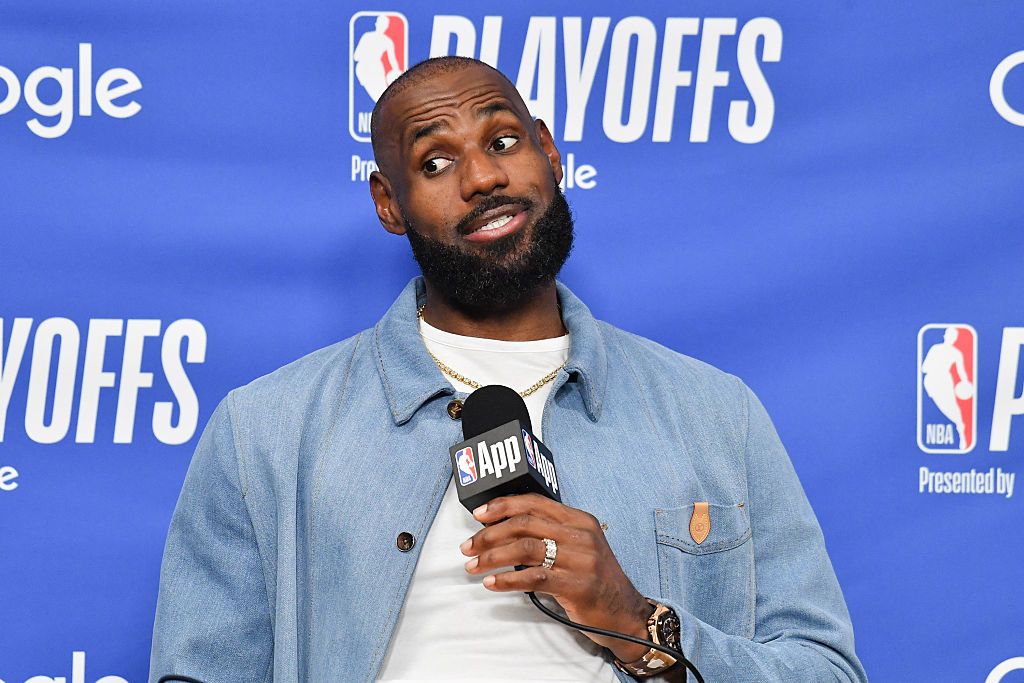
Nearly a month after he announced that he wouldn’t be returning to the Los Angeles Lakers for his 24th NBA season, LeBron James has finally made the fourth major free agency move of his career. On Friday morning, ESPN’s Shams Charania revealed that James had signed a two-year, $8 million deal with the Philadelphia 76ers.
James’ signing immediately changes the landscape in the East. The 76ers now have the second-shortest odds to win the Eastern Conference (+350) and the third-shortest to win the NBA Finals (+900) at DraftKings Sportsbook.
His decision will have the biggest impact on Philadelphia, but given his stature, it’ll have reverberations across the league. Let’s break down some winners and losers from this morning’s monumental news.
Winner: Josh Harris and David Blitzer
Win or lose, James is a draw. With Tyrese Maxey, Joel Embiid, and newly-acquired Jaylen Brown on the roster, the 76ers were always going to feature in plenty of nationally televised games, but now that James plays in the City of Brotherly Love, ticket prices and TV viewership should soar. James’ team debut (and presumably a Christmas Day game in Philadelphia) are going to be some of the most expensive tickets of the season, and his jersey will undoubtedly be the most popular, as it’s been for most of his career. Getting him on a veteran minimum contract is a steal even before considering his off-the-court impact.
Plus, the playoffs are profitable. Last season, the New York Knicks were estimated to generate more than $200 million in revenue throughout their championship run, and James’ signing makes it significantly more likely that the 76ers will make a deep playoff push. Even in his age-41 season, James was tremendous last season, averaging 20.9 points, 6.1 rebounds, and 7.2 assists per game, and the Lakers were 2.3 points points per 100 possessions better with him on the floor. James is still a winning basketball player, and his elite basketball IQ and gravity should provide Maxey, Embiid, Brown, and VJ Edgecombe with the easiest shots they’ve ever gotten. Philadelphia still has some defensive question marks, but its offense should be (at minimum) a top-10 unit if all five starters stay relatively healthy.
Loser: Number One Option Jaylen Brown
When Brown was first reported to be available in the trade market, there were rumors that he wanted to be the number one option, an opportunity he would not be afforded with the Boston Celtics now that Jayson Tatum is fully back from his torn Achilles. To be fair to Brown, he’d proven that it was possible to win with him as the go-to scorer, as the Celtics finished 56-26 in 2025-26, with Brown averaging a career-high 28.7 points per game while keeping his efficiency relatively in line with his career averages. He finished third in usage rate, behind only Luka Dončić and Giannis Antetokounmpo.
Even before James’ arrival, the 76ers arguably weren’t Brown’s team, as Maxey averaged 26.9 points per game in the first round to knock Boston out of the playoffs and Embiid finished fourth in usage rate among players with at least 1,000 total minutes throughout the regular season. It’s likely that Brown will take more shots than James regardless, since James tried a career-low 15.3 per game last season, but both players will have significant ball-handling duty, and James posted a true shooting percentage 8.2 percentage points higher than Brown in the clutch last season. When the lights are brightest, Nick Nurse could turn to Embiid, Maxey, and James before Brown.
Winner: The Eastern Conference
This is more a reflection of the offseason as a whole than of James’ decision in particular, but the East suddenly looks much deeper and more competitive than it did at the start of the summer. Brown went from one contender to another without sacrificing the Celtics’ regular season competitiveness, Antetokounmpo went from lottery fodder to a contender, Kawhi Leonard will likely join the Toronto Raptors eventually, and the Atlanta Hawks swapped a non-rotation player (Zaccharie Risacher) for Luguentz Dort — a point-of-attack defender tailor-made to stop Jalen Brunson — and Ryan Nembhard.
Whether any of these new-look squads are capable of taking down the Knicks and then either the Oklahoma City Thunder or San Antonio Spurs from the West remains to be seen, but the intrigue is there. Maxey, Brown, and Embiid combined to produce 19.7 win shares last season, on paper the second-most impressive trio of teammates he’s played with since the 2019-20 Los Angeles title squad. Adding the 5.4 win shares that James was worth last season, Philadelphia’s top four is tied for the sixth-strongest in the East, which could make for some extremely intriguing second-round series. Plus, he’ll have an intra-division rivalry with New York, and, assuming both are healthy, James and Leonard will continue to face off four times every season.
Loser: Stephen Curry
Towards the end of James’ recruitment process, it had become clear that the 76ers, Cleveland Cavaliers, and Miami Heat had emerged ahead of the Golden State Warriors, but the idea of recruiting James and trying to reunite him with either Anthony Davis or Kyrie Irving was the last gasp of the Warriors’ dynasty. Golden State has missed the playoffs in two of the last three seasons, will need to re-sign Draymond Green to a significant deal, and could conceivably end up against the first apron hard cap. Jimmy Butler III will likely miss the start of the season as he recovers from a torn ACL, and Moses Moody might miss the entire campaign.
There’s just no realistic pathway towards contention for the Warriors. Golden State has only the 15th-best odds to win the Finals and the fifth-best odds to win the West. The Warriors do have some draft capital, but with loads of competitive teams and the new penal lottery system, there might not be many teams interested in selling at the trade deadline. They lost three of their four games to the Minnesota Timberwolves (who added LaMelo Ball), all four to the Oklahoma City Thunder, and three of four against the Lakers. James is still good enough that he might’ve given Golden State a fighting chance in some of those games, but without him, Curry’s career looks destined to end in much the same way James’ Los Angeles stint did: as an aging legend on a team mired one step below contention.
Quiet Winner: Bronny James Jr.
One day before LeBron James decided not to return to the Lakers, Bronny James’ contract for the 2026-27 season became guaranteed, and while it’s conceivable that LeBron could end up demanding that his son join him in Philadelphia, Los Angeles has demonstrated no indication that it plans to deal the younger James. Bronny made some strides during his sophomore season, averaging 15.3 minutes per game across the Lakers’ final 10 games with Dončić and Austin Reaves sidelined and averaging 5.6 points and 1.3 assists per game on 42-36-100 shooting splits.
Los Angeles still has enough back court depth that Bronny won’t necessarily be in the rotation, but Dončić and Reaves aren’t defensive-minded like Bronny is and Quentin Grimes projects to play more on the wing, given the Lakers’ lack of depth in that position. Additionally, despite flashing potential in college at Alabama, Collin Sexton has been a negative defender throughout his NBA career, and Bronny has had better defensive metrics than Sexton while providing more athleticism and a more selfless approach offensively. Without the media hoopla surrounding LeBron, Bronny can finally start to focus wholly on his basketball development.