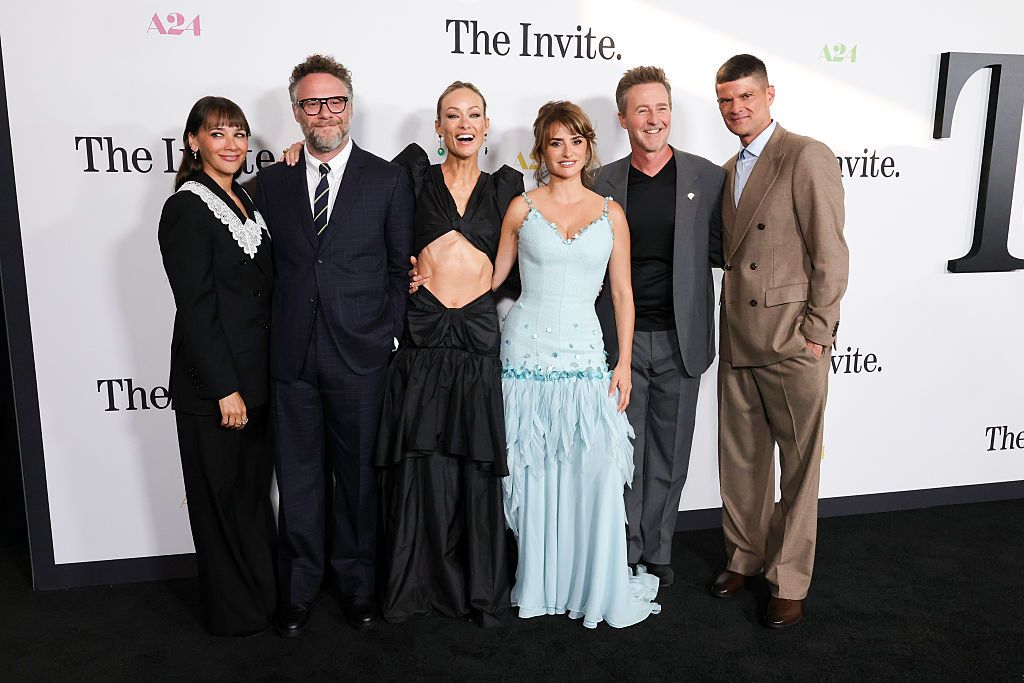
Olivia Wilde opens The Invite with Oscar Wilde, which is a pointedly semi-reflective place for this movie to begin. “One should always be in love,” the quote goes. “That is the reason one should never marry.”
Soon after, Seth Rogen’s Joe comes home from another dispiriting day, lugging his foldable bike and the mood of a man who has accepted defeat in a desiring-a-lightning-strike-heart-attack kind of way. Angela is waiting inside the apartment he inherited from his parents, reminding him that the upstairs neighbors are coming down for dinner. There is no wine, except the special-occasion wine. There is no peace, except the brittle kind married people sometimes mistake for routine. Above them, Piña and Hawk have been making enough noise during sex that we’ve reached building-complaint consideration levels. Within minutes, Wilde (Olivia, not Oscar) has her arena: a San Francisco apartment, a deadened marriage, two beautiful strangers, and the awful possibility that, despite what Angela and Joe believe, desire has never abandoned their home.
My full review is below, with light spoilers.
The Invite: full review
I always thought Booksmart understood desire with unusual kindness. It caught the earnest, luminescent hunger of young adulthood, while Superbad mostly poked fun at the same ache. Wilde’s debut saw wanting as comedy, humiliation, aspiration, and grace. The movie was filthy, bright, and emotionally alert. It gave teenage lust a pulse without shaping its arc toward slapstick.
That made the Don’t Worry Darling years feel especially bleak. Wilde’s second film had craft, whatever the circus around it threatened to obscure. She knew how to command non-diegetic sound, how to weaponize silence, how to dress a body and frame a room. The soundtrack to Booksmart was coolly curated. The void-esque silences in Don’t Worry Darling were genuinely isolating. Even when the movie buckled, the filmmaker’s hand remained visible.
Still, the media storm became bigger than the film. For a while, it was fair to wonder whether Booksmart would stand alone. Then The Invite arrived, and everything looked newly possible again. Wilde’s third feature is funny, mortifying, gorgeously acted, and quietly overwhelming.
The premise has the clean theatrical snap of a simple dare. Joe and Angela, played by Seth Rogen and Wilde, invite their upstairs neighbors to dinner. Piña and Hawk, played by Penélope Cruz and Edward Norton, arrive with beauty, confidence, and a philosophy of group sex. They seem like emissaries from some warmer planet, where we treat each other differently, caretake the peculiar stuff of each other’s souls together. Joe and Angela are—have long been—simply trapped inside their apartment. When I say that is all they feel they have to offer their guests, I’m not exaggerating.
That apartment set is one of the movie’s great achievements. It is big, expensive, meticulously-curated, and somehow altogether airless. Every room seems incomplete to Angela; it, being his late parents’ home, seems like absolution and hopelessness to Joe. The space has wine, books, furniture, light, and intention. It also has the dry, overcrowded feel of something awaiting a ’round-the-bend absolution.
Wilde understands rooms. She understands how set design can become biography. Angela’s eye has clearly touched every surface, yet nothing feels settled. The apartment holds taste, foregoes peace. It has the suffocating abundance of people who know how their life should look, then fail to live inside it.
That tension runs through the dinner. Joe and Angela do not have normal wine in the house, so they reach for special-occasion wine. The gesture is small, funny, and slightly tragic. They serve meat, cheese, and gluten to Pina, who expressly rejects that entire culinary continent. A soufflé burns. Hospitality becomes failure. Every domestic mistake seems to accuse the marriage.
The score keeps needling the evening forward. Its plucky violins suggest Broadway farce filtered through a heady self-help podcast. That combination sounds ridiculous, which is also why it works. The music understands the movie’s strange weather. Everyone wants liberation, language, structure, permission, and applause. Nobody wants to admit how badly.
Rogen gives Joe a soft, defensive shape. He plays him as a man who has turned woundedness into a personality. Joe can be funny, pitiful, tender, and deeply irritating within the same exchange. Rogen’s gift has always been ease, but here he finds pressure inside it. His body seems to know before his mouth does.
Cruz gives Piña a miraculous calm. She enters with the dangerous grace of someone who has stopped apologizing for pleasure. The movie never reduces her to fantasy, which is essential. Piña can be seductive, absurd, kind, impatient, and practical. Cruz lets the sensuality breathe without selling it as enlightenment.
Norton, though, nearly walks away with the room. Hawk could have been a cartoon of evolved masculinity, all open collars and borrowed wisdom. Norton makes him stranger than that. He gives Hawk warmth, vanity, appetite, and comic timing so precise it feels musical. His best line may be his simplest confession: “Sorry guys. We just wanted to come see the apartment. Maybe fuck a little bit.”
That line captures the movie’s finest comic register. It is ridiculous because it is honest. Most of The Invite plays in that gap between candor and performance. Everybody keeps wanting to say a brave thing. Nobody knows how to shape their mouths around it.
Wilde’s performance is the revelation. Her face acting is insane. Angela’s thoughts seem to arrive before she can defend against them. Shame passes across her eyes, then anger, then recognition, then the horrible flicker of wanting something unnamed. Wilde does not play Angela as repressed in any simple sense. She plays her as someone exhausted by her own self-erasure.
That becomes the movie’s deepest subject. The Invite is expressly about desire, but not as conquest or novelty. It is about forgetting how to be desired. It is about living so long in the wanting to be wanted that the want itself becomes clutter. Rage clouds it. Taste disguises it. Marriage flattens it into chores, grievances, routines, and dead air.
The movie’s most affecting scenes arrive when Angela is with Hawk and Joe is with Piña. On paper, these are the sex-comedy beats. Beautiful strangers introduce calcified married people to risk. Bodies enter unfamiliar rooms. Clothes become problems. Dancing becomes evidence. Nobody knows where to put their hands.
At first, those moments are awkward and funny. Someone trying to dance badly will always have comic value. Two people failing to undress with grace will always test a room. Wilde lingers long enough for the laughter to reflect on itself. You feel as the joke drains away. What remains is genuine vulnerability, and it feels incandescent. An understanding of true human outreach.
That’s where the film becomes braver than its premise. Free-swinging fun is all that’s on the invitation, but vulnerability becomes whole the story. Angela and Joe have to sit inside the gazes of Hawk and Piña. They have to become visible before they become free. These scenes ache because the characters are suddenly risking connection—actually wanting it, having agreed to it, having granted each other permission to pursue it—disrobed of all their armor. How, the film wonders, can we gracefully reach for anything after resenting ourselves and treating those we love with such undue cruelty for such a long time? Our limbs are so gangly, now.
This is also where The Invite speaks back to Booksmart. Wilde remains fascinated by desire as a frightening form of literacy. In Booksmart, young people were learning the language. Here, adults have forgotten it. They remember the grammar of complaint, sarcasm, superiority, and injury. They have lost the simple fluency of asking for touch.
Plenty of marriage movies understand divorce, resentment, and procedure. Marriage Story had a devastating eye for love turned administrative. The Invite reaches for something lower in the body. Under the layers, under the arguments, under the careful apartment and burned dinner, there is desire. The sugar of fiction. The furnace of everything that was and ever will be.
That does not make the film weightlessly optimistic, or a comfortable emotional groove. Its comedy is wince-funny, sometimes broad, sometimes almost Stiller-esque. Wilde lets embarrassment stay in the frame until it becomes part of the texture. People fall apart with their pants down. They discover truths under the least dignified possible lighting. The movie keeps finding dignity inside indignity, which is harder than it sounds.
The denouement is the one place where my admiration wobbled. Wilde pushes her protagonists toward relationship rock-bottom, then lets the language turn cloying. A therapy exchange, for me, ran too simple & clean for a film this prickly. But—crucially—it keeps the shape of authenticity, and I think that’s the point. I’m all too eager to believe it so, at least.
My favorite description of a good ending is: one that understands the best stories often close with a hand on a doorknob, turning. The Invite finds its version at a piano. Joe and Angela sit together after the night’s catharsis, a dusty wedded couple, wearied before a dustier altar. Their hands probe the keys. The song that bookends the film returns, fragile and unresolved, but a bit more refined.
Wilde’s final choice is decisive. She could have chased a colder ending, a sharper chamber-comedy bite, a final twist of adult cynicism. The one we get, however, feels feels earned by the movie’s willingness to strip bare every emphasis on craft flourishes, there at the end of all things for Angela and Joe.
Whether their song endures remains open. The story has zero interest in pretending one night can save a marriage. It only offers you the sound of the piano keys. That’s a smaller promise, and a much lovelier one.
The Invite FAQ
When does The Invite come out?
The Invite opened in limited theaters Friday, June 26, 2026, before expanding nationwide Friday, July 10, 2026.
How long is The Invite?
The film runs 1 hour, 47 minutes.
Who’s starring?
Seth Rogen stars as Joe and Olivia Wilde stars as Angela, with Penélope Cruz as Piña and Edward Norton as Hawk.
Who made The Invite?
Olivia Wilde directed The Invite from a screenplay by Rashida Jones and Will McCormack. Devonté Hynes composed the score.
What is The Invite about?
The Invite follows Joe and Angela, a married couple whose relationship is already fraying, after they invite their enigmatic upstairs neighbors over for dinner. The night begins as an awkward social encounter, then turns into a funny, intimate, and uncomfortable reckoning with sex, marriage, desire, and the stories couples tell themselves to survive.