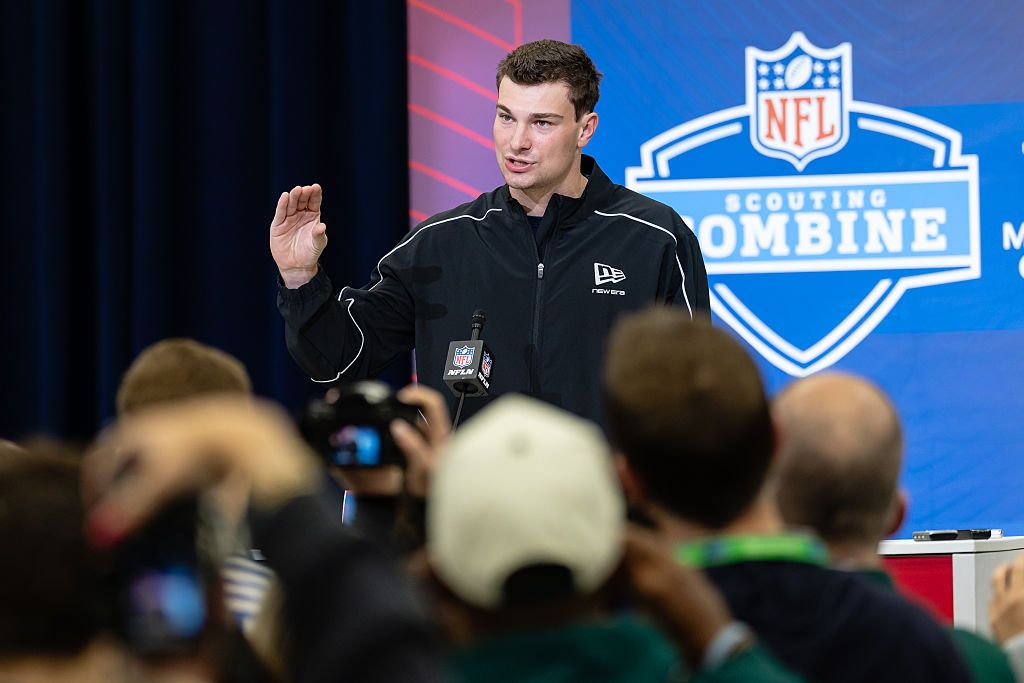
The first night of the NFL Draft always carries a certain theatrical calm—the stage lit, the suits pressed, the language rehearsed—but this one arrives with a different kind of tension underneath it. The board is thin at the top and crowded just beneath it, which means the evening won’t be defined by a long sequence of obvious picks. It will be defined by decisions that feel closer to wagers.
There is one fixed point. Las Vegas has its quarterback in Fernando Mendoza, a player whose college career reads like a study in control: nearly four thousand yards through the air in his final season, thirty-plus touchdowns, single-digit interceptions, and an efficiency profile that never slipped out of balance. That choice gives the night its starting line. Everything that follows leans into uncertainty.
New York sits at No. 2 with a decision that splits the class along its most important fault line. David Bailey offers pass-rush production that borders on overwhelming—double-digit sacks, pressure totals that stack up against anyone in the country, and a win rate that forces protection changes. Arvell Reese represents something else entirely: range, size, and the kind of second-level speed that reshapes how a defense can play. One choice pulls the early board toward edge rushers. The other invites a run on versatile defenders who can survive in space.
Arizona, holding the third pick, has spent the week listening. The expectation has been movement, but the price has held firm enough that staying put remains very much alive. Jeremiyah Love—one of the most productive and explosive backs in college football, with over 1,300 rushing yards and 20 total touchdowns last season—has hovered around that slot all week. If he’s the name called, it will confirm what this class has been hinting at for months: positional value is being negotiated in real time.
Behind them, the board opens wider. The Giants control two top-ten selections and, by extension, a large portion of the night’s rhythm. New Orleans, Kansas City, and Dallas have all been linked to upward movement, each with enough capital and enough urgency to justify it. Those calls matter less as rumors than as pressure. When multiple teams believe the same tier is about to disappear, picks start moving.
This draft doesn’t build in a straight line. It bends around a handful of players, then spreads quickly into preference and philosophy. The early picks will set the tone, but the shape of the night will be determined in the spaces between them—where the board thins, the phones ring, and teams decide whether they trust their evaluations enough to act on them.
2026 NFL Draft: Live updates, grades, analysis
Pick No. 32: Seattle Seahawks
Jadarian Price, RB (Notre Dame)
Seattle has always been willing to spend real capital on backs with explosive juice, and Jadarian Price fits that organizational impulse almost too neatly. He was not Notre Dame’s lead back, but the efficiency pops: 113 carries, 674 yards, 11 TDs and 6.0 yards per carry in 2025, after going 120 for 746 and seven TDs at 6.2 per carry in 2024. For his Irish career, Price finished with 1,692 rushing yards, 21 rushing TDs and a 6.0-yard average on 280 carries.
The trait profile explains the swing. Price tested at 5-foot-10.5, 203 pounds, ran 4.49, posted a 1.61 10-yard split, put up 21 bench reps, jumped 35 inches and hit a 124-inch broad. That is a Seahawks-type back: burst, long-speed, contact balance and enough mass to survive between the tackles.
The upside case is explosive-run creation. One Seahawks-focused draft study had Price leading the 2026 class in explosive-run rate and comparing favorably to previous Seattle investments Rashaad Penny, Kenneth Walker III and Zach Charbonnet. That matters because John Schneider has repeatedly paid for backs who can create chunk gains without perfect blocking.
The concern is usage breadth. Price had only six catches for 87 yards and two TDs in 2025, and his pass-blocking profile is not a clean selling point. That makes the pick pricey if Seattle views him as a three-down answer immediately.
Pick No. 31: Tennessee Titans
Keldrick Faulk, EDGE/DL (Auburn)
Tennessee needed more front-seven force, and Keldric Faulk gives the Titans one of the bigger, younger, more physically flexible defensive linemen in the class. He is 6-foot-6, 276 pounds, ran a 4.67 forty, jumped 35 inches, posted a 9-foot-9 broad, and brings 34 3/8-inch arms with an 84-inch wingspan. That is real NFL clay: long, heavy, explosive enough, and young enough at 20 years old to bet on the second contract version as much as the rookie one.
The production profile is sturdy, if not spectacular. Faulk started all 12 games in 2025, served as a team captain, earned third-team All-SEC honors, and finished with 29 tackles, five TFL, two sacks, four pass breakups and a fumble recovery. Auburn’s own log notes 32 consecutive starts dating back to 2023, so this is not a flash pick. It is a durability, size and role-versatility pick.
The advanced numbers explain both the appeal and the limitation. PFF had Faulk at a 75.8 overall grade, with an excellent 85.5 run-defense grade that ranked 20th among 852 qualified edge defenders. That is the Titans’ immediate win. He can set edges, dent tight ends, reduce inside and help build a tougher early-down front. The pass-rush grade, though, was only 66.0, with 30 pressures, two sacks, one QB hit and 27 hurries.
Pick No. 30: New York Jets
Omar Cooper Jr., WR (Indiana)
The Jets needed a reliable separator more than another theoretical field-stretcher, and Omar Cooper Jr. gives them a polished, sturdy target who can win early in the down. Cooper was Indiana’s leading receiver during its title run, finishing 2025 with 69 catches, 937 yards, 13 TDs and 13.6 yards per catch, with the touchdown total tied for third nationally. Activate Up to $15 Cash Back
The efficiency profile is strong. PFF credited Cooper with an 87.8 overall grade, 13th among 679 qualified receivers, plus an 85.9 receiving grade. Their charting had him at 58 receptions on 75 targets for 804 yards and 11 TDs, a clean usage-and-efficiency blend even across differing stat sources. Over the last two seasons, he stacked 97 catches, 1,531 yards and 20 TDs, and that sustained jump matters for a Jets offense that needs weekly answers, not splash-only variance.
The role is obvious. Cooper played primarily from the slot, with 605 of 751 snaps inside in 2025, which gives New York a middle-of-the-field chain mover who can work option routes, crossers and quick-game concepts. At 6-foot, 199-204 pounds, with a 4.42 forty, 1.55 10-yard split and 37-inch vertical, he has enough athletic juice to threaten leverage without needing to be a pure burner.
The grade stays at B+ because this is more fit than star-power swing. Cooper’s arm length and perimeter profile are not ideal, and if the Jets see him as a full-time outside receiver, that gets thin. But as a slot-plus weapon with strong hands, toughness and red-zone feel, he makes the offense cleaner immediately.
Pick No. 29: Kansas City Chiefs
Peter Woods, DT (Clemson)
Kansas City keeps feeding the front, and Peter Woods is the kind of late-first swing that makes more sense in the Chiefs’ ecosystem than it would almost anywhere else. He is not a perfect statistical profile, but he is young, powerful, scheme-flexible and now lands with Steve Spagnuolo, where interior movement, pressure disguises and line games can unlock the disruptive version.
Woods leaves Clemson with 99 tackles, 14.5 TFL, five sacks, two forced fumbles and two pass breakups across 35 games and 24 starts, plus 1,252 defensive snaps. He also became Clemson’s first All-American defensive tackle since Christian Wilkins in 2018, which speaks to the talent level even if the sack production never fully exploded.
The 2025 profile is more complicated. PFF credited him with a 72.5 overall grade, 65.4 pass-rush grade, 74.2 run-defense grade, 14 total pressures, three sacks, two QB hits, nine hurries and 21 solo tackles. That is not dominant first-round pressure volume, and it explains why he was still available at 29.
But the Chiefs are betting on role and burst. Woods is around 6-foot-2, 300 pounds, with reported pro-day testing of a 1.67 10-yard split, 4.54 short shuttle and 7.70 three-cone. He has aligned both inside and outside, though the cleanest NFL fit is inside, where his strong hands and lateral range can reestablish the line and affect the pocket.
Pick No. 28: New England Patriots
Caleb Lomu, OT (Utah)
New England took Campbell fourth overall last year, but his rookie season kept the tackle-to-guard question alive: 72.6 overall PFF grade, 76.1 pass-blocking grade, 67.7 run-blocking grade, 26 pressures, five sacks, five QB hits and seven penalties allowed over 782 snaps. Lomu gives the Patriots a cleaner outside option and lets Campbell slide inside, where his anchor and heavy hands can stabilize the pocket without asking him to live on an island.
Lomu’s pass-protection profile is the whole argument. At Utah in 2025, he started 12 games at left tackle, earned an 82.1 PFF pass-blocking grade, ranked 28th among FBS tackles, and allowed just eight total pressures, two QB hits and zero sacks. He also finished with only four penalties, which matters for a Patriots offense that cannot keep putting Drake Maye behind the sticks.
The run game is the reason this is not a clean A. Lomu’s 62.0 run-blocking grade ranked 232nd among tackles, so he is still more pass-game stabilizer than downhill eraser. But if Campbell moves to guard, that weakness gets cushioned. Lomu handles edge movement; Campbell supplies interior force. Together, they give New England two first-round bodies in front of Maye and a more logical offensive line map.
At 6-foot-6, 308 pounds, with almost all of his college work at left tackle, Lomu gives the Patriots length, feet and a real pass-set foundation.
Pick No. 27: Miami Dolphins
Chris Johnson, CB (SDSU)
Miami needed more back-end speed, ball production and perimeter stability, and Johnson checks those boxes with real statistical force. He was one of the best cover corners in college football in 2025, earning a 91.6 overall PFF grade, second among 897 qualified cornerbacks, with a 92.4 coverage grade, third at the position. That is premium production, not projection.
The ball production matches the grade. Johnson finished 2025 with 49 tackles, 36 solo stops, four interceptions, 146 interception-return yards, two pick-sixes, three tackles for loss, nine pass breakups and one forced fumble. He tied for ninth nationally at 1.17 passes defended per game and tied for the San Diego State team lead with four INTs. His career file is just as clean: 152 tackles, 105 solo, 3.5 TFL, one sack, five forced fumbles, six INTs and 14 PBUs across 47 games, with starts in all 23 of his final appearances.
The best number might be the tackling profile. Johnson played 1,732 snaps over four seasons and missed just eight tackles, a 5.4% miss rate, while allowing only 41.9% of targets to be completed in 2025. That matters in Miami, where cornerbacks cannot just run. They have to tackle in space, survive motion-heavy AFC East passing games and close throwing windows before the rush gets home.
The concern is strength at the catch point against bigger NFL receivers, but the value is strong. Johnson brings coverage grade, takeaway production, return juice and tackling dependability.
Pick No. 26: Houston Texans
Keylan Rutledge, OL (Georgia Tech)
Houston moved from No. 28 to No. 26, sending Buffalo 28, 69 and 167 for 26 and 91, and the urgency makes sense: the offensive line board had been stripped hard, with seven linemen gone in the first 21 picks and Olaivavega Ioane already off the board at No. 14.
Rutledge is the cleanest version of the pivot. He is not a glamour pick, but he is a plug-and-play right guard for a team that has to stop treating C.J. Stroud protection like an annual emergency. At Georgia Tech, he earned a 76.6 PFF grade, ranked 22nd among 686 qualified guards, posted a 77.1 run-blocking grade, and allowed just five pressures, zero sacks and two QB hits across 801 offensive snaps.
The athletic profile backs it up: 6-foot-4, 316 pounds, 5.05 forty, 1.81 10-yard split, 32.5-inch vertical, 8-foot-8 broad, 7.54 three-cone and 4.54 shuttle. That shuttle number matters for Houston because Rutledge is not just a phone-booth masher; he can redirect, climb, fit combo blocks and survive movement-based fronts.
Pick No. 25: Chicago Bears
Dillon Thieneman, S (Oregon)
Thieneman’s college pedigree is huge: 302 career tackles, 188 solo tackles, 8 interceptions, 13 pass breakups, 2 sacks and 2 forced fumbles across Purdue and Oregon. In 2025, he transferred to Oregon and finished with 92–96 tackles, 2 interceptions, 1 sack and 5 pass breakups, then backed the production with an 89.9 overall grade and 90.5 coverage grade, both top-10 marks among qualified safeties. He also tested like a first-round athlete: 6-foot, 201 pounds, 4.35 forty, 1.52 10-yard split, 41-inch vertical, 10-foot-5 broad jump and 18 bench reps.
The fit in Chicago is strong because Thieneman gives them a movable coverage piece, not a static post safety. He can play two-high, rotate down into robber looks, cover from the slot, and clean up throws over the middle. One scouting profile framed him as an extension of the defensive coordinator because he adjusts the secondary to motions and shifts, which is exactly the kind of intelligence Chicago needs as it builds more complex safety structures.
The concern is run-game strength and man-match quickness. His 69.3 run-defense grade in 2025 lagged behind the coverage work, and jittery slot receivers can stress his change of direction.
Pick No. 24: Cleveland Browns
KC Concepcion, WR (Texas A&M)
Concepcion’s 2025 breakout at Texas A&M gave him a true first-round profile: 61 catches on 101 targets, 919 yards, 9 receiving touchdowns, 15.1 yards per catch, a 78.4 overall grade and 79.9 receiving grade. The career production is even more useful: 2,218 receiving yards, 20+ receiving TDs, and rare manufactured-touch value dating back to NC State, where he had 71 catches, 839 yards, 10 TDs as a freshman and added 320 rushing yards. His 68 rushing attempts from 2023-25 ranked first among Power Four receivers, and he averaged 3.5 yards after contact per rush with a 72.1 rushing grade. That’s not ornamentation. That’s real offensive multiplicity.
The special-teams layer matters too. In 2025, Concepcion tied for first among Power Four players with 26 punt returns, ranked second with a 92.3 punt-return grade, third at 17.7 yards per return, and second with 1.0 missed tackles forced per return. Cleveland is getting receiver snaps, gadget touches and field-position value in one player.
The fit is strong because the Browns needed juice after the catch and formation flexibility. Concepcion can play slot, Z, motion into backfield looks, run horizontal routes, take screens, attack seams and make defenders miss. He gives Cleveland an easy-touch generator who can help a quarterback with spacing and quick answers.
Pick No. 23: Dallas Cowboys
Malachi Lawrence, EDGE (UCF)
Lawrence’s 2025 season at UCF gives the pick a strong statistical base: 28 tackles, 17 solo, 11 tackles for loss, 7 sacks, 3 pass breakups, 3 quarterback hurries and 2 forced fumbles in 12 games. He also finished his career 10th in UCF history with 20 sacks and was one of just four FBS players with five-plus sacks in each of the last three seasons. The pressure trend matters: 25 pressures and 8 sacks in 2023, 28 pressures and 5 sacks in 2024, then 40 pressures and 7 sacks in 2025. That’s growth, not a one-year flash.
The athletic profile is why Dallas can dream on more. Lawrence measured around 6-foot-4, 253 pounds with 33 5/8-inch arms, then tested like a missile: 4.52 forty, 1.59 10-yard split, 40-inch vertical and 10-foot-10 broad jump. That explosion fits a Cowboys defense that wants speed off the edge and quick pressure without blitzing its structure apart.
Pick No. 22: Los Angeles Chargers
Akheem Mesidor, EDGE (Miami, FL)
We grade this an A- for this draft because Los Angeles adds one of the most NFL-ready edge defenders in the class, and the fit with its pressure plan is immediate.
Mesidor’s 2025 season at Miami was outstanding: 92.5 overall PFF grade, 91.7 pass-rush grade, and a 90.5 run-defense grade, which ranked third nationally among qualified edge defenders. The production matched the grading. Depending on charting source, he generated between 55 and 67 pressures, with 9–13 sacks, 17.5 tackles for loss, 3–4 forced fumbles, and strong finishing efficiency. His PFF pressure chart credits nine sacks, 42 hurries and 4 hits, while broader college production has him closer to 63 tackles, 17.5 TFL and 12.5 sacks. Either way, the profile is not built on flashes. He won all season.
The Chargers fit is clean because Mesidor gives them a ready-made power rusher who can play multiple spots. At roughly 6-foot-3, 259 pounds, he can rush from a stand-up edge alignment, play with his hand down, or reduce inside on long downs. Los Angeles needed more front multiplicity and more reliable down-to-down disruption. Mesidor brings both. He wins with polished hands, leverage, effort and sequencing rather than pure speed, which should age well in an NFL front that wants pressure without blitzing every snap.
Pick No. 21: Pittsburgh Steelers
Max Iheanachor, OT (Arizona State)
Max Iheanachor is one of the more unusual profiles in this class. He only began playing football in 2021, which shows up in both directions—there’s real technical inconsistency, but also rapid growth. By 2025 at Arizona State, he had developed into a legitimate draftable tackle, earning recognition as a rising prospect with starter-level traits and movement ability. PFF’s board slotted him as OT6 and No. 30 overall, emphasizing his zone-scheme fit, length, and developmental ceiling.
Physically, the appeal is obvious. Iheanachor brings prototypical tackle size—around 6-foot-6, 310+ pounds with long arms—and enough mobility to function in space. He can mirror speed, climb to the second level, and operate in a wide-zone system, which aligns with what Pittsburgh wants to build offensively. When his technique is right, the reps look easy—he stays square, uses his length, and keeps rushers from winning cleanly.
But the volatility is real. His hand placement can be inconsistent, his anchor isn’t fully developed, and he can lose leverage against power. The lack of football experience shows up in reaction time and recovery mechanics—he’s still learning how to handle complex rush plans.
Pick No. 20: Philadelphia Eagles
Makai Lemon, WR (USC)
Lemon’s USC profile is loaded with bankable production. He won the Biletnikoff, posted a 90.8 PFF grade in 2025, and produced 79 catches, 1,156 yards and 11 TDs. The slot efficiency is elite: 128 slot targets over 2024-25, 2.85 yards per route run, 26.9% target rate, 35 explosive plays, and a 12.8% first-down-or-TD per route rate, all top-tier marks among Power Four slot receivers. He also gives Philadelphia real after-catch juice, with 21 broken tackles, 502 YAC, and 6.4 yards after catch per reception.
The fit is excellent because Lemon can live where this offense creates stress. He can work option routes, glance routes, crossers, quick screens and seam access from condensed looks, then slide outside when Philadelphia wants tempo or motion flexibility. With Brown gone, this is not a luxury pick. Lemon has a path to immediate snaps because he can absorb manufactured touches while also winning actual routes. He is more than a slot specialist, too: he averaged 4.10 yards per route run and earned a 91.0 receiving grade on outside targets over the past two seasons.
The concern is size and physicality. At roughly 5-foot-11, 192 pounds, he is not a pure bully outside. Press-heavy corners can test him.
TRADE ALERT:
The Philadelphia Eagles and the Dallas Cowboys have swapped picks, granting the Eagles 20th.
Full trade details:
PHI receives: 2026 No. 20 overall pick
DAL receives: 2026 No. 23 overall pick, 113, 147
Pick No. 19: Carolina Panthers
Monroe Freeling, OT (Georgia)
Freeling is a massive, smooth mover at 6-foot-7, 315 pounds with 34 3/4-inch arms, 10 3/4-inch hands, a 4.93 forty, 1.71 10-yard split, 33.5-inch vertical, and 9-foot-7 broad jump. The athletic profile is real, and so is the pass protection. In 2025, he played 747 offensive snaps, posted an 85.6 PFF pass-blocking grade that ranked 10th among 632 qualified tackles, and allowed just 5 total pressures, 1 sack, 0 QB hits, and 2 penalties. He started 13 games last season after starting four as a sophomore, so Carolina is buying a player who ascended quickly rather than a fully maxed-out four-year starter.
The fit is clear. Carolina has to keep building the edges around Bryce Young, and Freeling gives them length, recovery athleticism, and true blindside upside. He can mirror speed, climb in space, and support the zone/play-action structure the Panthers need to keep the quarterback out of constant late-down stress. The concern is run-game power. His 61.3 run-blocking grade ranked 252nd among qualified tackles, and his tape can still show strength/anticipation gaps against heavier fronts.
Pick No. 18: Minnesota Vikings
Caleb Banks, DT (Florida)
Banks is a rare build: roughly 6-foot-6, 327-330 pounds, with enough movement skill to play more than nose tackle. At Florida, he worked mostly as a 3-technique to 4i, which matters for Minnesota because Flores lives in fronts that blur responsibilities before the snap. Banks can line up shaded over guards, cover tackles as a 4i, reduce inside on passing downs, and occupy two gaps when Flores wants to mug the second level.
The production is more useful than flashy. Across his college career, Banks totaled 48 tackles, 10.5 tackles for loss, 6.5 sacks, 3 forced fumbles, 59 pressures, and 21 defensive stops. In 2024, he had 21 tackles, 7 TFL, 4.5 sacks, and 2 forced fumbles. His 2025 pass-rush production included 25 pressures from defensive tackle, among the better interior marks in the class, and PFF’s board ranked him DI2 and No. 32 overall, noting that his length and strength fit best in an odd front where he can occupy space and function as a complementary pass rusher.
That is the Flores fit. Minnesota doesn’t need Banks to be a 12-sack interior star. They need him to dent protections, hold the B-gap, keep linebackers clean, and create confusion when six defenders threaten and only four come. His size-speed profile lets Flores build heavier simulated pressures without sacrificing gap integrity.
The concern is consistency. Banks has always looked more talented than productive, and his foot fracture from the combine adds short-term medical context, though reports indicate he is tracking toward June clearance. The tackling angles and finish can get loose.
Still, this is a scheme-specific hit.
Pick No. 17: Detroit Lions
Blake Miller, OT (Clemson)
Grade: (grades stop after the 16th pick)
Miller started 54 games at Clemson, played 3,762 career snaps, and logged 3,631 snaps at right tackle with another 101 at left tackle. In 2025, he allowed just 14 pressures and 2 sacks while drawing only 5 penalties. Across four seasons, he surrendered 79 pressures and 8 sacks, which is strong durability and pass-pro stability for that many reps. PFF’s tackle board had him as a potential starting NFL tackle, built on patient protection, experience, and enough frame to keep developing power.
The Lions fit is sharp because this roster badly needed tackle stability after major offensive-line turnover. Frank Ragnow retired, while Taylor Decker and Graham Glasgow were released, leaving Detroit younger but less proven up front. Miller gives them a natural right tackle candidate opposite Penei Sewell, and he lets the Lions keep their offensive personality intact: heavy personnel, downhill run game, play-action, and a pocket that gives their quarterback clean launch points.
He is not a dancing-bear tackle or a rare traits swing. The concern is functional strength. NFL power rushers will test whether he can anchor consistently, and his game is cleaner than it is overwhelming. But Detroit is one of the best landing spots for that profile because the offensive infrastructure and run-game clarity help him play to rhythm.
This is the kind of Lions pick that ages well: experienced, physical, assignment-sound, and tied directly to how they want to win.
Pick No. 16: New York Jets
Kenyon Sadiq, TE (Oregon)
Grade: B+
Kenyon Sadiq’s profile is built on rare athleticism paired with real receiving production. In 2025 at Oregon, he posted 509 receiving yards and eight touchdowns, averaging strong efficiency per target, and then backed it up at the combine with a 4.39 forty at ~245 pounds—one of the fastest times ever recorded at the position. That speed shows up immediately on tape. He can run seams, split safeties, and stress linebackers in ways most tight ends simply can’t.
The usage hints at more. Sadiq wasn’t just a red-zone piece—he produced vertically and created chunk plays, with a high rate of explosive receptions relative to his total targets. His yards per route run sits in the 2.0+ range, and he consistently forced mismatches against slower defenders. He’s not a volume tight end yet, but the efficiency is there.
The fit with the Jets is about adding a different dimension. This offense needed a player who can stretch the middle of the field and create space for everything else. Sadiq gives them that immediately. He can align in-line, flex out, or operate from the slot, and his presence forces defenses into tougher personnel decisions.
Pick No. 15: Tampa Bay Buccaneers
Rueben Bain Jr., EDGE (Miami)
Grade: A-
We grade this an A- for this draft because Tampa Bay lands one of the most productive, high-motor edge disruptors in the class—without needing to move—and adds a player who fits their defensive DNA immediately.
Rueben Bain Jr.’s 2025 season is built on pressure volume and consistency. He posted a 92.5 overall PFF grade with a 91.8 pass-rush grade, generating roughly 75–80 total pressures, 12+ sacks, and 15+ tackles for loss. That’s not situational production—that’s week-to-week disruption. His pass-rush win rate hovered around 18–20%, which puts him firmly in the upper tier of this class. He doesn’t just win—he converts those wins into drive-altering plays.
The run defense holds up as well. Bain graded around 87.5 against the run, showing the ability to set the edge, maintain leverage, and avoid being washed out. At ~6-foot-3, 270 pounds, he plays with natural power and leverage, consistently controlling contact and collapsing space.
The fit in Tampa Bay is immediate. This defense thrives on pressure from multiple alignments, and Bain gives them a player who can win without heavy scheming. He can line up on the edge, reduce inside on passing downs, and generate pressure with both power and quickness. That versatility fits perfectly in a front that values disruption over static roles.
There are still questions. His arm length is not ideal, and some of his wins come from leverage and effort rather than refined hand technique. That creates projection against longer NFL tackles.
But the production answers most of it. Bain consistently wins anyway.
Pick No. 14: Baltimore Ravens
Olaivavega Ioane, OL (Penn State)
Grade: B+
We grade this an A- for this draft because Baltimore lands one of the most efficient interior linemen in the class—elite pass protection, high-level finishing in the run game, and a perfect schematic fit.
Ioane’s 2025 profile is about eliminating interior pressure. He allowed 0 sacks and just 4 total hurries across 300+ pass-blocking snaps, translating to a pressure rate hovering around 1.0–1.3%, which is elite for a full-time guard. He posted an 87.0 pass-blocking grade and roughly an 80.0 overall PFF grade, consistently winning first contact and preventing quick losses. Over his final two seasons, he allowed fewer than 10 total pressures combined, showing this wasn’t a one-year spike—it’s a sustained trend.
The run game production matches Baltimore’s identity. Ioane recorded 38 pancake blocks in 2025 and maintained a run-blocking grade in the high 70s to low 80s, with strong displacement numbers on gap concepts. His impact block rate sat around 10–12%, and he consistently generated vertical push, which is critical in a downhill rushing offense.
At ~6-foot-4, 320 pounds, Ioane wins with leverage, balance, and hand placement. His anchor is firm—he rarely gives ground to interior power—and his ability to re-fit hands mid-rep keeps the pocket clean.
The fit in Baltimore is almost perfect. This offense is built on power, counter, and interior run efficiency, and Ioane enhances all of it. He keeps the A-gaps clean for Lamar Jackson, protects the integrity of play-action, and creates lanes inside where Baltimore does most of its damage.
The only limitation is range—he’s not a high-end lateral mover in space, which matters less here than it would elsewhere.
This is a plug-and-play guard who stabilizes the core of the offense immediately.
Pick No. 13: Los Angeles Rams
Ty Simpson, QB (Alabama)
Grade: C+
We grade this a C+ for this draft because the Rams passed on immediate, high-end offensive impact for a developmental quarterback profile that doesn’t clearly justify the slot—especially given where this roster sits.
Ty Simpson’s 2025 production at Alabama is solid, not top-15 caliber: roughly 2,800 yards, ~21 touchdowns, ~7 interceptions, a completion rate in the mid-60s, and around 8.0 yards per attempt. The advanced layer reflects the same story—mid-to-high 70s PFF grade, flashes of high-end throws, but inconsistent processing and pressure response. His turnover-worthy play rate rises under duress, and he doesn’t yet operate with the timing and control you want from a quarterback taken this early.
The traits are why he goes here. Simpson has plus arm strength, can drive throws outside the numbers, and adds 300+ rushing yards worth of mobility. But this is a projection pick. He’s not a finished processor, not a consistent rhythm passer, and not ready to elevate an offense immediately.
That’s where the context hurts the grade. The Rams are not rebuilding—they’re pushing. This roster needed a playmaker, not a project. Makai Lemon was on the board, coming off a 1,156-yard, 11-touchdown season with elite yards-per-route efficiency and 500+ yards after the catch. That’s instant offensive juice for a team trying to maximize a closing window.
Instead, they take a quarterback who likely sits. Even in a McVay system, this is a multi-year development arc.
This isn’t about Simpson being a bad player. It’s about timing and opportunity cost. The Rams had a chance to add immediate production to a contending offense and chose uncertainty instead.
That’s why this lands closer to average than impact.
Pick No. 11: Miami Dolphins
Kadyn Proctor, OL (Alabama)
Grade: B+
We grade this a B+ for this draft because Miami is betting on rare tackle traits at a premium spot, but the profile requires projection to fully match their offensive identity.
Kadyn Proctor’s 2025 season at Alabama was high-volume and uneven in a way that shows both the ceiling and the work left. He logged 800+ snaps, finishing with an ~80.0 overall PFF grade, including a mid-to-high 70s pass-blocking grade and an ~84–86 run-blocking grade. Across the season, he allowed roughly 20–25 total pressures and 4–6 sacks, with a pressure rate hovering around 3.5–4.0%—not poor for the SEC, but not elite for a top-12 tackle. The key detail: his losses tend to cluster. When his timing is off, reps can unravel quickly.
The physical profile is what Miami is buying. At 6-foot-7, ~360 pounds with elite length, Proctor brings natural power and anchor that most tackles simply don’t have. His impact block rate sits north of 15%, and he consistently creates displacement in the run game. When he lands first contact, defenders stop moving forward. That’s the upside.
The fit is where this gets interesting. Miami’s offense under Mike McDaniel is built on wide-zone, lateral movement, and timing-based passing, which typically favors lighter, quicker tackles with elite foot speed. Proctor is a different archetype. His lateral agility is improving, but it’s not natural yet, and his pad level and conditioning can fluctuate across long drives.
That creates the projection: can Miami refine his footwork, improve his consistency, and keep his weight and conditioning in a range that allows him to function in space?
If they do, they get a long-term blindside anchor with rare tools. If not, he’s a powerful but scheme-misaligned tackle.
Pick No. 11: Dallas Cowboys
Caleb Downs, DB (Ohio State)
Grade: A-
Caleb Downs’ résumé is stacked with both volume and suppression. In 2025 at Ohio State, he recorded 68 tackles, five tackles for loss, two interceptions, and multiple pass breakups, while posting an 83.7 overall PFF grade, 87.0 coverage grade, and 82.6 run-defense grade. Over his full college career, he piled up 250+ tackles, 15+ PBUs, multiple interceptions and forced fumbles, all while maintaining a sub-55% completion rate allowed, a QB rating allowed in the 60–70 range, and roughly 0.6–0.8 yards per coverage snap. He also kept his missed tackle rate under ~10%, which is rare for a player with that level of involvement.
The hype around Downs has been about reliability at scale. He’s a play preventer as much as he’s a playmaker. He consistently erased explosives, processed route combinations early, and operated across 700+ snaps in 2025 between deep safety, box, and slot roles. That’s why he was viewed as one of the safest defensive prospects in the class—elite floor, minimal bust risk, and immediate translatability.
The fit in Dallas is almost perfect. This defense thrives on speed, disguise, and turnover pressure, but it requires a back-end player who can keep everything connected. Downs gives them that. He can play single-high in Cover 1, rotate into split-safety looks, match tight ends, and trigger downhill against the run without losing structure. Behind an aggressive front that already generates pressure, his ability to limit explosive plays and clean up missed fits becomes even more valuable.
He’s not being asked to create chaos—he’s being asked to control it. And that’s exactly what he did in college.
Dallas paid to eliminate uncertainty and landed one of the highest-floor defenders in the draft.
TRADE ALERT:
The Miami Dolphins and the Dallas Cowboys have swapped the eleventh and twelfth picks of the draft.
Full trade details:
DAL receives: 2026 No. 11 overall pick
MIA receives: 2026 No. 12 overall pick
Pick No. 10: New York Giants
Francis Mauigoa, OL (Miami)
Grade: B+
We grade this a B+ for this draft because New York stayed disciplined at No. 10 and prioritized pass protection, pairing a high-floor tackle with their earlier Arvell Reese pick to stabilize both sides of the ball. But there are some concerns with Mauigoa’s ability to transition to the NFL game.
Francis Mauigoa’s profile is built on consistency at volume. In 2025 at Miami, he allowed one sack on 557 pass-blocking snaps, finishing with an 87.0 pass-blocking grade and 83.6 overall PFF grade. Zoom out and it’s even cleaner—just three sacks allowed across 1,500+ career pass-block snaps, with pressure rates consistently in the low single digits. That’s not matchup luck—that’s repeatable protection. He routinely keeps rushers from winning early, which is the first requirement for NFL tackles.
The fit with the Giants is direct and necessary. This offense has struggled with edge pressure, forcing quarterbacks into quick decisions and limiting downfield development. Mauigoa changes that immediately. At 6-foot-6, ~315 pounds, he plays with balance and control—calm pass sets, active hands, and a strong enough anchor to absorb power without collapsing the pocket. He doesn’t panic, and he doesn’t create extra problems.
The run game is solid, not dominant—~79.4 run-blocking grade—but effective enough within structure. He can reach, seal, and stay attached, which fits a system that values execution over sheer displacement.
There is some debate. His arm length is not elite, and longer, high-end NFL edge rushers will test his margins. That caps the ceiling slightly and keeps this from a full A.
But the scheming is clean. After addressing defense at No. 5, the Giants protect the offense at No. 10 with one of the safest tackles in the class. No trade, no reach—just a foundational piece who keeps the pocket intact.
That’s how you build balance in the top 10.
Pick No. 9: Cleveland Browns (via trade back with KC)
Spencer Fano, OT (Utah)
Grade: A-
We grade this an A- for this draft because Cleveland trades back, stays in the same talent tier, and lands a tackle whose pass-protection profile fits exactly how this offense wants to operate.
Spencer Fano’s 2025 season is built on elite efficiency and volume. He allowed pressure on just 1.4% of his pass-blocking snaps, the lowest rate in the country, across 800+ snaps, finishing with an 83.9 overall PFF grade and an 85+ pass-blocking grade. He consistently kept the pocket clean, allowing just a handful of total pressures and essentially no quick losses, which is the key trait NFL teams project. Over his final two seasons, his pressure rate stayed below 2.0%, which is rare for a full-time tackle handling high-level competition.
The movement profile drives the evaluation. At 6-foot-6, 308 pounds, Fano wins with footwork, balance, and recovery. He mirrors speed rushers effectively, resets when challenged inside, and avoids the kind of lunging reps that create sacks. In the run game, he posted a 13.6% impact block rate and consistently executed reach blocks and second-level climbs, which matters more in Cleveland’s scheme than raw displacement.
The fit with the Browns is clean. This offense is built on zone concepts, play-action, and rhythm passing, which require tackles who can move laterally, stay connected, and protect the quarterback without constant help. Fano checks those boxes immediately. He doesn’t need to be schemed around—he allows the offense to stay on schedule. That’s especially important for a team that leans on timing and efficiency rather than pure dropback chaos.
The concern is power. NFL edge defenders will test his anchor more consistently, and he’s not a dominant drive blocker in tight quarters. That’s why this lands at A- instead of A.
But the logic is strong. Cleveland moved back, preserved value, and added a tackle who fits their system and stabilizes the edge from Day 1.
Pick No. 8: New Orleans Saints
Jordyn Tyson, WR (Arizona State)
Grade: B+
We grade this an B+ for this draft because New Orleans adds a true high-volume, isolation receiver whose production and usage profile fit perfectly with what Kellen Moore wants to build around Tyler Shough. The only risk is health. And that’s the knock.
Tyson’s Arizona State résumé is defined by demand and efficiency. In 2025, he posted 61 catches for 711 yards and 8 touchdowns, but the underlying profile is what pushes him into the top 10 conversation. He carried a 32%+ target share in consecutive seasons, one of the highest marks among Power Four receivers, and turned that volume into consistent chain-moving production—roughly 2.5+ yards per route run and a first down or touchdown on about one out of every four targets.
The isolation data is elite. Against man coverage, Tyson commanded a 43.6% target rate, caught 100% of his catchable targets in 2025, and produced 600+ yards versus man over two seasons, with 13 of his last 15 touchdowns coming in those looks. That’s quarterback trust and repeatable one-on-one winning—exactly what NFL offenses pay for.
He’s not just a boundary target either. Tyson wins early with releases, maintains leverage through the route, and finishes late with strong hands and body control. His contested-catch ability and red-zone usage translate directly—nearly 30% of his scoring came inside the 20, often in tight coverage.
The fit with New Orleans is immediate. Moore’s offense is built on spacing, timing, and defined reads, and Tyson gives Shough a true X receiver who can handle press, convert on third down, and create structure when the play breaks down.
The risk is durability. His prior multi-ligament knee injury is the one real concern, and it’s why this lands at A- instead of A.
But the production, usage, and fit are all aligned. This is a quarterback-friendly, volume-stabilizing pick.
Pick No. 7: Washington Commanders
Sonny Styles, LB (Ohio State)
Grade: A-
We grade this an A- for this draft because Washington lands one of the most versatile and productive defenders in the class—but the value is tied directly to how well they deploy him.
Sonny Styles’ 2025 season at Ohio State is loaded: 82 tackles, nine tackles for loss, 4.5 sacks, six pass breakups, and two interceptions, backed by an 88.0 overall PFF grade, including 87.4 in coverage and 87.8 in run defense. Over his final two seasons, he stacked 180+ tackles, 17 TFL, 7 sacks, and 8 PBUs, showing consistent, multi-phase production. He allowed a sub-55% completion rate when targeted, limited explosive plays, and operated across 650+ snaps at multiple alignments—deep safety, box, slot, and pressure roles—on a defense that allowed roughly 5.0 yards per attempt through the air.
The appeal is how much he can do. At 6-foot-4, ~230 pounds, Styles has the range to cover tight ends, the closing speed to erase crossers, and the physicality to support the run. He doesn’t need to come off the field. That’s where the value lives—he expands what a defense can call.
But the grade stops short of a full A because there’s real tension in the profile. Styles is a tweener in the best and riskiest sense. He’s not a pure safety, and he’s not a traditional linebacker. Smaller slot receivers can stress his change-of-direction, and he’s not built to consistently take on downhill NFL run fits like a true MIKE. Even the pass rush—4.5 sacks in 2025—is more flash than fully developed plan.
This is a usage-dependent star. If Washington moves him, disguises him, and keeps him in space, he can be a centerpiece. If they lock him into a static role, the impact shrinks.
They drafted flexibility. Now they have to use it correctly.
Pick No. 6: Kansas City Chiefs (via CLE)
Mansoor Delane, DB (LSU)
Grade: A
We grade this an A for this draft because Kansas City paid to secure the cleanest, most suppressive coverage profile on the board—and the production fully justifies the aggression.
Delane’s 2025 season at LSU is built on denial. He posted a 90.5 overall PFF grade and 90.7 coverage grade, allowing zero touchdowns in coverage across the season while recording two interceptions and 11 pass breakups. Quarterbacks largely stayed away—just 14 targets on 138 man-coverage snaps—and when they did test him, the efficiency wasn’t there. He held opposing receivers to a sub-50% completion rate when targeted and allowed roughly 0.7–0.8 yards per coverage snap, which sits in elite territory for outside corners.
The ball production is consistent, not fluky. Across his final two seasons, Delane totaled 20+ passes defended, multiple interceptions, and consistently graded above 85.0 in coverage, showing repeatable performance rather than a one-year spike. He also added 40+ tackles in 2025 with a mid-70s run-defense grade, which reinforces that he’s not a liability when offenses bring the ball to him.
Physically, the profile fits the role: 6-foot-1, ~195 pounds, long arms, and strong press ability. He disrupts releases early, stays in phase vertically, and finishes late at the catch point. His forced incompletion rate sits near the top of the class, which is why his target volume stayed so low.
For Kansas City, this is about locking down the perimeter. They needed a corner who doesn’t require safety shading and can survive in man coverage against top receivers. Delane gives them that immediately.
The trade up reflects urgency. With the corner tier thinning and multiple teams in range, the Chiefs didn’t wait. They secured a Day 1 starter whose profile—low target rate, low yards allowed, no touchdowns conceded—is exactly what a contending defense prioritizes.
TRADE ALERT:
The Cleveland Browns have traded the sixth overall pick to the Kansas City Chiefs.
Full trade details:
KC receives: 2026 No. 6 overall pick
CLE receives: 2026 No. 9 overall pick, 74, 148
Kansas City identified the tier break and acted before it disappeared. This is consistent with how Kansas City operates. They don’t trade up for need—they trade up for impact. The roster is already stable, which allows them to target a difference-maker rather than patch a hole. In a draft without consensus after the top pick, that kind of aggression matters more. They’re buying certainty inside a volatile board.
Look for them to target some of these hybrid defenders like Styles, Delane, Downs.
Pick No. 5: New York Giants
Arvell Reese, EDGE (Ohio State)
Grade: A+
We grade this an A+ for this draft because the Giants stayed at No. 5 and took the class’s most explosive hybrid defender, a player whose value comes from how many problems he can solve at once.
Reese’s 2025 season at Ohio State gives this pick a real statistical backbone: 69 tackles, 10 tackles for loss, 6.5 sacks and two passes defensed across 14 games, with an 87.0 PFF run-defense grade, 72.9 pass-rush grade, and 75.4 overall grade. His coverage grade, 53.6, is the concern, and it keeps this from a clean A. But the Giants are not drafting a finished coverage linebacker. They are drafting a 6-foot-4, 240-plus-pound pressure athlete with rare movement, length and alignment flexibility.
That matters for New York because Reese can live in multiple roles immediately. He played roughly half his snaps on the defensive line and half in the box, which gives the Giants a movable front-seven piece rather than a static off-ball linebacker. He can mug gaps, rush off the edge, chase screens from the backside and close space before blocks fully develop. The athletic profile is real: he has been clocked in the mid-4.4s to low-4.5s, and his range shows up in pursuit.
This is also a bet on ceiling. Reese is raw as a pass rusher, and his hand plan needs refinement, but the traits are hard to find. The Giants needed speed, disruption and a defensive identity after reshaping the roster. Reese gives them all three.
At No. 5, this is aggressive, but coherent. New York took the defender with the highest movable-piece upside on the board.
Pick No. 4: Tennessee Titans
Carnell Tate, WR (Ohio State)
Grade: B+
We grade this a B+ for because Tennessee just gave Cameron Ward the cleanest receiver on the board and chooses bankable passing-game infrastructure over pure flash.
Carnell Tate’s profile is built on efficiency that screams Sunday translation. At Ohio State, he posted a 90.3 PFF grade, a 90.2 receiving grade, 793 yards, 8 touchdowns, 18.0 yards per catch, and 3.02 yards per route run. The separator is how complete the production is: PFF’s receiver board ranks him WR1 and No. 10 overall, pointing to his hands, route craft, blocking reliability and NFL-ready releases. He also graded above 91.5 in the short, intermediate and deep areas in 2025, which matters because Tennessee is not drafting a gadget. They are drafting a full-field receiver.
The fit is excellent. Ward needs a dependable outside target who can win timing routes, protect the quarterback from tight-window mistakes, and turn structure into chunk plays. Tate gives him that. He wins with body control, leverage, late hands and catch-point toughness, including an 85.7% contested-catch rate. That is huge for a young quarterback still learning which NFL throws are safe and which are bait.
At around 6-foot-3, 195 pounds, he can be disrupted by physical press corners, and adding strength will be important for his release package at the next level. He’s also not a true vertical burner—more smooth than explosive—which shows up both in his separation style and limited after-the-catch dynamism. The route running is advanced overall, but scouts want to see sharper breaks on comebacks and curls, which could determine whether he tops out as a dependable WR1 or a very high-end WR2.
Tate is not the most explosive after-catch weapon in the class, and he does not bring the pure chaos element of Jordyn Tyson or Makai Lemon. But Tennessee needs precision, reliability and third-down gravity. Tate supplies all three.
This is a roster-building pick. The Titans invested in their young quarterback last year, and now they hand him the kind of receiver who makes an offense feel calmer. Tate may not be the loudest wideout in the class, but he might be the easiest one to trust immediately.
Pick No. 3: Arizona Cardinals
Jeremiyah Love, RB (Notre Dame)
Grade: B+
We grade this an B+ for this draft because Arizona stayed put and took one of the most dynamic offensive players in the class instead of forcing a trade that never fully materialized.
Jeremiyah Love’s production is top-three caliber, regardless of position. In 2025 at Notre Dame, he ran for 1,372 yards and 18 touchdowns, added 27 receptions for 280 yards and 3 scores, and finished with 21 total TDs. The efficiency underneath that is what elevates him: 6.9 yards per carry, 4.5 yards after contact per attempt, and 118 missed tackles forced over two seasons. That’s not just volume—that’s sustained creation. He turns clean looks into explosives and broken plays into positive gains.
The Love hype has been enormous because he checks every premium-back box at once: size, long speed, contact balance, receiving utility and touchdown economy. PFF called him the clear-cut RB1 with an elite three-down profile and the No. 1 Power Four RB grade over the last two seasons, and that is the foundation for the generational-adjacent conversation: 95.3 overall grade, 96.4 rushing grade, 80.0 receiving grade, 118 missed tackles forced, 63 explosive runs, 4.5 yards after contact per carry, 6.9 yards per carry, 66 targets, and a 4.36 forty at 212 pounds.
He produced 63 explosive runs—his best asset, potentially—across his final two seasons and added real receiving value—66 targets, 1.59 yards per route run, and 24 missed tackles forced as a receiver. That’s a true three-down profile.
For Arizona, this is about offensive identity. They needed a player who can generate efficient offense without perfect conditions. Love does that. He raises the floor of the run game, enhances play-action, and gives the quarterback a reliable outlet when structure breaks. He doesn’t need heavy blocking advantages to produce—he creates them.
The pushback is positional value. Taking a running back at No. 3 requires conviction. But this class doesn’t follow traditional rules, and Love’s production, explosiveness, and versatility justify the slot more than most backs ever could.
Arizona didn’t get their trade. They got a foundational offensive piece instead.
Pick No. 2: New York Jets
David Bailey, EDGE (Texas Tech)
Grade: A-
We grade this an A- for this draft because the Jets leaned into the cleanest defensive value on the board and landed a pass rusher whose production already lives at the NFL threshold.
Bailey’s 2025 season was violent in ways that translate. He posted a 93.3 pass-rush grade, a 21.6% pass-rush win rate, and generated 81 total pressures with 14.5 sacks and 19.5 tackles for loss. That’s not just disruption—that’s finish. He consistently turned wins into drive-killing plays, which is the difference between a productive college rusher and a true edge presence. The efficiency holds up snap-to-snap: he won early in reps, forced tackles into recovery mode, and collapsed pockets before quarterbacks could settle. Add in a sub-4.6 forty at 250+ pounds and explosive testing numbers, and the physical profile backs the production.
From the Jets’ perspective, this is about stacking pressure. Their defense already operates with structure and coverage discipline, but Bailey adds something harder to manufacture—independent pass-rush creation. He doesn’t need schemed pressure to win. That matters in January, when protections tighten and one-on-one matchups decide games.
There’s still some projection in the run game. His run-defense grade sits in the mid-70s, and he can be displaced by stronger tackles when he loses leverage. But the Jets aren’t drafting him to hold the edge first—they’re drafting him to tilt the pocket. On obvious passing downs, he’s already a problem.
Contextually, this also reflects the board. After Mendoza, the class splits into preference tiers. The Jets could have gone Arvell Reese and chased versatility. Instead, they took the most bankable pressure producer available.
At No. 2, you want a player who changes outcomes. Bailey does that immediately.
Pick No. 1: Las Vegas Raiders
Fernando Mendoza, QB (Indiana)
Grade: A
Las Vegas didn’t blink. They took the most controlled quarterback in the class and gave themselves a real offensive baseline again.
Fernando Mendoza’s final season at Indiana reads like a No. 1 pick pedigree with no wasted motion: over 3,900 passing yards, 32 touchdowns, 5 interceptions, a 69.0% completion rate, and 9.1 yards per attempt. The advanced layer is even cleaner—91.6 PFF grade, 79.0% adjusted completion rate, 5.7% big-time throw rate against just a 2.6% turnover-worthy play rate. That’s the profile of a quarterback who pushes the ball without putting it in danger.
The situational splits hold up. Mendoza graded above 90.0 from a clean pocket and stayed functional under pressure, consistently identifying leverage and delivering on time rather than drifting into chaos. On third down, he converted at a high clip through timing throws and boundary placement, and in the red zone he maintained efficiency without forcing tight-window mistakes. Even the mobility shows up in the right places—roughly 300 rushing yards and a 38.2% first-down-or-touchdown conversion rate on the ground, which turns broken plays into extended drives.
The fit is immediate. This Raiders offense has lacked structure—too many empty possessions, too many negative plays. Mendoza changes that. He operates on schedule, distributes accurately, and reduces volatility. His ability to layer throws and win in the intermediate game should raise the efficiency of the entire unit. Brock Bowers is the centerpiece. He gives Mendoza an elite middle-of-field target, a seam winner, and a high-volume safety valve after averaging elite fantasy/receiving production despite poor Raiders QB play. Jack Bech is the young receiver piece on the roster, while Tre Tucker supplies the speed element and vertical spacing. Jalen Nailor was the Raiders’ notable skill-position addition this offseason, giving them another field-stretcher / rotational receiver. Kendrick Bourne is there as veteran depth and underneath reliability. In the backfield, Ashton Jeanty gives Mendoza a true premium run-game partner, with the current roster still thin enough behind him that Las Vegas may add more help later.
Mendoza lacks the typical chaos ceiling of a first-overall quarterback, here. The arm is good, but not overwhelming, and his game is to generate offense purely on-script. The legs are not a weapon whatsoever, despite the fantastic touchdown run in the CFP. He’s a timing-and-delivery quarterback, and an elite one at that.
This is about control, efficiency, and building something sustainable. Mendoza gives the Raiders a Day 1 starter who organizes the offense and raises the floor immediately. We grade this an A for this draft because the Raiders turned the No. 1 pick into immediate offensive stability without sacrificing efficiency or long-term viability.
Key words being “for this draft.”
7:45pm ET – Where we stand one hour before the clock starts
The rumor market has tightened into a few very real pressure points rather than a wide field of speculation. Everything still hinges on the Jets at No. 2 and Cardinals at No. 3, but the tone has shifted in the last 24 hours. Arizona is still open for business, yet the sense around the league is that the price hasn’t been met, which has introduced a legitimate chance they simply stay put and take Jeremiyah Love. That possibility is shaping behavior behind them. Teams aren’t just calling to move up—they’re deciding how aggressive to be based on whether the board will actually open. The Saints remain the most consistently tied team to a top-three jump, while the Chiefs have taken a more flexible posture, exploring both moving up and sliding back depending on how the first few picks land. The Cowboys sit in the middle as the most volatile variable, with enough capital to jump but no clear signal on how far they’re willing to go.
What’s changed most late is the clarity around specific player-team pairings, which is quietly locking parts of the board in place. The Giants’ expected approach—defense at No. 5, Jordyn Tyson (Arizona State) at No. 10—has firmed up to the point where teams picking behind them are now planning around it. That compresses the receiver market and raises the urgency for teams in the back half of the top 10 to act if they want access to that tier. At the same time, Caleb Downs has real momentum inside the top five, and Arvell Reese vs. David Bailey at No. 2 remains the decision that dictates the early run on defense. The net effect is a board that feels partially locked and partially fluid—several picks with strong directional signals, surrounded by a trade market that only fully activates if Arizona decides to move.