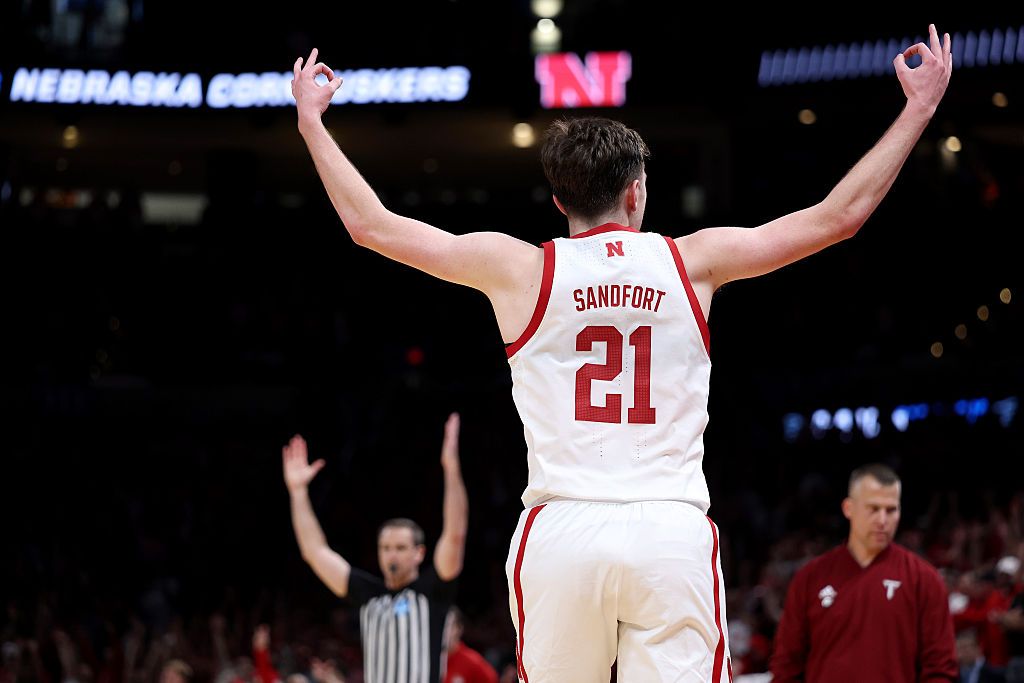
Nebraska and Vanderbilt arrive here wearing different kinds of danger. Vanderbilt has the flashier silhouette—the SEC offense, the live-wire guards, the feeling that a seven-minute heater can turn the floor into a downhill runway. Nebraska feels heavier than that. The Huskers just authored the first NCAA tournament win in program history with a 76-47 dismantling of Troy, and they did it with the exact sort of March composure that tends to matter one game later: 20 assists, six turnovers, and a defense that never let the game get loose. Vanderbilt got here too, but its path looked different—more shotmaking, more volatility, more reliance on guards creating offense on demand. That contrast is the whole game. Below is my preview, prediction, and pick for today’s March Madness college basketball game between the Nebraska Cornhuskers and the Vanderbilt Commodores.
Here’s how I’ll play it. I’ll be pumping out these predictions for individual games all season, with plenty of coverage here on DraftKings Network. Follow my handle @dansby_edits for more betting plays.
Nebraska vs. Vanderbilt prediction, preview
The team math starts with just how different these two profiles are. Vanderbilt is scoring 86.1 points per game and has piled up 3,014 points in 35 games, with a 47.6% field-goal mark, 37.4 made baskets per night, 15.4 assists, 8.5 threes, and a 79.1% free-throw clip on 18.7 makes per game. The Commodores are not living on one lane either: Tyler Tanner, Duke Miles, Tyler Nickel, Devin McGlockton, Jalen Washington, and AK Okereke all average at least 8.6 points, and the team is 27-8 overall with a 6-1 neutral-floor record. Nebraska’s counter is more surgical. The Huskers are 27-6, allow only 65.6 points per game, rank among the national leaders in scoring defense, hold opponents to 40.1% shooting and 29.9% from three, and give up only 14.5 opponent free-throw attempts per game. They also defend without donating possessions: 12.6 opponent turnovers forced per game, 11.6 opponent assists allowed, and one of the best foul-avoidance profiles in the field. Offensively, Nebraska is cleaner by structure than raw volume suggests—77.2 points per game, 18.0 assists, only 9.6 turnovers, a 1.87 assist-to-turnover ratio, and 351 made threes, which set a school record. The Huskers have hit double-digit threes in 22 games and are 18-4 when they do, while their top four scorers combine for 53.4 points a night. In a game sitting around one possession, that blend of elite ball security, spacing volume, and shot suppression is a real identity edge.
The player layer gets scary because Vanderbilt’s guard room can make this feel fast in a hurry. Tanner is averaging 19.3 points, 5.1 assists, 4.2 rebounds, and 2.3 steals while shooting 48.8% from the field, 37.3% from three, and 86.1% at the line. Miles gives them another creator at 16.4 points, 3.4 rebounds, and 2.6 assists with 89.8% free-throw shooting, while Nickel has supplied 13.4 points per game and 105 made threes at 39.9%. McGlockton adds 11.9 points and 7.9 rebounds on 62.7% shooting, and Washington is at 10.4 points on 61.3% from the floor, so Vanderbilt’s perimeter juice is backed by real interior efficiency. Nebraska answers with a different kind of pressure. Pryce Sandfort is at 17.8 points per game and just opened the tournament with 23 points and seven threes against Troy. Rienk Mast gives Nebraska a 6-foot-10 offensive connector at 13.5 points, 5.8 rebounds, and 2.9 assists, Braden Frager adds 11.6 points and secondary spacing, and Jamarques Lawrence helps round out that top-four scoring core that clears 53 points per night. The important distinction is functional, not decorative: Vanderbilt’s offense is guard-led and can win with bursts, but Nebraska can survive a colder stretch because it has a passing big, multiple shooters, and an offense that just produced 20 assists on 28 made field goals in the opener. That is why Nebraska does not need one guy to win a duel; it can win by making the game feel connected for 40 minutes.
Vanderbilt vs. Nebraska pick, best bet
Against McNeese in the opener, the Commodores shot 51.0% from the field and got 26 points, seven rebounds, and five assists from Tyler Tanner, while Devin McGlockton went a perfect 6-for-6 from the floor with 12 points and eight boards. In the SEC tournament, Vanderbilt beat Florida 91-74, its first win over an AP top-five team since 2012 and its largest-ever margin over a top-five opponent, then got 25 points from Tanner in the title-game loss to Arkansas. Tanner finished the regular season and tournament stretch as a true engine, while Duke Miles and Tanner also climbed into Vanderbilt’s single-season steals record book, sitting first and fourth all-time, respectively, entering this game. But that is exactly where Nebraska’s profile becomes attractive rather than scary.
Vanderbilt’s biggest spikes have come when the game loosens—shotmaking jumps, transition leaks open, turnovers turn into runouts, or the whistle starts feeding the guards. Nebraska is built to thin out each of those lanes. The Huskers just put up 20 assists against six turnovers in the Troy win, own one of the best assist-to-turnover ratios in the country, average only 9.64 turnovers per game, and turned their opener into a 17-5 edge in points off turnovers, a 26-10 edge in points in the paint, and a 19-3 second-chance edge. So the real refutation is not that Vanderbilt lacks ceiling—it clearly has it. It is that Nebraska is much less likely than McNeese or Florida to hand Vanderbilt the kind of loose-possession, whistle-friendly environment that has powered the Commodores’ best recent stretches.
Nebraska’s current version looks settled. The opener against Troy was not just a blowout; it was an adult performance from a team that never lost its shape and never let the moment speed it up. Vanderbilt’s current version is more combustible in both directions. That is not a criticism—it is part of what makes the Commodores dangerous—but it does mean their best stretches tend to come when the game is being played on emotion and pace and guard improvisation. Nebraska’s roster balance offers a different translation. Better foul discipline means fewer free points. Better assist structure means fewer empty possessions. A sturdier second-half defensive profile means the game has more chances to tighten around Nebraska’s habits if the first 10 minutes do not decide it. In March, that kind of order often ages better than a team asking its guards to keep painting over thin possessions.
The bet is Nebraska moneyline. The market hanging this game in the Vanderbilt -1.5 to -2.5 neighborhood is exactly why the ML is the right shape instead of trying to get cute with a spread. Nebraska has the cleaner possession ecosystem, the better defensive floor, and the more reliable whistle profile. Vanderbilt can absolutely win if Tanner and Miles turn this into a guard-creation exam and the Commodores live at the stripe, but the more repeatable 40-minute script still belongs to the Huskers. The way it dies is Vanderbilt getting downhill early enough to play from in front and letting its guards dictate the terms, but all signs still point to Nebraska being the steadier side in the possessions that matter most. Nebraska 74, Vanderbilt 71.
Best bet: Nebraska (+100) vs. Vanderbilt
Tail it with me in the DKN Betting Group here!
I’ve included this play in a parlay I’ve posted here in The CBB Board, the betting group where you can find DKN Analyst plays each and every day. It’s free. You just join and tail bets directly from your DraftKings app and get byte-sized analysis (< 1000 characters!) from myself and my colleagues. I encourage you to check it out.