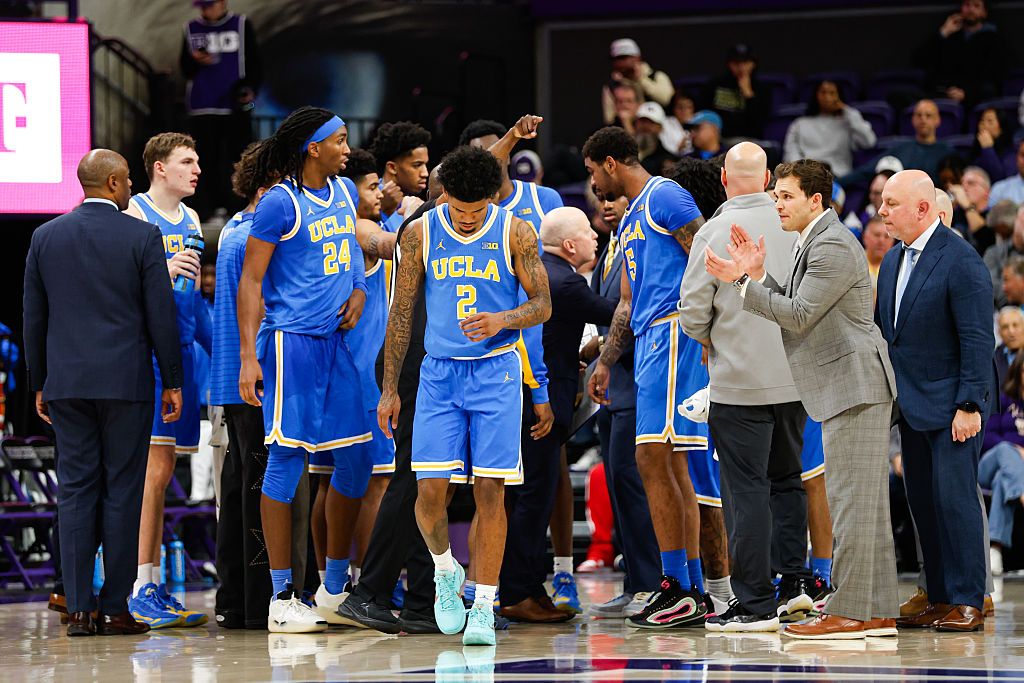
UCLA walks in at 23-11 after winning five of its last six before the Big Ten semifinal loss to Purdue, and the Bruins still profile like the cleaner tournament team even with the seed line flattening the difference. UCF is 21-11 and fully credible out of the Big 12, but its path here looks narrower. This game is really about whether the Knights can turn it into a rebounding-and-extra-possession fight before UCLA’s steadier possession game settles over the floor. Below is my preview, prediction, and pick for today’s March Madness college basketball game between the UCLA Bruins and the UCF Knights.
Here’s how I’ll play it. I’ll be pumping out these predictions for individual games all season, with plenty of coverage here on DraftKings Network. Follow my handle @dansby_edits for more betting plays.
UCLA vs. UCF prediction, preview
The Bruins have been playing the cleaner version of March basketball for weeks now. On the season they average just 8.9 turnovers per game, score 37.2 first-half points, and allow only 33.0 before the break, which is exactly the kind of early control profile that travels into a 7-10 game. More important, the recent form supports the season line instead of fighting it. Over UCLA’s last five games, the Bruins turned it over only 47 times total—9.4 per game—while going 4-1 with wins over USC, Nebraska, Rutgers, and Michigan State before the six-point loss to Purdue. UCF’s recent run has felt much less stable: 86 against Baylor, 104 in overtime against Oklahoma State, then 62 at West Virginia, 66 in overtime against Cincinnati, and 59 against Arizona. They’re oscillating between explosive and stuck, and the stuck versions have shown up against the exact kind of structured opponents who do not hand over cheap possessions willy-nilly.
UCLA’s last five produced 113 made field goals on 254 attempts, 44 made threes on 126 attempts, and 58 made free throws on 73 attempts. Even with the shooting swinging game to game, the floor held because the turnover math never really broke. Baylor held the Knights to 28 rebounds, West Virginia limited them to eight assists, Cincinnati forced a season-high 19 turnovers, and Arizona held them to only three made threes in the Big 12 tournament loss. That is the real recent-form angle here. UCLA’s offense has been sturdy even when the jumper cools; UCF’s offense has looked more vulnerable lately when an opponent keeps the game clean, shrinks the transition windows, and makes the Knights score through repeated half-court possessions.
Tyler Bilodeau is still the cleanest scorer in the game, but Donovan Dent is the player who makes UCLA feel built for this spot. Dent is at 7.5 assists per game on the season, fourth nationally at that moment, and over a recent four-game stretch he piled up 46 assists against only two turnovers. That is absurd control. It also fits what the eye test has been showing: Dent’s first triple-double in Big Ten tournament history against Rutgers was was a reminder that UCLA’s lead guard can run a tense tournament possession in multiple ways without giving the game away. Bilodeau gives the Bruins the efficient frontcourt scoring they need next to that. UCF absolutely has real counters—Themus Fulks is a legitimate organizer, Riley Kugel can get hot, and Jamichael Stillwell remains the matchup lever—but the recent player math still says UCLA’s top-end creators are functioning in a cleaner ecosystem.
UCF vs. UCLA pick, best bet
UCF has the one leverage point that can make a favorite-side ticket feel flimsy in a hurry. Jamichael Stillwell just posted 17 points and 15 rebounds against Cincinnati, UCF is 18-1 when it wins the rebounding battle, and UCLA’s most relevant recent warning came in the 73-66 loss to Purdue, when the Bruins got beat 17-9 in second-chance points. That is the whole upset script. If the Knights turn this into a glass war, steal six to eight extra shots, and keep UCLA from cashing in its ball-security edge, the number gets tight fast. But the refutation is that UCF’s recent offense has been much shakier once opponents force repeated half-court execution. The Knights have gone 86 against Baylor and 104 in overtime against Oklahoma State, but also 62 at West Virginia, 66 in overtime against Cincinnati, and 59 against Arizona over their last five. Cincinnati finished with 19 turnovers in that UCF win, and Arizona then held the Knights to 59 in the Big 12 quarterfinals. UCLA has been the steadier team trip to trip, and that matters more than UCF’s one loud lever.
UCLA had won five of six before the Purdue loss, including the Big Ten tournament win over Rutgers where Donovan Dent recorded the first triple-double in Big Ten tournament history. Even in the Purdue defeat, the Bruins stayed structurally sound enough to hang around late. UCF, by contrast, arrives off a much bumpier close: a one-point overtime escape against Cincinnati, a 15-point loss at West Virginia, and then the 81-59 loss to Arizona. The health angle helps the Bruins too. Bilodeau and Dent both entered this window expected to be available, which keeps UCLA’s scoring-and-organization spine intact. UCF’s path needs frontcourt pressure and full-strength size, so any uncertainty around John Bol matters more on this side of the matchup.
That is why the bet still lands on UCLA -5.5. The Bruins have the cleaner recent form, the more stable backcourt, and the better possession profile for a tournament game like this. UCF absolutely has a cover path through offensive rebounding and second chances, but it feels too narrow to trust against a team that rarely gives games away. The way it dies is UCF winning the glass hard enough to change the shot-count math, but all signs still point to UCLA being the side with more ways to control the game on purpose.
Final score: UCLA 76, UCF 68.
Best bet: UCLA -5.5 (-110) vs. UCF
Tail it with me in the DKN Betting Group here!
I’ve included this play in a parlay I’ve posted here in The CBB Board, the betting group where you can find DKN Analyst plays each and every day. It’s free. You just join and tail bets directly from your DraftKings app and get byte-sized analysis (< 1000 characters!) from myself and my colleagues. I encourage you to check it out.