There’s nothing quite like a home run. Not only is it the best thing that a batter can do on a baseball field from a strategic sense, but it’s the best thing to watch and react to as a fan. In short, everyone loves home runs. There’s a reason that the Home Run Derby is the main event of MLB’s All-Star festivities, right? There’s also a reason that home run props are consistently the most popular bets on the DraftKings Sportsbook each and every night of the summer.
Well, it’s not quite that time of year yet, but with Spring Training games now underway and the season just over a month out, it seems like a great opportunity to break down a few home run futures for 2026. There’s several different markets on the DKSB, headlined by home run leader. On top of that, there’s scaling markets for individual home run totals, starting at 35+ and going up in intervals all the way up to 60+.
Let’s dive in and talk about some guys who will be lighting up scoreboards for the next six months.
Home Run Leader: Nick Kurtz (+1000)
There are some obvious red flags with Nick Kurtz’s profile. The soon-to-be 23-year-old ranked in the first percentile of whiff rate in his rookie campaign (35.5%), which translated into a fourth percentile strikeout rate (30.9%). The left-handed Kurtz also struggled immensely with same-handed opponents in 2025, hitting below the Mendoza line in his 153 plate appearances within the split, with an 83 wRC+.
All that said, Kurtz has already smashed 36 long balls in his first 420 at-bats at the MLB level, equipped with 98th percentile bat speed (77.2) and a 98th percentile barrel rate (18.4%). Among players with at least 450 PAs, Kurtz’s .329 ISO sat fourth in baseball, only trailing the likes of Aaron Judge, Cal Raleigh and Shohei Ohtani. It’s hard not to dream on what a full year with the Athletics could bring from a counting stat perspective — especially with 81 games at Sutter Health Park. We now have a whole season of data from the minor league stadium, and while it didn’t quite reach the offensive heights of Coors, Sutter Health ranked second in overall park factor in 2025, according to Baseball Savant. The field in Sacramento was also the sixth-easiest place in the league to hit a home run by the same metrics.
If you prorate Kurtz’s performance from last season over 700 plate appearances, you get 51 home runs. Maybe the rest of the league adjusts to the young slugger, or maybe the former fourth-overall pick takes another step in 2026. It’s all on the table with samples this small. Still, there’s clear upside here. Kurtz is worth a shot at 10/1.
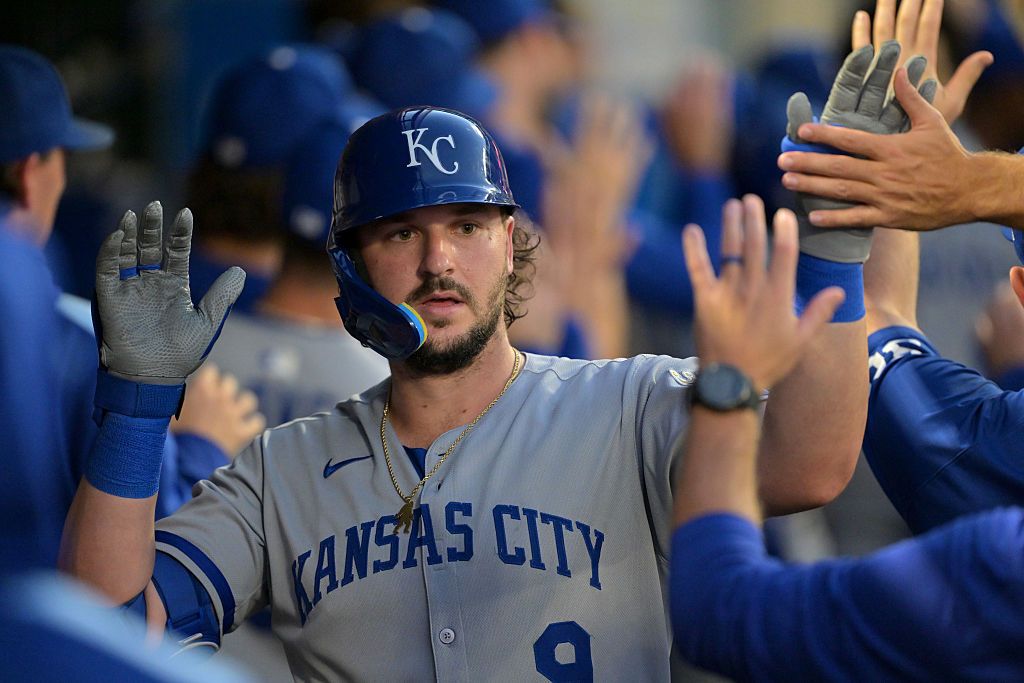
Vinnie Pasquantino 35+ Home Runs (+225)
Before we get into the Kauffman Stadium wall tomfoolery, let’s take a moment to appreciate Vinnie Pasquantino’s numbers from after last year’s All-Star break. In 278 plate appearances, the hulking first baseman hit 17 home runs, registering a .532 slugging percentage and a .280 ISO to close out 2025. Pasquantino also sports a career 13.5% strikeout rate, so unlike the aforementioned Kurtz, there’s no worries about his ability to consistently produce batted ball events — which evens out only slightly above-average marks in expected wOBA (.334) and barrel rate (10.8%).
In no uncertain terms, this is a profile that should dependably be producing 30+ home run outputs in healthy seasons. To that point, Pasquantino hit 32 long balls last year. So, where are the extra three homers coming from to cash this prop? Alright. It’s now time to get into interior design and architecture. By park factors, Kansas City was the fourth-hardest place to hit a home run in 2025. This was not an anomaly, either, as Kauffman’s long been associated with having a spacious outfield. This is why it was big news when Royals GM J.J. Picollo announced that the stadium would undergo some changes heading into 2026. Namely, the fences in left and right field will be coming in by roughly 10 feet, while the wall heights along much of the outfield are coming down by up to 18 inches.
It remains a mystery just how much this will impact home run totals in Missouri next season, but in a similar situation in Baltimore, hitters saw immediate positive results. Also, according to MLB.com’s Mike Petriello and Statcast, an eye-popping 231 batted ball events in Kauffman from 2021 to 2025 would have left the park under these new configurations. Seems like reason for Pasquantino to get excited about 2026, and I’m not the only person who thinks so.
Ben Rice 35+ Home Runs (+350)
I probably don’t need to spend too much time talking about the advantages of being a left-handed power hitter at Yankee Stadium, so let’s just skip right to the part where we discuss the attributes that specifically make Ben Rice an intriguing candidate to surpass the 35 home run plateau.
To be blunt, Rice was an analytics darling throughout 2025. In fact, he finished his first full season in MLB ranking in the 97th percentile in expected wOBA (.394), expected slugging percentage (.557) and hard hit rate (56.1%). His success had nothing to do with being a “short porch merchant” or any other narrative people like to attach to New York hitters. A career 0.93 GB/FB ratio is also promising when projecting forward, especially in comparison to other tantalizing names in this tier of the odds list. Names like Roman Anthony (+400), who despite his obvious skill set, has consistently produced 50% ground ball rates at every level of baseball he’s played the past four seasons.
Rice is entering his age 27 campaign in 2026. Aaron Boone has already stated that the former 12th-round pick will play everyday this upcoming season, whereas platoon availability limited Rice to only 530 plate appearances in 2025. I think a full-time move to first base could be beneficial for Rice, as well. Not only are the physical and mental demands of catching at the MLB level well documented, but, frankly, Rice graded out as one of the worst — if not the worst — backstop in baseball last season. Unburdening himself from that stigma might free Rice up to make the next step in the batter’s box.