Super Bowl week turns music into marquee conversation—both as vehicle-for and topic-of. In Santa Clara, the asphalt around Levi’s Stadium becomes a pop-up commons—coolers and propane, folding tables and aunties, jerseys over hoodies, a whole temporary city built on appetite and anticipation. The broadcast machine loves a clean host-city montage, but the Bay rarely cooperates with corporate-laminated postcard aesthetics. It’s too clamorous for that. Too noisy, determined to be heard.
Indeed—sound is part of the civic record here. The Bay keeps its receipts in rhythm. You can hear eras in the way a kick drum sits, in the brightness of a snare, in the particular swing of a bassline that feels engineered for a trunk rattling at a red light. You can hear neighborhoods in slang, in ad-libs, in the way a hook gets written to survive a parking lot, a cookout, a bus stop, a backyard show. The region’s music doesn’t merely reflect the city; it archives it—its swagger and its anxiety, its contradictions, its hustles, its joy. Bay records have always doubled as dispatches: from Green Day’s East Bay bite to Journey’s arena glow, from Metallica’s thrash thunder to Jefferson Airplane’s Haight haze—a sound that carries news, mood, and posture when the official story of the place is being told elsewhere.
The question of who gets the mic, one might say, no matter the event, carries the same weight as who gets the mural wall. And this year’s best shot—other than Green Day’s billing with Bad Bunny—to showcase local talent? The Super Bowl LX Tailgate Concert.
And, this year, the performer’s impact won’t just linger on the outer walls of the stadium, if he were only a mural. No. He’s much, much bigger than that, already. And he’s headed inside the house, too.
What is the Super Bowl LX Tailgate Concert?
For years, the Super Bowl’s pregame concert lane has operated like a touring pavilion that happens to park in different zip codes. The names change, the sponsor badge changes, the platform changes, and the vibe keeps landing in the same place: polished, camera-ready, geographically blank.
Tampa got Miley Cyrus with rock-and-roll legends framed as a thank-you spectacle. Los Angeles got the Chainsmokers and immediately turned the set into a group chat roast, the internet treating the performance like open-mic night for sarcasm. Phoenix got a split bill built to offend nobody—Jason Derulo and the Black Keys, safe as a press release. Vegas got Gwen Stefani and Blake Shelton, headline-friendly in the way a push notification is headline-friendly. New Orleans got Post Malone once the league slid from TikTok to YouTube, a quiet reminder that these tailgates are also distribution deals wearing concert clothes. Even the older Music Fest weekend template—Miami, with DJ Khaled, Guns N’ Roses, Maroon 5—proved the same instinct: book the biggest possible act, let the host city become backdrop, let the local flavor live in a quick drone shot and a few b-roll cuts of palm trees.
But, like a good grassroots campaign, pregame music lives on momentum. When it works, it feels like a fuse. When it misses, it feels like branded filler—an impeccably lit holding pattern of sonic corporate husks lip-syncing their calcified singles while the only real music of the night—the halftime show—loads. The NFL and its fans are tired of misses.
This year, it seems the event is trying to solve the flub problem by emphasizing sense-of-place. Place, after all, is the whole religion of football: stadiums as cathedrals, traditions as inheritance, fan bases guarding their neighborhoods like sacred ground. The best NFL Sundays are built on geographic specificity—the weather, the ritual, the way a region hears itself in the noise.
The Bay, especially, demands that specific recognition from and in its music. Bay Area rap has never floated above geography; it drags the streets into the speakers, turns slang into rhythm, turns community into percussion.
That’s the runway for LaRussell. And if you’re meeting him for the first time, the easiest way in is to understand him as movement: a Vallejo operator who built his career like a rolling street festival, then walked it straight into the NFL’s most fortified weekend—arriving with an accent you can’t sand down and a crowd you can’t fake.
LaRussell: Background, music, & how he moves
LaRussell’s presence on Sunday reads like a genuine rebalancing of the Super Bowl’s cultural circuitry because the NFL didn’t just book a local opener and call it representation. They handed him two levers on the day, and both of them shape the temperature. For anyone coming in cold: LaRussell is a Vallejo rapper and self-built impresario who climbed by turning proximity into a business model and community into a venue. Before the league ever said his name, he was staging backyard shows at home—literal block-level concerts where family, neighbors, kids on bikes, and out-of-towners packed in close—then posting the footage like proof of work, the kind of evidence that says, “This isn’t hype; this is turnout.” He wrapped that ethic in Good Compenny, a banner for the whole approach: build your own room, keep the door open, let the audience feel like participants rather than spectators.
He’s pushed independence with actual mechanics and models, too—or, at the very least, a creative force of purpose. He ran a pay-what-you-want album drop through Even with a public, audacious sales goal that turned every purchase into a vote, then watched the story catch fire when legendary Dallas Mavericks guard Kyrie Irving threw down $11,001 and Snoop Dogg put up $2,500, big-number endorsements of the idea that the artist can set the terms and still scale. That’s the pedigree the Super Bowl is tapping. All the best Vallejo artists—E-40 (one of LaRussell’s earliest collaborators), Mac Dre, Mac Mall, B-Legit—have always understood that talent alone doesn’t protect you; infrastructure and community and family do. LaRussell is no different. Inherent in his Vallejo ambition is the blueprint for bringing people along.
LaRussell’s music
The music explains why this Super Bowl assignment fits, because LaRussell’s records already sound like event management. They’re built with an instinct for crowd physics—how a room warms up, how a moment turns, how energy moves from one pocket of people to another until it becomes shared. Even the way his most-streamed songs present themselves feels like Bay Area shorthand: titles that double as instructions, as questions shouted across a parking lot, as the kind of language you hear before you ever hear a melody. They read like quick vocabulary words for a region that likes its music social, its hooks usable, its rhythm sturdy enough to hold a whole afternoon.
“Again,” the big one with E-40, shows the blueprint: it moves bodies first and explains itself later, bass hitting like a friendly shove and drums snapping with that bright Northern California sheen, the hook built for real Bay Area call-and-response—half-singing, half-laughing, ad-libbing the chorus into a shared joke—while E-40’s presence feels like a Vallejo handoff, elder-state authority blessing new motion without turning anything into a museum piece. “I Might Be” shifts the temperature, gliding through the lulls with melody that hangs like grill smoke and a voice sitting deep in the pocket, conversational and unbothered, the kind of confidence that doesn’t need to raise its volume to take over a room. “WHAT WE DOIN!?” is tailgate-coded as a rallying cry, a question that’s really a cue—quick-cut energy, sharp angles, allergic to dead air—perfect for the moment the lot stops being “arriving” and becomes a block party with logistics. And “10s, 20s, 50s, 100s” turns counting into percussion, stacking cadence the way a great DJ stacks transitions, numbers as drumline and repetition as groove, a very Bay Area trick of turning everyday language into musical infrastructure while the song keeps dancing.
The larger point is that none of this music is trying to be placeless. LaRussell doesn’t sand off the regional edges to chase a generic “national” sound. He leans into the swing. He leans into the slang. He leans into that particular Bay Area balance of toughness and humor, bravado and warmth—music that can sound like a celebration and a neighborhood update in the same breath. You hear it in the way the bassline walks, in the way the hooks are written for people standing near each other, in the way the songs assume an audience that talks back. That’s the spine of Bay Area rap at its best, from Mac Dre to Too $hort: the voice sounds like where it comes from, and the crowd becomes part of the record while it’s playing.
That’s also exactly what the Super Bowl has so often flattened in the sponsor-stream era. Pregame music tends to arrive like a touring product: camera-ready, platform-native, safe enough to drop into any city without changing a single thing. LaRussell’s sound resists that whole idea. It insists that the host region has an accent worth hearing—not as a montage over aerial shots, but as the music itself. And that’s why he’s such an inspired choice for the house voice job, too. Those go-to-break moments are where an event can feel either alive or corporate. Give that responsibility to someone whose records are designed to hold a crowd—designed for transitions, designed for participation—and suddenly the Super Bowl starts sounding like it understands where it is.
It didn’t come without relentless grassroots work.
Nailing the Super Bowl LX Tailgate bid
First, the story started circulating the way modern music stories do: a photo of LaRussell with Jay-Z—one of the most powerful taste-makers in American pop—hit the internet and kicked the rumor mill into gear. The reason that mattered is that Jay-Z’s company, Roc Nation, has been plugged into the league’s entertainment ecosystem for years, so a single image read like a smoke signal: this Bay Area groundswell had drifted into the Super Bowl’s inner orbit.
On Christmas Day, LaRussell lit the fuse by posting a performance of “I’m From the Bay” backed by the Pittsburg High School Marching Show Band. He tagged it with a chant-ready caption: “LaRussell for Super Bowl 2026.”
Then he kept returning to the idea—posting, performing, rallying, letting the ask live in plain sight until it started to feel less like a Fellini film fever dream on social, and more like a movement with a deadline. Even that choice—the marching band, the civic cadence, the community feel—telegraphs the roots: schoolyards, local pride, Bay Area culture as something you build together, not something you outsource.
LaRussell understands that Northern California doesn’t rally around polish; it rallies around people who show their work. That’s the key rhythm in his career: he makes the pitch audible, then he builds enough momentum around it that the institution has to decide whether it wants to be part of the story or get dragged by it.
On Wednesday, January 28, 2026, the news arrived with real fanfare—rolled out as a joint NFL/Roc Nation social drop, a short Instagram video staged right outside Levi’s Stadium, with Collab Choir singing the announcement into the cold air like it was already a chorus. LaRussell isn’t framed as a cameo in that clip; he’s framed as a host: opening the Super Bowl LX Tailgate Concert for Teddy Swims, and also taking the in-game assignment that matters to anyone who’s ever felt a stadium go flat—the live “house band” role that scores the timeouts, the commercial breaks, the connective tissue of Super Bowl Sunday.
After the announcement that he’d be opening the Super Bowl LX Tailgate Concert for Teddy Swims—and handling the in-stadium music role during the breaks—LaRussell went to The Breakfast Club, the kind of nationally syndicated hip-hop platform where career turns get put on the record. There, he confirmed the next step behind the scenes: he’d signed with Roc Nation. He talked about it like a scaling move, not a makeover—more reach, more infrastructure, more doors opened—while keeping the parts that define independence, his ownership and creative control, tight in his own hands. He’s said he previously turned down an offer from Def Jam Recordings, and he’d already operated within the industry on limited terms through a project arrangement with EMPIRE. Put all of that together and the arc reads clean: he doesn’t get swept along by momentum; he manufactures it, then negotiates from the position he created—arriving at the biggest stage in American sports with his Bay Area accent and his leverage intact.
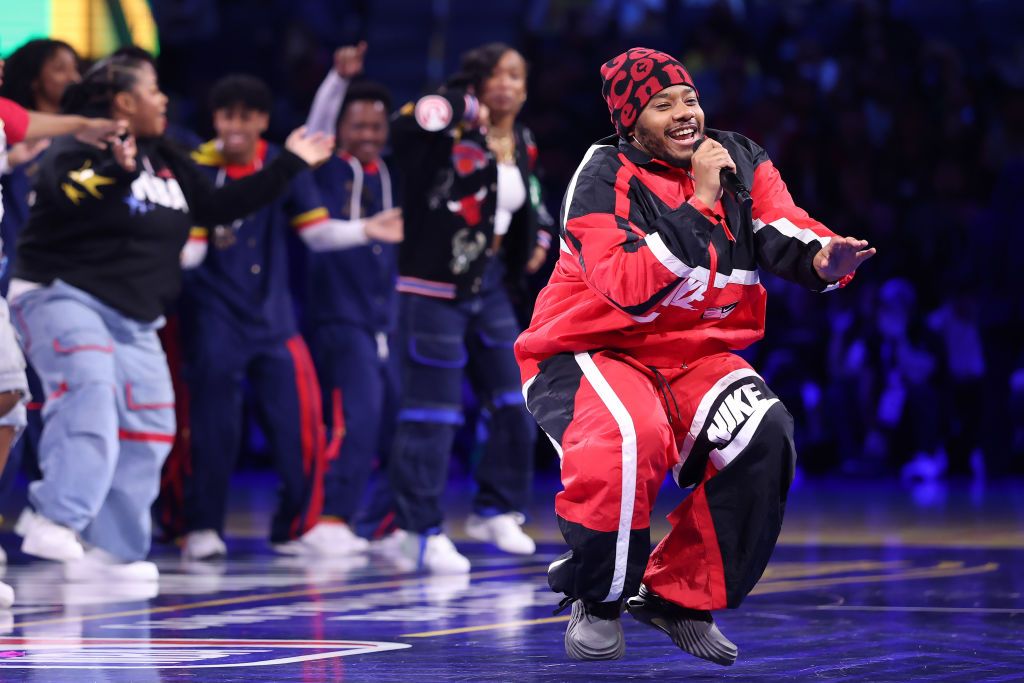
Oh! And he’s done the league-weekend thing here before, too—showing up during NBA All-Star in San Francisco to introduce Rising Stars (seen in this piece’s featured image), then surfacing all weekend in the city’s pop-ups and side rooms, already practicing the art of sounding like the host city on the host city’s biggest stage.
How to watch LaRussell on Super Bowl Sunday
First, he opens the Super Bowl LX Tailgate Concert outside Levi’s Stadium—an on-ramp to kickoff, streamed on Peacock, built for the whole country to tune in before the game even breathes—exactly the kind of threshold moment he’s been scoring for years, where a crowd is still arriving in waves and the day is still deciding what it wants to be. Then he walks inside as the house band voice, controlling the go-to-break sound and the between-the-whistles oxygen: timeouts, commercial breaks, the seams where stadium audio usually turns into anonymous noise. In the Bay, those seams matter; the region’s rap has always been designed for transition and release, for call-and-response, for basslines that carry a neighborhood’s posture without needing subtitles.
Put that sensibility in charge of the pauses and you get something rare: a Super Bowl that sounds like where it’s being played, and an artist whose entire history is about gathering now entrusted with the in-between moments that decide whether an event feels alive.
Super Bowl LX Tailgate Concert FAQ:
How can I watch the Super Bowl LX Tailgate Concert?
You can watch the Super Bowl LX Tailgate Concert live on Sunday, February 8, 2026 at 3:50 p.m. ET via Peacock.
Who is performing at the pregame Super Bowl LX Tailgate concert?
Teddy Swims is the headliner, and LaRussell is the opening act.
Who is LaRussell?
LaRussell is an independent Bay Area rapper from Vallejo who built his following the hard way: backyard performances, pop-up energy, and a community-first approach that treats the audience like collaborators, not just consumers.
Will the Tailgate be featuring any surprise guests/artists?
Nothing official has been announced. As of now, the public lineup is LaRussell opening and Teddy Swims headlining. If the NFL does spring a guest, it would likely be unannounced and day-of, but there’s no confirmed “surprise guest” list out there.