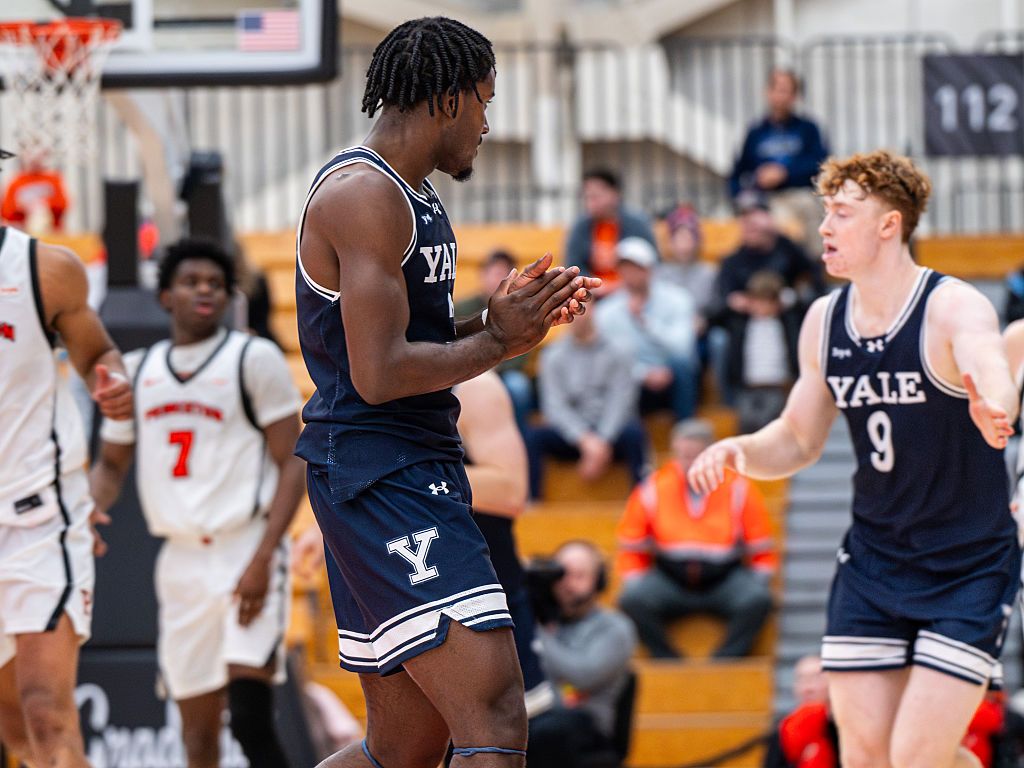
Noon at the Palestra is its own religion, and Penn needs every hymn it can get. Yale rolls in at 14–3 and 3–1 in the Ivy, on a two-game win streak, trying to keep the top of the league within arm’s reach. Penn sits 9–8 and 2–2, with a road-heavy early conference slate already behind it, and this is the kind of home-floor day that can bend an Ivy season back into shape. The market is telling you Yale is the better team, but it’s also warning you about the style: -7.5 in a high-three environment is never “safe.” The total at 158.5 is a statement too, because these aren’t timid offenses, and both teams are willing to let threes decide the mood. This game is going to feel fast, and it’s going to feel volatile. Below is my preview, prediction, and pick for tonight’s college basketball game between the Pennsylvania Quakers and the Yale Bulldogs.
Here’s how I’ll play it. I’ll be pumping out these predictions for individual games all season, with plenty of coverage here on DraftKings Network. Follow my handle @dansby_edits for more betting plays.
Penn vs. Yale prediction, preview
The math backs that up before we even get cute. The possession expectation lives around 69–70 trips, with Yale at 71.0 possessions per game and Penn at 68.7. Yale’s offense is humming at 1.195 points per possession, and Penn’s is still strong at 1.151, which is why a 158.5 total isn’t lunacy. The shot quality is premium on both sides, with Yale at a 60.3% eFG and Penn at 57.0%, and both teams are living off their perimeter skill. Yale gets 44.8% of its points from three, and Penn is even more three-driven at 47.9%. That’s why the volatility tag is high, and it’s why a two-minute stretch can decide the whole spread. The separation lane, though, is cleaner than variance. Yale protects the ball at a different level, with only 14.0% turnovers per play, while Penn sits at 18.0%, and that’s the easiest way for a road favorite to create margin without needing a shooting avalanche.
Yale’s offense is built like a machine that keeps producing good looks. The assist quality is elite, at a 1.745 assist-to-turnover ratio, and the ball security is national-level at 9.1 turnovers per game. That’s how a team travels. Yale’s shooting numbers are obscene in the way that changes a handicap. It’s first nationally at 41.4% from three, and it pairs that with 56.8% eFG and 49.5% from the field. When you get that blend with a top-12 AST/TO, you don’t need hero shots. You just need normal possessions. And Yale’s free-throw shape supports late-game scoring too, with 77.7% at the line and 22.1 attempts per game, which matters in a spread game where the last four minutes can turn into a parade.
Penn’s offense has a very real “keep it close” identity, but it’s narrower and more fragile. The upside is clear: Penn shoots 39.8% from three, seventh nationally, and in Ivy play it has been the best three-point shooting team in the league at 39.7% on 27-of-68. Penn also lives in the foul-drawing lane, leading the Ivy at 23.5 free-throw attempts per game, with Yale right behind at 21.4, so there are real “free points” pathways for both teams to keep scoring even through cold stretches. Penn’s rebound shape is also live, because it’s +5.5 in rebounding margin in Ivy games, best in the league, and its season ORB% is 31.8%. That’s exactly how underdogs hang around in a game where the favorite wants clean possessions. The glaring weakness is inside, because Penn’s two-point percentage is 46.2%, which sits near the bottom nationally, and that’s a problem when the threes don’t fall.
The roster story makes those identities feel more human. Yale has multiple shot-makers who are not shy. Nick Townsend is a certified flame-thrower, at 53.6% from three on 30-of-56, and he’s also a clean free-throw scorer at 79.3%. Riley Fox sits at 40.0% from three with excellent finishing efficiency, and Isaac Celiscar is a paint finisher at 59.3% from the field with 83.6% at the stripe. Yale’s entire rotation is built on “good shot, good shot, good shot,” and even the lower-efficiency shooters like Trevor Mullin can still space the floor at 36.5% from deep.
Penn’s entire offense, meanwhile, is anchored by one true alpha. Ethan Roberts is averaging 20.1 points per game, framed as the Ivy’s best scorer, and he’s even louder in league play at 24.8 per game. That’s the kind of half-court gravity that keeps a home dog alive. TJ Power is the second accelerant at 14.8 per game, and he’s been scorching in Ivy games, hitting 53.8% from three, with a 27-point pop at Dartmouth as a recent reminder. Those two can make any spread feel like a trap if the threes are falling.
Yale vs. Penn pick, best bet
The counterargument to Yale -7.5 is simple and dangerous: the backdoor script is always live. Penn is three-heavy by design, it can rebound, and it can live at the line. In a game with this much three-point share, you can play well for thirty-six minutes and still get sniped by “three + foul + three.” Penn has also lost its last six home games against Yale, which adds the psychological edge for the favorite and the emotional edge for the dog, depending on how the first five minutes feel. The refutation is still the same lane that keeps showing up: turnovers. Penn’s 18.0% turnover rate is a landmine against a Yale team that already wins by shot quality and possession efficiency. If Penn starts giving away empty trips, it will be chasing the scoreboard with threes, and that’s how favorites cover through variance.
The betting paragraph is where the whole thing clarifies. -7.5 is brittle because of the three-point environment, and the total is high because both teams can score and both teams can earn free throws. The total has multiple independent supports: pace is not slow, both offenses are efficient, both teams rely heavily on threes, and the free-throw lane is real for both sides. The fragility is also obvious: a cold stretch from deep can stall a big number even with tempo. So I’m leaning to the side, not the total, because Yale’s edge is more repeatable. Yale is the cleaner team, with elite ball security, elite shooting, and a free-throw profile that can close games without drama. Penn can absolutely keep this tight if Roberts detonates and the offensive glass wins them extra possessions, but that plan is still living with the turnover risk that Yale can punish into margin.
I’m taking Yale -7.5, and I’m sizing it like a high-volatility game because the late backdoor is real. Yale should win the possession economy, win the shot-quality war, and cash enough free throws to keep Penn from making one run feel final. Penn should fight on the glass, lean into Roberts’ shot-making, and try to turn the last six minutes into a three-point duel.
I’ve got Yale 86, Penn 77.
Best bet: Yale -7.5 (-110) at Penn
Tail it with me in the DKN Betting Group here!