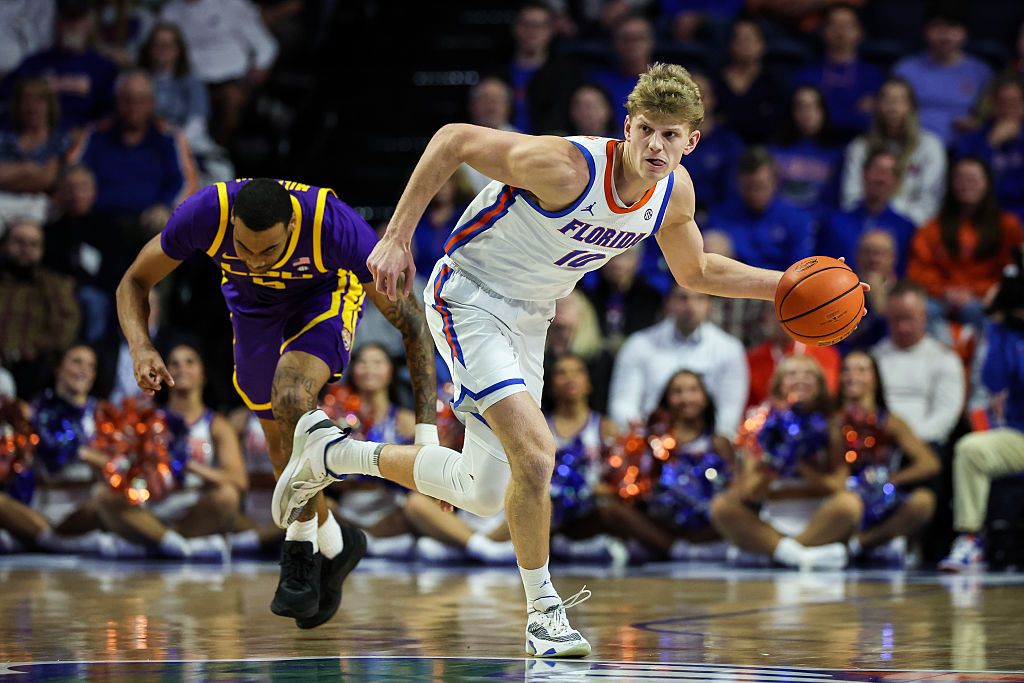
Gainesville is acting like a proving ground again, not just a stop on the SEC loop. Florida is riding a heater that’s turned confidence into consequence, and the market is reacting. The number opened Florida -9.5 and has climbed to -11.5, with the moneyline stretching from -500 to -610. The total opened 162.5 and is now 163.5, because nobody is pricing a crawl here. Auburn arrives with real quality, but this spot asks it to survive a full-throttle home script. Below is my preview, prediction, and pick for tonight’s college basketball game between the Florida Gators and the Auburn Tigers.
Here’s how I’ll play it. I’ll be pumping out these predictions for individual games all season, with plenty of coverage here on DraftKings Network. Follow my handle @dansby_edits for more betting plays.
Florida vs. Auburn prediction, preview
The math says this game wants possessions, not patience. Auburn plays at 72.3 possessions per game and Florida sits at 72.1. Florida is scoring 1.17 points per possession, while Auburn is at 1.07, and that gap matters in a game this fast. Auburn’s defense is sturdier than the pace implies at 0.96 points allowed per possession, while Florida allows 0.99, so neither side is toothless. The shot-quality lane is close, with Auburn at 52.5% eFG and Florida at 53.9%, but the free-points lane is not. Florida’s free-throw attempt rate is 36.6% per play, which is an engine, not a garnish. Auburn’s is 19.5% per play, meaning it can’t count on the stripe to keep up every night. The glass is a volume amplifier for Florida too, with a 34.0% offensive rebounding rate against Auburn’s 32.7%. When a home favorite can stack free throws and extra shots, margin builds without needing a perfect shooting night.
This is also a possession-quality game, and the turnover lane is where Auburn can still flip the math. Auburn forces turnovers on 16.3% of opponent plays, and that’s the one clean way to steal points in a road gym. Florida’s turnover profile is more ordinary, forcing takeaways on 14.4% of opponent plays. Auburn also suppresses opponent three volume, allowing just 28.6% opponent 3PA per play, which is a real way to cap runs. Florida, by contrast, lives in a higher-three environment, taking threes on 36.8% of plays and allowing opponents to take them on 36.2%. That creates more scoring branches, which is why 163.5 isn’t a typo. The venue splits make the pressure louder. Florida is scoring 94.1 per game at home while allowing 67.3, with 49.1% shooting and 45.5 rebounds per game. Auburn away is 75.6 scored and 74.1 allowed, with 34.5 rebounds, which is not the same defensive profile.
Florida’s heater feels real because the pieces fit together like a functioning machine, not a highlight reel. Thomas Haugh (F) isn’t just 17.4 a night in 34.1 minutes; he’s the guy who keeps the possession from dying when the first option gets walled. He plays through contact, lives in the paint-adjacent spaces, and his scoring keeps defenses from loading up on the creators. Rueben Chinyelu (C) at 10.7 boards per game is the tone-setter for why Florida’s 34.0% offensive rebounding rate matters; he turns “good defense” into a second whistle and another shot. Alex Condon (F) is the hinge who makes the tempo playable—3.5 assists and 4.1 free throws made per game is a profile that says “I can connect, and I can punish,” and that’s how Florida keeps pressure on both the rim and the scoreboard. Viktor Mikic (W) carrying a 29.3% usage share gives the offense a real fulcrum; when Florida needs a possession to be organized, it knows whose hands it wants.
Auburn’s answers are more confrontational than elegant, and that’s why they can survive in these environments. Keyshawn Hall (F) at 20.1 points with 86.6% at the line is Auburn’s lifeline when jumpers look flat; he can keep the game from running away just by drawing contact and cashing it. Tahaad Pettiford (G) is the volatility switch—13.9 points with 27.0% from three on 122 attempts means the shot can betray Auburn, but it can also detonate a three-minute stretch and flip the whole script. KeShawn Murphy (F) at 10.5 and 6.5 on 57.9% shooting is the stabilizer inside, the guy who can finish what Hall and Pettiford create without needing touches to be pretty. Filip Jovic (C) is the dirty-work engine—67.1% from the field and 45 offensive boards—because his rebounds are the kind that turn a stop into a foul, and a foul into margin pressure. That’s the ecosystem: Florida wins by stacking free throws and extra shots until the opponent’s legs go, and Auburn fights it by forcing chaos, shrinking three volume, and getting enough line points to stay attached.
Auburn vs. Florida pick, best bet
The Auburn case still deserves respect, because the matchup isn’t a simple talent gap. Auburn’s defense is allowing just 39.1% opponent shooting and 29.3% opponent threes in the season box profile, and that’s real resistance. Auburn can also win the chaos branch with steals and blocks, sitting at 7.7 steals and 4.7 blocks per game. Florida’s recent defense has leaked a bit, allowing 76.0 per game over the last three with opponents shooting 48.3% overall. If Auburn keeps turnovers near its season 14.1% rate and wins a short stretch from three, +11.5 can hang around. The refutation is that Florida’s home scoring output is a different animal, and the free-throw profile is a silent separator. Florida’s 36.6% FTA per play means it can score when shots look ugly. Auburn’s road split also shows the defense bending, and that’s a bad combo at this pace.
The market moved toward Florida for a reason, from -9.5 to -11.5, and the moneyline stretched from -500 to -610. The power ratings match it, with Florida ranked seventh and Auburn twenty-eighth, and Florida’s home rating at 88.0 versus Auburn’s away rating at 72.6. A projection that lands around Florida 94, Auburn 83 fits the game’s pace and the 163.5 scoring environment. This spread is still a big ask, because threes and late fouls always keep backdoors alive. But Florida’s cover path is built on repeatable volume: rebounds, free throws, and a home offense that keeps piling possessions.
Florida should lean into tempo and paint pressure early, because the free-throw attempt rate is the cleanest scoring floor. That plan fits because Florida is generating trips at 36.6% per play and crashing at 34.0% on the offensive glass. Auburn should try to keep Florida out of that rhythm by shrinking possessions with ball security and forcing halfcourt reps. That plan fits because Auburn suppresses opponent three volume and forces turnovers on 16.3% of plays. The problem is that Florida’s home split suggests it can still reach the mid-nineties without a three-point avalanche. If the whistle shows up and the glass tilts even slightly, the margin can grow in steady increments.
I’m taking Florida -11.5, with Florida 94, Auburn 82.
Best bet: Florida -11.5 (-110) vs. Auburn
Tail it with me in the DKN Betting Group here!