Selection Sunday finally feels big again. And messy! For the first time, the College Football Playoff is handing out 12 invitations instead of four, and the sport wakes up knowing there are more chairs than ever and still not nearly enough. Conference championship banners are barely dry, flights are booked but not yet announced, and every locker room with a pulse is refreshing the same bracket graphic in their heads. The committee is not just picking a field; it is drawing the map for a brand-new postseason ecosystem, with on-campus games, byes for bluebloods, and genuine paths for programs that used to live on the fringes.
The top of the board feels almost civilized. Indiana, Georgia and Texas Tech did what January teams are supposed to do, stacking league titles on strong regular seasons and making the bye conversation a debate about ordering, not eligibility. Ohio State is the rare heavyweight that can lose on Saturday and still look and feel like a title threat on Sunday. Oregon and Ole Miss are waiting in that next tier, not asking if they’re in, only how far the committee wants to send people to play them.
Everything else is pure argument. The ACC woke up to its doomsday scenario, with Duke’s upset throwing the league champion out of the ranking neighborhood where auto-bids actually live. Miami has a head-to-head win over Notre Dame and a conference office openly stumping for its inclusion, yet the Irish have lived in front of the Hurricanes in every public ranking so far. Texas has three losses but as many elite wins as anyone on the bubble. Alabama has three losses and a coach insisting that an ugly night in Atlanta should not erase three months of work.
Then there’s the new blood that makes this format sing and sting at the same time. Tulane and James Madison turned league titles into real playoff leverage, pushing themselves toward locked-in auto-bids and shoving brands like BYU and Vanderbilt into the sweat zone. Somewhere, players who spent August being told they were “Group of Five” are packing for a postseason that runs through actual playoff brackets, not consolation bowls. Somewhere else, a top-15 roster is about to find out that in a twelve-team world, there is still a thirteenth team.
That’s the temperature walking into the show. At the top, it’s about seeding and paths; in the middle, it’s about matchups and travel; on the line, it’s about identity and respect. By the end of the day, we’ll have a bracket. Right now, we have something just as volatile: a sport full of teams convinced they belong, and one committee about to explain who actually does.
I’ll roll right into live updates now, and will make sure to provide links to all our rolling Opening Odds articles, so all us sharps can get in on the look-ahead lines.
Chaos time. If you’re interested in more NFL/CFB content, follow my handle @dansby_edits.
Official 2025-26 College Football Playoff bracket — at a glance
As tweeted by Adam Schefter, who figures to be busier with a different league in—oh—minutes’ time!
2025-26 College Football Playoff selection live results
Thoughts on the future of this process
When I zoom out from this bracket, I actually feel pretty good about where the process is headed, even if it just broke a couple of hearts in South Bend and Provo.
On Tulane and JMU, I’m firmly on the side that they should be in, and not as charity cases. They didn’t get in because their conferences needed representation. They got in because the sport agreed to a structure: highest-ranked conference champions are guaranteed access. That’s not a vibes decision; that’s the rule everyone scheduled and recruited under. You can’t sign up for auto-bids in August and then complain in December when they go to someone outside the power leagues. If you hate that, your problem is with the format, not with Tulane or JMU.
I also like that their presence forces discomfort. Notre Dame, BYU, Texas, Vanderbilt—those are real teams who got squeezed because the committee had to honor championships and not just helmets. That’s the point of expansion: you can’t hoard all 12 spots with brands and best-loss arguments. Somebody with a cleaner logo was always going to get left out so a Tulane or JMU could get a shot. To me, that’s a feature, not a bug.
Do I think Tulane and JMU are better than Notre Dame or BYU on a neutral field? Probably not, though I’d go to war for Jonny “Juice” Sumrall (Go Gators!). But I don’t think this bracket is supposed to be a 12-team Vegas power rating. It’s supposed to balance “who’s best” with “who earned it.” Tulane won the American. JMU ripped through the Sun Belt and finished the job. They turned the structure to their advantage.
Going forward, I think that’s the tension we’re going to live with every year: auto-bids versus pure strength, access versus perfection. And I’m fine with that. In a world where Indiana, Ohio State, Georgia and Texas Tech already vacuum up the top four, I want a couple of outsiders walking through the same tunnel, not stuck in another consolation bowl while we argue about whether the ninth-best power-conference team deserved a mulligan.
On teams who spent Conference Championship Weekend on the couch
Biggest couch winner is obviously Miami. The Canes did nothing but still watched every domino fall exactly how they needed. BYU got wrecked, Alabama took a third loss, Duke blew up the ACC auto-bid, and the committee finally needed a way to both honor head-to-head and avoid freezing out an entire power league. Miami’s Week 1 win over Notre Dame aged into a golden ticket while they were in sweats.
Oregon and Ole Miss basically got what they bargained for. Both sat, both already had top-6 resumes, and Saturday was about protecting their ceiling, not climbing. Georgia and Texas Tech winning locked them out of bye territory, but nobody behind them made a wild enough statement to jump them. For idle heavyweights with strong metrics, “nothing changed” is a win.
Texas A&M feels like the couch loser in the top tier. They didn’t play, didn’t add a bad loss, and still watched the room decide their record was a little too clean and their schedule a little too light. They stay above the chaos line, but the committee basically used Saturday to confirm A&M as the best of the non-elite, not a bye candidate.
Oklahoma’s Saturday was pure validation. They were never getting to 5, but they also never looked in danger of dropping out of the top eight. Everyone they needed to behave did just enough, and the committee rewarded the full body of work rather than letting a late surge from someone else steal their home game.
Notre Dame is the cruelest couch story. BYU lost, Alabama lost, and every ND fan woke up thinking “we’re safe.” Instead, the committee used the chaos to solve other problems—boost Alabama on schedule, rescue the ACC with Miami, honor Tulane and JMU as champs—and let the Irish be the one helmet sacrificed. They sat still and watched everyone reframe their resume around a Week 1 loss.
Analysis on the whole bracket
Big picture, this bracket looks exactly like the season we just watched: chalk at the top, absolute chaos on the margins, and the SEC’s fingerprints all over everything. Indiana, Ohio State, Georgia, Texas Tech as the bye line is sane and defensible. Two Big Ten monsters, the SEC champ that just erased Alabama, and a Texas Tech team that turned the Big 12 into a crime scene. No real argument there.
From seed 5 down, it turns into a politics seminar. Oregon and Ole Miss as the top at-larges feels right. A&M at 7 feels like the classic “we respect you but not your schedule” compromise. Oklahoma at 8 fits the profile: grown-up defense, big road wins, two clean dings. Then you hit the meat of it: Alabama 9, Miami 10, Tulane 11, JMU 12. That’s the committee trying to solve three problems at once—reward elite schedules (Bama), avoid shutting out the ACC (Miami), and honor the 5-champ auto-bid era (Tulane/JMU)—and Notre Dame and BYU bleed out so everyone else can live.
The SEC absolutely cleans up here: Georgia, Ole Miss, A&M, Alabama all in, plus two of them hosting first-round games. The Big Ten gets the double-bye flex. The ACC gets saved from humiliation by Miami’s head-to-head chip. The Big 12 trades BYU for JMU and shrugs. The Group of 5 gets its dream with Tulane and James Madison both walking through the actual playoff door, not just a New Year’s Six side room.
And the matchups are filthy. JMU at Oregon is the classic “welcome to big-boy ball” test. Tulane back at Ole Miss is a revenge spot and a recruiting war, with Sumrall halfway to Gainesville. Miami at A&M is the ACC’s referendum game in a cauldron. Alabama at Oklahoma is pure brand theater: Saban’s shadow, SEC vs future-SEC, and a Tide team that knows it probably got the benefit of every doubt.
Initial reaction: the committee threaded a very small needle. They leaned into schedule strength and peak wins, used head-to-head once when it solved a problem (Miami over ND), protected conference representation just enough, and let Notre Dame and BYU eat the new format’s dark side. Fair? Debatable. Fascinating? Absolutely.
First teams out — Notre Dame Fighting Irish, BYU Cougars
Notre Dame as first team out says the room chose two things over the Irish:
- Alabama’s strength-of-record / strength-of-schedule and win at Georgia, and
- Miami’s head-to-head win over Notre Dame plus the ACC optics.
Once Tulane and JMU locked two auto-bids, you had seven at-large chairs and eight heavyweights: OSU, Oregon, Ole Miss, A&M, Oklahoma, Alabama, Miami, Notre Dame. The committee decided Alabama’s three-loss profile was still too strong to cut, then decided the ACC couldn’t be shut out entirely, and used Miami’s head-to-head over ND as the tiebreaker. That combination leaves Notre Dame as the only “dispensable” brand. They basically got crushed by the new math, not their own play.
BYU as second team out is the flip side of the auto-bid sword. At 11–2 with both losses to Texas Tech, the Cougars were always living on a razor’s edge. The minute Duke won the ACC and fell too low to claim an auto-bid, the door swung open for James Madison as a fifth champ ahead of BYU. JMU’s Sun Belt title turned one of the last at-large chairs into a guaranteed spot for a smaller league, and BYU got bumped down a rung without playing another snap.
So the hierarchy is crystal clear:
- Committee protected elite schedules and peak wins (Bama).
- Rescued a power league with a deserving-ish rep (Miami).
- Honored the auto-bid structure for Tulane and JMU.
Notre Dame and BYU become the cautionary tales: do almost everything right, but if the conference map and auto-bids break against you, being “top-12 good” doesn’t mean you’re top-12 in.
12-seed — James Madison Dukes
James Madison at 12 is the doomsday line becoming real for everybody except the Dukes.
This is exactly the nightmare we talked about for the ACC and BYU: Duke wins the league, can’t sniff the top-12 neighborhood, and that opens a second chair for a Group of Five champ. JMU grabs it and BYU, with an 11–2 Big 12 season, falls straight into the void. That’s not hypothetical anymore. The committee just used the last at-large-adjacent spot on a Sun Belt monster.
And honestly? JMU earned every bit of this. They’ve been playing like an FBS veteran since the second they cleared the transition rules, rolled through the Sun Belt, and then finished the job in the title game while bigger brands tripped on their own politics. In a four-team world nobody even bothers to learn their quarterback’s name. In a 12-team world, they’re packing for Eugene and a fistfight with Oregon.
This is also the loudest possible reminder of how the format actually works. Conference champs matter. Duke’s upset made room. Tulane and JMU exploited it. BYU, Texas, Vanderbilt all get to watch the selection show knowing they lost their spot not to a committee “eye test,” but to an auto-bid guarantee and a Sun Belt program that never blinked.
JMU just went from transition curiosity to full playoff participant. Somebody in that Oregon facility is already sick of hearing about “trap games.”
11-seed — Tulane Green Wave
Tulane at 11 is the perfect sendoff tour for Jon Sumrall, and accidentally the best free Florida recruiting ad you could script.
The Green Wave just turned “Group of Five dream” into hard playoff currency. They won the American, climbed into the auto-bid lane, and now walk into this bracket as the team nobody in the SEC actually wants to see again. Ole Miss knows that better than anyone. That 45–10 beating back in September looks different now that Tulane is wearing a conference crown and dragging its defense and tempo into a playoff tunnel.
Sumrall is the engine. He coaches like every snap is fourth down, blitzes like he’s mic’d up for a clinic, and carries himself with that edge every big program claims to want and almost none actually hire. Florida just did. Every sideline shot today is basically Gainesville propaganda: here’s the guy who took Tulane from “cute New Year’s Six story” to “you have to host them in an actual playoff game.”
As an 11, Tulane gets to be both underdog and problem. They’re the smallest helmet in a quadrant full of giants, led by the most electric coach in the country, playing with complete house money. And if they walk into Oxford and punch Ole Miss again on Sumrall’s way out the door, the SEC East is going to hear that echo all offseason.
Interlude — The Notre Dame Snub
This one genuinely stunned me. All week, every signal said Notre Dame was safely inside the wire, living in the top 10, riding a ten-game win streak, and benefiting from BYU’s collapse. Instead, the committee threaded the narrowest needle possible—protecting Alabama’s schedule, rescuing the ACC with Miami, and letting the Irish fall through the one open trapdoor. For a brand that just spent three months playing like a playoff lock, seeing “Notre Dame” in the first-team-out line feels less like a gentle committee tweak and more like a sucker punch from the new 12-team math.
On paper, this looked locked a week ago. Ten straight wins. A freshman quarterback who turned into a metronome. A defense that basically erased the deep ball for two months. They lived in the committee’s top 10 all season, sat at No. 9 in the penultimate ranking, and had BYU lose on cue to clear one obstacle. Under every mock we’d seen, that profile made the playoff comfortably.
What changed wasn’t Notre Dame; it was the politics of the cut line. Once Tulane and James Madison grabbed auto-bids, there were seven at-large seats for eight heavyweights: Ohio State, Oregon, Ole Miss, A&M, Oklahoma, Alabama, Miami and ND. Ohio State through Oklahoma were never in danger. The real question became: which one of Bama, Miami, ND gets sacrificed? The committee answered by protecting two things at once.
Alabama stayed in on strength-of-record, strength-of-schedule and a win at Georgia that nobody else can match. Miami got elevated because keeping the ACC completely out of a 12-team field was apparently a bridge too far, and the Canes had the trump card of a head-to-head win over Notre Dame plus a win over Florida State. When they chose to solve the ACC problem with Miami and still reward Alabama’s schedule, Notre Dame became the only expendable helmet left.
So the Irish didn’t get punished for a bad loss this year; they got squeezed by the new format’s auto-bid arithmetic and the optics of freezing out an entire power conference. The committee leaned on head-to-head when it helped Miami, leaned on schedule when it helped Bama, and left Notre Dame holding the bag. For an independent that just ripped off ten in a row, the message is clear: in a 12-team world, brands alone won’t save you if you lose the wrong opener and the conference chessboard breaks against you.
10-seed — Miami Hurricanes
Wow. Miami at 10 tells us a few things instantly:
First, the ACC just dodged doomsday. Duke nuked the league’s auto-bid, and the only path left was the committee choosing an ACC team on merit. Slotting Miami at 10 means the room decided, “We are not running a 12-team playoff with zero ACC representation.” The Canes just became the life raft for an entire conference.
Second, this almost certainly means Notre Dame is the big loser. With Alabama at 9 and Miami at 10, plus Tulane and James Madison needing spots as auto-bid champs, there’s only room for two more: the G5s. Unless the committee is about to stiff-arm Tulane or JMU, Notre Dame just got pushed from “top-10 fixture” to “first team out.” That’s the committee siding with head-to-head and conference context over ND’s ten-game heater and prettier efficiency sheet.
Third, it rewires our battleground read. We thought the path to get both ND and Miami in required Bama to fall behind the Canes. Instead, the committee said:
- Alabama stays in on strength of record and peak wins.
- Miami gets rewarded for beating Notre Dame and beating Florida State.
- Notre Dame eats the bullet
ACC big winner. Notre Dame absolutely livid. And the committee just sent a very loud message about head-to-head when the margins are razor thin
9-seed — Alabama Crimson Tide
This isn’t a gentle nudge down after getting worked by Georgia. This is the room saying, “We still think Alabama is clearly better than the rest of the bubble,” even with three losses and a negative rushing day on the biggest stage. They are protecting the total resume: the win at Georgia, wins over Vanderbilt, Missouri, Tennessee, top-10 strength of record, top-15 strength of schedule. They are telling you schedule and peak wins matter more than an ugly final impression.
Functionally, this does two things. First, it locks Alabama into the field. At 9, they’re not sweating JMU/Tulane mechanics. The Tide are on a plane to somebody’s campus, not to a consolation bowl. Second, it crushes Miami’s margin. With Bama locked in, Notre Dame almost certainly lands inside the top 10 too, which leaves Miami fighting for one remaining at-large chair instead of two.
It also reveals how little that Georgia blowout moved the room emotionally. DeBoer’s “don’t overreact to one game” argument clearly landed. The committee is signaling they’ll tolerate three losses if you played and beat monsters, and that SoR/SOS will trump ACC politics and a couple of bad Saturdays elsewhere.
Big winner: the SEC, which now has Georgia, Ole Miss, A&M and Alabama all sitting in playoff lines. Big loser: the ACC’s dream scenario where Bama tumbles behind Miami and opens a clean lane. That path just got a lot tighter.
8-seed — Oklahoma Sooners
The Sooners lived in that “adult win” lane all year. They went on the road to Tennessee and Alabama in back-to-back weeks and didn’t blink, stacking two of the best hostile-environment wins anyone in this bracket owns. The offense never turned into the buzzsaw people remember, but the defense finally did the thing Oklahoma fans have begged for a decade: it traveled, it tackled, it bailed out dry spells.
The resume isn’t flawless. Ole Miss walked into Norman and pushed them around, and Texas caught them once in rivalry chaos. That’s why they’re at 8 and not sniffing the bye line. But when the committee weighed them against the rest of the at-large crowd, it saw a defense that earned real respect and a team that handled its road assignments better than sexier brands behind them.
This seed is a sweet spot and a dare. You get a home game at Owen Field, almost certainly against Notre Dame, with the bracket quietly telling everyone that the Sooners are the last hosts and the first true toss-up. Survive that, and you likely step into a quarterfinal already hardened by a playoff night in Norman.
Oklahoma isn’t the loudest story in this field, but as an 8 they’re perfectly cast: the team nobody circled in August that suddenly has every heavyweight hoping someone else deals with them first.
7-seed — Texas A&M Aggies
On paper, the Aggies did almost everything right. Eleven wins, four of them on the road, a thriller at Notre Dame that aged beautifully as the Irish climbed into the top 10. They avoided landmines, didn’t spit up a Florida-type loss like Texas, and never had to wear the kind of blowout that just buried Alabama. In a vacuum, that resume looks like a 5 or 6 seed, not a team staring at the nastiest first-round draw on the board.
Their problem is the schedule math the committee kept whispering all year. No Georgia. No Alabama. Only one win over a CFP top-25 team, that 41–40 epic in South Bend. When the room stacked A&M next to Oregon and Ole Miss, it saw Ducks and Rebels with multiple ranked wins and a little more teeth at the top. A&M had the cleaner record, not the louder resume, and in this format the committee just told us which it prefers.
So 7 is a technical win and an emotional loss. You get a home game in College Station…and quite possibly Alabama walking through the door as the 10. For a team that dodged the league’s heaviest helmet in the regular season, that feels like punishment disguised as seeding. If anyone has a right to mutter about being under-slotted today, it’s the Aggies.
6-seed — Ole Miss Rebels
In Pete Golding’s hands, this version of Ole Miss feels meaner, more grown up, still explosive but finally synced with its defense. The resume is as steady as anyone outside the bye tier: 11–1, the only loss a road trip to Georgia, the eventual SEC champ. Everything else reads like a program that didn’t flinch during a coaching transition. They walked into Norman and beat Oklahoma. They nuked Tulane 45–10 in September, a result that aged like top-shelf bourbon once the Green Wave grabbed the American title and a playoff auto-bid.
The committee has loved that combination all year: a real road scalp, a dominant win over a conference champ, and no bad Saturdays. Ole Miss doesn’t have the sheer depth of top-25 wins that Georgia or Ohio State do, but there’s not a single result on the sheet they have to explain away. In a bubble world, that’s gold.
Landing at 6 means a home playoff game in Oxford and, almost inevitably, a rematch with Tulane. That’s the Golding era in a nutshell: inherit Kiffin’s offensive infrastructure, bolt on a snarling defense, and then invite a conference champion back to your place to prove September wasn’t a fluke. Ole Miss isn’t sneaking into this bracket. They’re walking in the front door like a program that intends to stick around.
5-seed — Oregon Ducks
The Ducks spent three months living in the elite tier of every efficiency metric that matters, then watched chaos elsewhere lock their ceiling. Georgia and Texas Tech handled their business, so the bye line stayed closed, but Oregon still walks away as the top at-large and the first team nobody wants visiting their house. Top-five in offensive and defensive efficiency, top-10 in strength of record, and nothing fake anywhere on the schedule.
Their one blemish is the cleanest kind: a loss to Indiana, the No. 1 seed, in a game that aged better every week. Everything else is sturdy. A road win at Washington, a ranked win over USC, a November trip to Iowa that turned into another quality notch once the Hawkeyes climbed back into the rankings. Oregon didn’t need flash to impress this committee; they needed competence on repeat, and they delivered.
Landing at 5 is also a gift wrapped in annoyance. No bye, but a home game and the No. 12 seed coming to Eugene, almost certainly James Madison. It’s the archetype of this new format: a heavyweight with national title ambitions hosting the upstart that just crashed the party.
For the Ducks, this is the year the “soft” Pac-12 narrative finally dies. They went into a Big Ten grind, came out 11–1, and now sit on the doorstep of the quarterfinals with Autzen ready for a playoff night game.
4-seed — Texas Tech Red Raiders
The Red Raiders didn’t just win the Big 12; they turned it into a demolition derby and parked on the trophy. They saw BYU twice, once as the plucky upstart everyone thought was getting shortchanged, and beat them by multiple scores both times. That 34–7 title game was the resume exclamation point: four takeaways, a front seven that lived in the backfield, and a defense that made an 11–1 team look like a September cupcake.
Underneath the style points, the numbers are ruthless. Texas Tech entered championship weekend No. 2 in the country in scoring margin per game at 31.5, and No. 1 in raw margin at 410. Total efficiency loved them, too – third nationally, with the defense sitting at No. 1. You don’t luck into that over three months. You show up, week after week, and choke the oxygen out of people.
The committee never forgot that their lone loss came on the road at Arizona State when Behren Morton got hurt. Context mattered. With a healthy quarterback, the Red Raiders spent the rest of the season turning Saturdays into stress tests for whoever lined up across from them.
So the 4-seed here isn’t pity or leftover space. It’s a recognition that Texas Tech combined math and menace better than almost anyone. They get the bye, they get the banner, and they get a bracket that now has to account for the most violent defense in the field.
3-seed — Georgia Bulldogs
The Bulldogs spent half the year living in that strange middle ground, still terrifying but no longer invincible, carrying a home loss to Alabama that everyone kept using as proof of slippage. Then they walked into the SEC title game, found the same opponent, and turned the whole season back in their favor. Twenty-eight to seven over Nick Saban’s old empire, in that building, with that audience, is as loud a statement as this bracket has.
This isn’t just about helmets and history, either. Georgia spent the fall stacking the kind of wins that age beautifully on a Selection Sunday graphic. They hammered Texas 35–10, smothered Tennessee, handled Ole Miss, and dragged Georgia Tech through four quarters of attrition. Strength of record, strength of schedule, defensive efficiency – pick your metric, and the Bulldogs live near the top of it with a resume that never needed a beauty filter.
Against Alabama the second time, the defense looked like the version everyone feared in August. They erased the Tide’s ground game, turned passing downs into jailbreaks, and forced a quarterback who hurt them in September into a day of off-platform panic. Three scores later, whatever doubt existed about who owned the SEC this year evaporated.
So Georgia slides into the 3-seed not as some consolation prize, but as a fully operational contender that just solved its biggest problem on the biggest stage. The bye is earned, the scars are fresh, and nobody on their side of the bracket is sleeping easy.
2-seed — Ohio State Buckeyes
All season, their profile lived in that rare air. Top tier in efficiency, double-digit wins stacked on top of each other, and a point differential that turned Saturdays into track meets and walk-throughs. The offense never felt out of phase. They hit explosives outside, churned yards between the tackles, and lived in favorable down and distance because the quarterback almost never wasted a snap.
Even in the title game, when Indiana’s defense played out of its mind, Ohio State kept answering. Long fields didn’t scare them. Third and long wasn’t a funeral march. They forced Indiana to call its absolute best stuff on every drive just to hang on. That’s what a No. 2 seed looks like in this format: the team nobody actually wants to see as a “runner-up.”
Ohio State doesn’t get a banner for Indianapolis, but they get something just as dangerous. They get in as the slightly wounded giant, sitting on a bye, with three weeks to turn a one-score loss into a postseason problem for everyone else.
12:25pm ET: 1-seed — Indiana Hoosiers
The greatest turnaround in college football history has Indiana at one, and Ohio State at two.
The Hoosiers didn’t just sneak through the Big Ten; they dragged the league’s heavyweight into a phone booth and won. Ohio State arrived with the No. 1 ranking, video-game numbers and every structural advantage, and Indiana’s defense still took their lunch. They squeezed the Buckeyes’ run game, clogged every early-down window and forced the most talented offense in the country into anxiety throws.
All year, the metrics hinted this wasn’t a fluke waiting to happen. Indiana was No. 1 in strength of record, No. 1 in total efficiency, and top-five in game control before they even kicked off in Indianapolis. That profile usually belongs to logo programs; this time it belonged to a team that spent decades as background noise.
Against Ohio State, the defense finally got the stage it deserved. They rushed with discipline instead of ego, closed scramble lanes, and turned red-zone snaps into fourth-quarter oxygen. Every early tackle in space stole a Buckeye series. Every disguised rotation slowed the trigger just enough.
Indiana’s offense made plays, sure, but the reason the Hoosiers sit atop the bracket is that defense. It took the committee’s No. 1 team and made them look mortal, then desperate, then finished.
For Indiana—First outright Big Ten title since 1945. Only unbeaten team in the country. A No. 1 seed earned snap by snap, not handed by reputation. Indiana is the proof that if you hit every note for three months, even the sport’s old hierarchies have to listen.
12:18pm ET: Rankings are in!
ESPN cuts to break as Rece Davis reminds us that the producers behind the broadcast are, oftentimes, the most powerful people in the world, given the information they behold.
Let’s get messy. After a rather elegant Nespresso holiday commercial, if I do say so myself.
A note on the bubble-team coaches’ campaigning
I can’t help but think, as Kalen DeBoer and Cristobal and the likes campaigning for their at-large bids, of Leonardo DiCaprio’s visibility on TikTok during the promotional campaigns for One Battle After Another. Which probably feels like—just the phrase, here—what the bubble teams are up against.
But there really is an emphasis on this sort of visibility, transparency, and willingness to play ball, isn’t there? Makes me wonder what would happen if any of these coaches refused to get involved in the rhetoric and simply pointed to their pedigree.
And we’re off! (12:05pm ET)
Pomp & circumstance, a lovely kinetic Rece Davis intro across a big-lights studio, and the comfort of Joey Galloway at the desk for the selection show. Let’s settle in, shall we, here, as Kirk Herbstreit rasps out weary & prescient analysis about the Alabama conversation.
Projected bracket as of 11:00am ET on December 7, 2025:
According to major media outlets, this is the projected bracket as it stands now:
Top 4 with byes
- Indiana (13–0, Big Ten champ) – No. 1 overall, only unbeaten team.
- Ohio State (12–1, Big Ten runner-up) – close title-game loss, still elite resume.
- Georgia (12–1, SEC champ) – avenged Bama, stacked top-25 wins.
- Texas Tech (12–1, Big 12 champ) – dominant metrics, two blowout wins over BYU.
Likely 5–12 seeds
- Oregon (11–1)
- Ole Miss (11–1)
- Texas A&M (11–1)
- Oklahoma (10–2)
- Notre Dame (10–2)
- Alabama (10–3)
- Tulane (American champ)
- James Madison (Sun Belt champ)
Projected first-round matchups (on campus, Dec. 19–20):
- 12 James Madison at 5 Oregon
- 11 Tulane at 6 Ole Miss
- 10 Alabama at 7 Texas A&M
- 9 Notre Dame at 8 Oklahoma
Miami is effectively the first team out in this projection, with BYU also squeezed out once Tulane and James Madison take the final auto-bid spots.
In brief: Where we stand going into the show
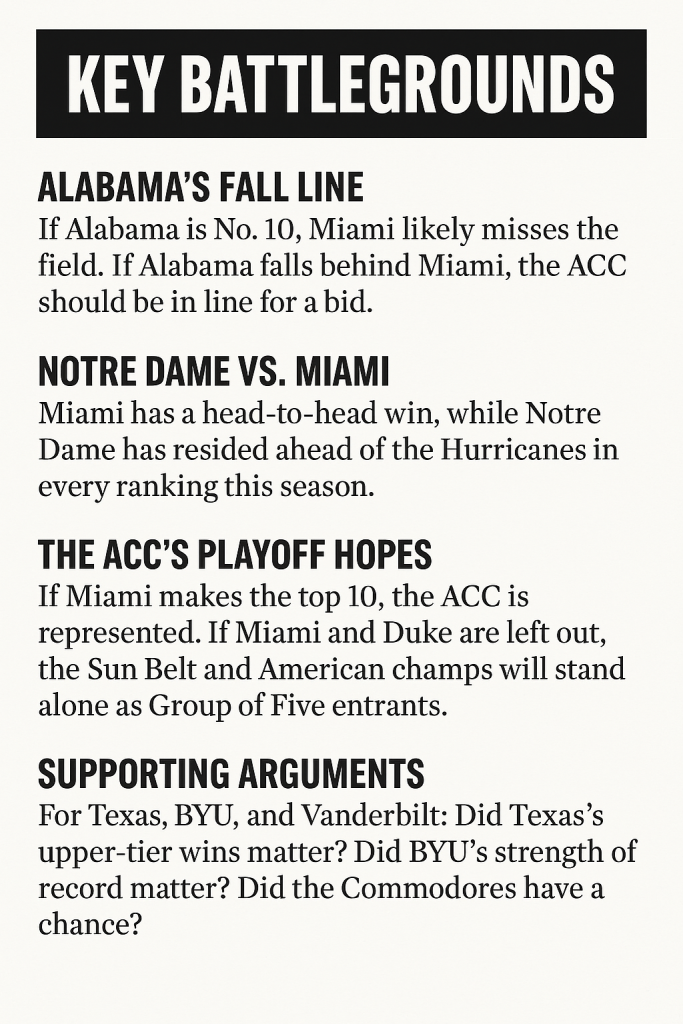
I Canva’d an image here for our key battlegrounds before i get into the more in-depth list. It looks like breaking news on the Sunday front page, doesn’t it? Hear all about it!
Breaking it down:
Tulane and James Madison have locked up two auto-bids, leaving only 10 spots for everyone else, with seeds 1–8 mostly safe and the real fight at 9–10 among Notre Dame, Alabama and Miami; the first battleground is Alabama’s fall line, where staying at No. 10 keeps the Tide in and Miami out, but dropping behind the Hurricanes likely locks both Notre Dame and Miami into the field and shunts Alabama to a New Year’s Six game; the second battleground is head-to-head versus resume between Notre Dame and Miami, with Miami holding the Week 1 win and ACC backing while Notre Dame leans on ten straight wins, stronger efficiency and last year’s title-game run, making their final ordering a referendum on how much head-to-head actually matters; the third battleground is the ACC’s survival, because Duke’s too low to earn an auto-bid and the league’s only path is Miami cracking the top 10, otherwise the ACC goes 0-for-12 while the Sun Belt and American both send champs.
Underneath that, secondary debates linger over Texas’s three premium wins versus the Florida face-plant, BYU’s strength-of-record edge after two losses to Texas Tech and whether Vanderbilt ever truly had a path from just outside the blast radius; when the show starts, the real drama lives where the line flips from 9 to 10 to 11, because that’s where the ACC’s fate, Alabama’s playoff streak and Miami’s head-to-head argument all collide.
Pre-selection sentiments: a deeper dive
Start where the bracket actually stops. With Tulane and James Madison locking up two automatic spots, there are only ten chairs for everyone else. Seeds one through eight feel settled in pencil; the real knife fight lives at nine and ten, where Notre Dame, Alabama and Miami have circled each other for a month. Noon is about which two of those three the committee chooses to bless, and in what order.
The first battleground is Alabama’s fall line. The Tide lost by three scores to Georgia with the entire committee watching, and that third loss is the crack Miami and Notre Dame are trying to pry open. If Alabama clings to No. 10, the SEC sends its runner-up and Miami stays outside the rope. If the Tide slide behind the Hurricanes, it almost guarantees both Notre Dame and Miami slide safely into the field and pushes Alabama into New Year’s Six exile.
The second battleground is head-to-head versus resume in the Notre Dame–Miami argument. Miami beat the Irish in Week 1, owns the cleanest data point in that pairing and has an entire conference lobbying on its behalf. Notre Dame has lived ahead of the Canes all season anyway, on the strength of ten straight wins, prettier efficiency numbers and last year’s title-game run. However the committee stacks them today will tell us exactly how much head-to-head really matters when everything else is close.
The third battleground belongs to the ACC as a whole. Duke just stole the league title and can’t realistically climb anywhere near the auto-bid cutoff, which means the ACC’s only path into this playoff is Miami sneaking into the top ten. If the Canes miss, the conference goes 0-for-12 in a year when the Sun Belt and American both plant flags. That’s not just a snub; it’s a power-structure story.
Underneath those headline fights sit the last little debates, the ones Texas, BYU and Vanderbilt will quietly obsess over. Did Texas’s three premium wins make up for the Florida face-plant? Did BYU’s strength-of-record edge matter at all once Texas Tech beat them twice? Did Vanderbilt ever have a real shot, or were they always living just outside the blast radius? The answers to those questions won’t change the bracket, but they’ll color how every bubble team in future years reads the committee’s language.
So when the show starts, don’t get distracted by the banner shots and the easy byes. The drama is in the middle of the screen, right where the numbers flip from nine to ten to eleven. That’s where the ACC’s fate, Alabama’s streak of playoff relevance and Miami’s head-to-head argument all collide.