Week 11 doesn’t tiptoe; it splinters across continents and knocks at rosters already taped together. Jets–Patriots is already in the books, Foxborough clearing its throat for the rest of the slate. Madrid takes the next spotlight, Commanders–Dolphins at the Bernabéu, the league’s first regular-season game in Spain. Kickoff hits 9:30 a.m. Eastern, a full-lineup stress test. Sunday night swings back to Philadelphia, Eagles–Lions under playoff lighting. Cam Jurgens returns inside while Detroit arrives without Sam LaPorta and a fully healthy secondary. Monday closes the loop in Vegas, Cowboys–Raiders on a scarred field. Quinnen Williams debuts for Dallas while both franchises fight relevance more than aesthetics. In between, Buffalo–Tampa and Bengals–Steelers lose Dalton Kincaid and Samaje Perine. Rico Dowdle gets greenlit for Panthers–Falcons while bye weeks strip out the Colts and Saints. This is the part of the season where injuries become identity and travel quietly dictates tempo. The edge lives in tracking who just inherited the empty spaces—first reads, red-zone work, and real, uncompromised snap shares. With that frame, here are my Five Lists of Five: Week 11 edition, here, and, like the digits in the week, double down on some stashes, dart throws, breakouts, and, probably most importantly, as always, running back sleepers for fantasy football Week 11.
The refrain remains the same—All I want is for you to be better than your friends. You’re going to be surrounded by them on Sunday, probably. How sweet would it be if you could be sure you’ve checked every box possible that might guarantee you a resounding victory this week? Some kick-your-feet-up insights? I’ve got some. And I know my audience. The smoke-break audience. The quick-scan-of-the-phone-on-the-way-to-the-fridge audience. The I-ain’t-reading-all-that-but-good-luck folk. I’m a man of the people.
And so: the Five Lists of Five series. Think of these as byte-sized, two-minutes-to-yourself lists to scan during your weekend as you foam at the mouth for any competitive fantasy edge. As much relevant analysis as I can fit into, like, ~250 words per player.
Below: Top five players to trade for at the deadline this week.
Here are the other offerings from my 2025 Fantasy Football Five Lists of Five: Week 11 edition:
- Top five must-start players for Week 11 of 2025 fantasy football
- Top five breakout running backs for Week 11 of 2025 fantasy football
- Top five breakout wide receivers for 2025 fantasy football Week 11
- Top five WR/CB matchups to target for Week 11 fantasy football
Follow my handle @dansby_edits for all preseason and fantasy draft kit content—as well as plenty of NFL betting goodies—all summer long. All my other fantasy football draft kit content is at the bottom of this list!
Top five fantasy football trade targets at the 2025 trade deadline
Michael Pittman, WR, Indianapolis Colts
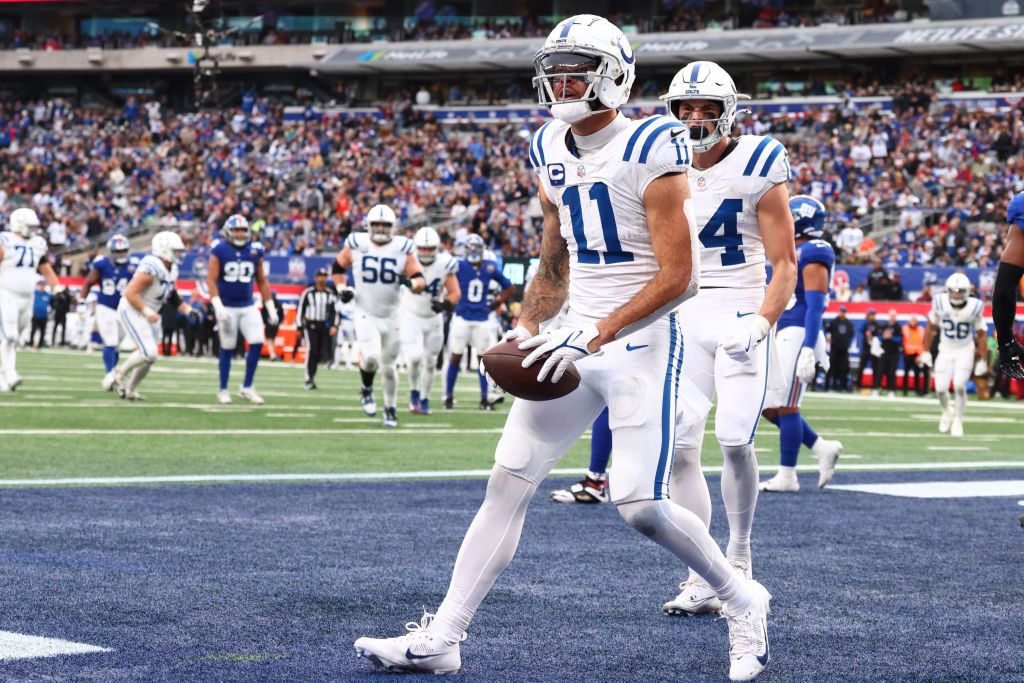
Michael Pittman Jr. is the kind of asset you buy when everyone else is staring at the schedule grid instead of the math. The down week is fresh—two catches for nineteen yards—and a bye sits in front of you, which means his manager is holding a zero and a bad taste. Underneath that, nothing about his role has softened. He owns a 22.6% target share (WR22) on 69 targets, true centerpiece involvement on a team that still wants to throw to move the ball.
The coverage profile is exactly what you want in a trade chip. Against man, Pittman’s at 69 routes, 11 catches, 105 yards, with an 18.8% target rate, 33.5 PPR points, and 0.49 fantasy points per route. Versus zone, he scales up: 251 routes, 43 receptions, 475 yards, a 22.3% target rate, 114.5 PPR, and 0.46 fantasy points per route. He’s the answer against both shells, not a specialist you can script out.
Inside the twenty, the picture gets even cleaner. Pittman runs 86.0% of red-zone routes, with a 14.3% red-zone target share, four touchdowns, and 32.6 red-zone fantasy points—he’s the main wideout when drives actually cash out. Even with last week’s faceplant, he sits on 150 PPR points, eighth among wide receivers, which tells you how high the weekly floor has been.
The schedule is your leverage. There’s a bye, then two rough matchups, and managers see that as a headache. If you’re already pointed at the playoffs, that’s exactly when you step in: pay a slight discount now for a true WR1 profile that hits friendlier secondaries down the stretch.
DK Metcalf, WR, Pittsburgh Steelers
DK Metcalf is exactly the kind of uncomfortable name you trade for, not away. The surface case is easy for another manager to sell low on: boom–bust box scores, a reputation for volatility, and a looming bye that threatens a late-season zero. Underneath that noise, his role is still that of a solid WR2. He owns a 21.8% target share on 56 targets, basically WR28-level involvement, which is the kind of weekly diet you buy when it’s mispriced.
The matchup notes against Cincinnati only sharpen the appeal. The Bengals sit around league-average in man and zone frequency, but they’re bottom ten in first-down plus touchdown rate allowed in both man (51.6%) and zone (39.2%) and grade poorly across most coverage metrics. Against man this year, Metcalf has 69 routes, five receptions, 61 yards, a 14.5% target rate, 23.1 PPR, and 0.33 fantasy points per route. Versus zone, where Cincinnati still leaks, he’s at 213 routes, 27 receptions, 441 yards, a 21.6% target rate, 89.1 PPR, and 0.42 fantasy points per route, making him Pittsburgh’s best wideout against that shell and a natural complement to Calvin Austin.
His current receiving line sits in the mid-fifties for yards, and he’s functioning as WR53 in production on WR31 usage this month, making him one of the most volatile week-to-week assets in the position pool even as Pittsburgh carries about 27.25 projected points in this spot. That combination—true WR2 volume, a coverage-soft opponent, high team total, week-to-week variance, and an upcoming bye suppressing acquisition cost—is exactly what a contending roster should be buying into before the schedule softens and the spike weeks arrive.
Quinshon Judkins, RB, Cleveland Browns
Quinshon Judkins is the kind of back you trade for before everyone realizes the schedule finally turned green. The surface says slowed down, but context says survived one of the nastiest RB slates in the league. In eight starts, his only game against a bottom-twelve run defense was that first Baltimore meeting, where he ripped 6.1 yards per carry. Everything else has been uphill: stacked boxes, top-tier fronts, and a horrific offensive line that forces him to win through contact, not space.
Even inside that mess, the usage is exactly what you pay for. Since Week 3 as the starter, he’s averaging 14.7 half-PPR points on 15.0 expected, which is RB10 usage in healthy games. That’s bell-cow math, not committee noise. The red-zone ledger is even louder: 21 red-zone carries, a 63.6% share, four touchdowns, eight routes, and 27.7 red-zone fantasy points, with the rest of the room miles behind. When Cleveland gets close, it’s Judkins first, second, and usually third.
The kicker is the road ahead. Five of his next seven opponents sit in the bottom twelve in run-defense grade, the other two hover around league average, and that stretch starts again with Baltimore. The early-season grind is baked into his box scores; the soft landing is not. Pair that with an 82.5 total-yards line and a tape profile still littered with nice plays behind a bad line, and you get the archetypal buy-low: elite role, brutal past environment, and a runway that finally favors the math.
Jaylen Warren, RB, Pittsburgh Steelers
Already a must-start this week for me, I still think it’s worth noting that Jaylen Warren represents one of the best running back trade candidates on the board. He owns a 58.0% rushing share, eighteenth among backs, with 113 attempts, living in the same neighborhood as featured names like Bijan. Over the last three weeks his touch share climbed from 36.6% in Week 8 to 37.5% in Week 9, then 50.0% in Week 10, backed by a 73.9 offensive grade. That’s not a change-of-pace profile; that’s a backfield quietly consolidating around him.
The role is dense where it matters. Inside the twenty, Warren has 22 red-zone carries, 64.7% of Steelers RB attempts, with three touchdowns, plus 17 red-zone routes and a 25.0-point red-zone fantasy ledger. Cincinnati has already allowed 31 red-zone touchdowns, most in the league, he’s a prime candidate for a bounceback after last week’s scoreless line. The Bengals have also surrendered 390 receiving yards and 45 catches to running backs, both top-eight figures, which dovetails with his 2–4 catch baseline.
Volume models see a mid-range RB2 already. His norm has settled around 13–16 rushes plus 2–4 receptions, and his next three games are against the Bengals, Bears, and Bills—three of the four defenses allowing 5.0 yards per carry—followed by the Ravens and Dolphins at 4.6 and 4.9 YPC allowed. Efficiency is set to rise. This week his total-yards line sits at 90.5, with Cincinnati giving up 29.8 half-PPR points per game to backs, a full 5.1 more than the second-worst defense, and Pittsburgh favored by 5.5.
That’s classic trade-for math: RB1 usage, softening schedule, and one of the best RB matchups on the board while the market still prices him as only a mid-tier RB2.
Jordan Addison, WR, Minnesota Vikings
Jordan Addison is exactly the trade target I want in Week 11. The surface reads 26 catches, 392 yards, two scores, and managers shrug. I see a downfield role insulated by air yards and usage, not vibes. After a three-game suspension he returned to 18 catches, 283 yards and a touchdown on 26 targets in his first three games, with four straight double-digit PPR outings. The peripherals scream spike weeks: 100.7 air yards per game, 25.1% of team air yards, 14.0 aDOT and 19.7% targets-per-route. That is a young receiver being treated like a vertical feature, not a rotational accessory.
Week 10’s line—three for 35 on eleven targets in a messy loss to Baltimore—just builds discount energy. The issue was J.J. McCarthy’s 53.7% completion rate and two picks, not Addison’s deployment. Minnesota sits 21st in scoring and 22nd in passing offense, yet still concentrates volume on Justin Jefferson and Addison. If McCarthy settles near league-average efficiency, that 15.1 yards per catch turns volume into weekly top-ten upside.
The runway matters. Two of the next four come inside the Vikings’ dome, with NFC North and NFC playoff opponents that should keep scripts competitive. In those environments Kevin O’Connell leans into three-receiver sets, play-action, and crossers that feed Addison’s downfield role. I’m sending out every boring WR3 and touchdown-dependent flex for him. You win titles by buying this archetype before the box scores finish catching up. Rest-of-season, I rank him as a mid WR2 you can still acquire at WR3 pricing.