Week 11 doesn’t tiptoe; it splinters across continents and knocks at rosters already taped together. Jets–Patriots is already in the books, Foxborough clearing its throat for the rest of the slate. Madrid takes the next spotlight, Commanders–Dolphins at the Bernabéu, the league’s first regular-season game in Spain. Kickoff hits 9:30 a.m. Eastern, a full-lineup stress test. Sunday night swings back to Philadelphia, Eagles–Lions under playoff lighting. Cam Jurgens returns inside while Detroit arrives without Sam LaPorta and a fully healthy secondary. Monday closes the loop in Vegas, Cowboys–Raiders on a scarred field. Quinnen Williams debuts for Dallas while both franchises fight relevance more than aesthetics. In between, Buffalo–Tampa and Bengals–Steelers lose Dalton Kincaid and Samaje Perine. Rico Dowdle gets greenlit for Panthers–Falcons while bye weeks strip out the Colts and Saints. This is the part of the season where injuries become identity and travel quietly dictates tempo. The edge lives in tracking who just inherited the empty spaces—first reads, red-zone work, and real, uncompromised snap shares. With that frame, here are my Five Lists of Five: Week 11 edition, here, and, like the digits in the week, double down on some stashes, dart throws, breakouts, and, probably most importantly, as always, running back sleepers for fantasy football Week 11.
The refrain remains the same—All I want is for you to be better than your friends. You’re going to be surrounded by them on Sunday, probably. How sweet would it be if you could be sure you’ve checked every box possible that might guarantee you a resounding victory this week? Some kick-your-feet-up insights? I’ve got some. And I know my audience. The smoke-break audience. The quick-scan-of-the-phone-on-the-way-to-the-fridge audience. The I-ain’t-reading-all-that-but-good-luck folk. I’m a man of the people.
And so: the Five Lists of Five series. Think of these as byte-sized, two-minutes-to-yourself lists to scan during your weekend as you foam at the mouth for any competitive fantasy edge. As much relevant analysis as I can fit into, like, ~250 words per player.
Below: Top five breakout running backs for Week 11. These are guys that FantasyPros ECR has ranked in the mid-to-late RB2-or-worse range whose matchups I think warrant fringe RB1 consideration. Sometimes they’ll indeed be running backs who aren’t just breaking out of the prison of their rankings, but are indeed breaking onto the scene. But not always. There are only so many names that have scaleable and sustainable relevance in fantasy football!
Here are the other offerings from my 2025 Fantasy Football Five Lists of Five: Week 11 edition:
- Top five must-start players for Week 11 of 2025 fantasy football
- Top five breakout wide receivers for 2025 fantasy football Week 11
- Top five WR/CB matchups to target for Week 11 fantasy football
- Top five fantasy football players to trade for at the 2025 deadline
Follow my handle @dansby_edits for all of my fantasy football content—as well as plenty of NFL and College Football betting goodies—all season long.
Top five breakout RBs to target for Week 11 of 2025 fantasy football
Blake Corum, Los Angeles Rams
Blake Corum is the kind of creeping usage shift that matters in November. Week 10 told the truth: 26 snaps, seven routes, thirteen carries, zero targets, with Kyren Williams at thirty snaps and fourteen carries. That is no longer a cameo; on the ground, it was essentially a true fifty–fifty split. He has now hit thirteen touches in three straight games, with Sean McVay moving from “Kyren bell cow” to a by-drive committee that keeps both backs live.
The most important migration is inside the twenty. Over the first six weeks, Corum managed just five red-zone carries and one inside the five. Across the last three, he owns six red-zone carries and two inside the five, a quiet but real tilt toward trust where fantasy points are densest. His season-long rushing share sits at 27.4% of Rams rush attempts on sixty-seven carries, only forty-second among backs, but that number disguises how front-loaded Kyren’s monopoly was.
McVay has been explicit about getting off the unsustainable 2024 workload and being disciplined with the Williams–Corum split; internal pieces from September already framed Corum as the emergence that lets Los Angeles preserve its engine. The tape has followed: fresh legs, breakaway runs, and a one-two punch that accounted for nearly half the offense in earlier weeks.
Seattle brings a top-tier run defense, first in EPA per rush and near the top in success rate, so efficiency will not come free. But in 7–2 vs. 7-2 showdown where the Rams lean into thirteen personnel and want to bludgeon a fellow DVOA darling, Corum’s growing slice of early downs and scoring-area work makes him a live Week 11 breakout—flex-plus usage with genuine multi-touchdown upside if one drive tilts his way.
Bhayshul Tuten, Jacksonville Jaguars
Bhayshul Tuten is the kind of role you stash before the box scores make it obvious. Week 10 usage looks modest on the surface—17 snaps, 10 routes, two targets, four carries behind Travis Etienne and LeQuint Allen—but the geometry of his touches points forward. His season rushing share sits at 20.0% of Jacksonville rushes (47th), 45 carries total, yet his fingerprints show up exactly where fantasy value densifies.
The red-zone profile is the tell. Tuten owns 14 red-zone carries, a 25.9% red-zone carry share, and three rushing touchdowns, plus seven red-zone routes and one red-zone target, translating to 23.6 red-zone fantasy points. That’s not empty garbage-time inventory; that’s curated leverage work on an offense that still lives in shotgun spacing and RPO stress. When Liam Coen wants downhill tone and quick answers near the stripe, Tuten’s number stays in the script.
Week 11 against the Chargers is labeled as a temper expectations window, and that context matters. Los Angeles brings elite red-zone defense—second-best in overall red-zone success allowed and first against the pass—so the broader Jaguars passing tree and ancillary pieces sit under a lid. That cap, however, also nudges rational play-calling toward the ground on compressed fields, especially if Herbert forces a slower, possession-heavy game.
This is the exact moment to be early. A back with only a 20% season rushing share but a quarter of the red-zone diet is one injury, one hot hand, or one game-script swing away from a spike week. Tuten profiles as a breakout-flex bet for Week 11 and a premium stash beyond it.
Aaron Jones, Minnesota Vikings
Minnesota’s offense has been hunting for ballast, and Week 10 finally showed where Kevin O’Connell wants to find it. Aaron Jones stepped out of the committee fog with 46 snaps (70.8% of offensive snaps), 30 routes, five targets, nine carries, his first clear feature back game after weeks of near-even work with Jordan Mason. He handled 18 of 24 first-half snaps, owned the opening script, then rotated more late, but the usage notes are blunt: this is Jones’ backfield now.
The season-long rushing share still looks pedestrian—19.8% of team rushes, just 36 carries, good for 49th among backs—because it bakes in the hamstring layoff and that early split. The signal is in the recent shape. He sits around RB17 for Week 11, rankswise, pegged around 74.5 total yards with 8.9 expected half-PPR points in four healthy games, then 11.6 expected half-PPR in Week 10 as he separated from Mason and absorbed the goal-line role. His red-zone ledger is light but pointed: two red-zone carries (8% share) with one rushing TD, plus nine red-zone routes and one target for 6.5 red-zone fantasy points—the kind of profile that explodes quickly once the touch count scales. This is layered on top of a 2024 résumé with 1,138 rushing yards and true workhorse usage.
The opponent is permissive where it matters. Chicago is allowing over 135 rushing yards per game at 5.2 yards per carry, and running backs have produced roughly 22.9 PPR points per game, a touch above league average. In a must-have divisional home game for a 4–5 Vikings team that ranks just 24th in rushing yards per game, rational coaching tilts toward their healthiest veteran engine.
Jones profiles as a Week 11 breakout: a newly re-consolidated feature back, mid-RB2 floor with a very real path to RB1 output if Minnesota finally leans into balance.
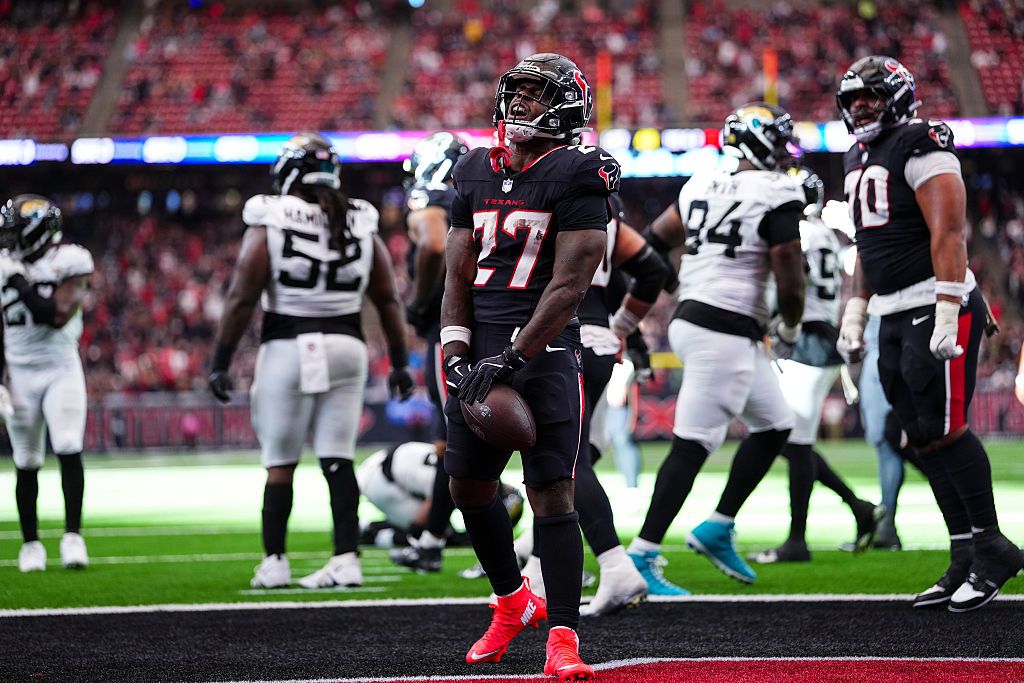
Woody Marks, Houston Texans
Houston’s pivot from survival mode to “no more rookies” shows up clearest next to the quarterback. C.J. Stroud sits with a concussion again; Davis Mills starts, and DeMeco Ryans has said the young pieces don’t get training wheels anymore. That’s exactly how Week 10 felt for Woody Marks. He logged 60 of 75 offensive snaps, ran 27 routes, drew three targets, and handled 14 carries—a true takeover after sitting below 50% snaps the prior week. He’d already led the room with 232 of 545 snaps (42.6%) coming in; this was consolidation, not a cameo.
The role is dense. Marks handled 80.8% of early-down snaps and 70% of third downs, vacuuming up passing-down work that had lived with Dare Ogunbowale, who had been over 50% on third down for three straight games. Week 10’s line—14 carries for 63 yards and a touchdown, plus 2 catches for 18 yards—is what that usage should look like on an average efficiency day. His 38.2% season rushing share on 81 carries (31st among backs) undersells the new truth. Recent rankings park him around RB21 with a 74.5 total-yards line and 16.3 expected half-PPR in Week 10, noting he handled the goal-line work and won’t be game-scripted off the field because of his routes. Houston’s implied team total sits around 22.75 points against Tennessee.
The matchup quietly supercharges it. The Titans are allowing roughly 141 rushing yards per game at 4.8 yards per carry with 15 rushing touchdowns, bottom-tier run defense any way it’s sliced. They already saw Marks drop an RB5 finish on them in Week 4, and nothing structural has improved since. In a 4–5 vs. 1–8 divisional game where Houston wants to protect its backup quarterback and ride grown rookies, a back commanding 80%+ snaps, early downs, third downs, and goal-line work is a breakout engine. Marks is a Week 11 RB2 with a very real RB1 outcome if Houston’s script holds.
Tyler Allgeier, Atlanta Falcons
Falcons running back Tyler Allgeier isn’t a secret in that building anymore. Raheem Morris just called him “the least talked about superstar” on the roster, and the usage backed the compliment immediately. Week 10 crystallized the new world: Bijan Robinson cleared 85% of snaps, yet Atlanta leaned into heavy two-back sets, especially 21 personnel, with Allgeier on the field next to him. Most of those looks were Allgeier runs, letting Bijan flex out and stress coverage while the hammer handled inside work.
The stat line captured that intent. Allgeier logged 11 carries, with five red-zone attempts and both of Atlanta’s carries inside the five. He finished as RB7 in half-PPR, third in fantasy points per snap (0.8) and fifth in fantasy points per touch (1.6) among backs with at least a 25% snap share. That marries with the early-season profile: through Weeks 1–9, he and Bijan each had 16 red-zone carries, but Allgeier led in close work with three inside-the-five attempts to Robinson’s two. For the full year he owns 32.3% of team rushes on 74 carries, only 38th in rushing share, yet he’s tied for the team lead in touchdowns because Atlanta loads him up where drives cash out.
Waiver notes read it correctly: his touchdown equity is outsized relative to his raw snap share. As the Falcons keep living in two-back looks near the stripe and Morris keeps praising his superstar closer, Allgeier profiles as a live Week 11 breakout—touchdown-chasing RB3/flex with a real chance to tilt matchups if Atlanta sustains drives.