The 2024 Buffalo Bills finished the season with 520 pass attempts, the seventh-fewest in the league. Last season, only the Indianapolis Colts, Los Angeles Chargers, Pittsburgh Steelers, Green Bay Packers, Baltimore Ravens and Philadelphia Eagle attempted fewer passes.
The Colts were the only team out of the above listed group that didn’t make the playoffs, and that’s because no one on the quarterback depth chart could throw.
The Bills are one of the premier teams in the league, having won at least 10 games in six straight seasons with playoff appearances in all. Over the last five seasons, the offense has been top 10 in both points and yards. The defense has been top 10 in points and yards in three of those seasons, with last year’s iteration at 11th for points and 17th for yards.
Bills target share overview
In Josh Allen’s first full season as a starter, he finished with 461 pass attempts. That number increased in each of the next two seasons, as the Bills offense became a heliocentric one, with Allen flaming all areas of opposing secondaries.
Allen still remains the alpha and omega of the Bills offense, but the pass attempts have decreased from 646 to 570 and finally to 483 last season. The pass rate was 59.21% in 2021. In 2022, it was 59.44%. The following season it plummeted to 53.53% and was 50.74% last season.
Allen is still rushing around 100 times per season, but it was the emergence of James Cook that really spiced up the kitchen and sprinkled some rushing awesomeness to counterbalance the aerial game.
Now, Cook is currently in contract talks with the Bills, which could throw a wrench into everything. It’s unlikely he holds out because players have little leverage in these situations, but his performance could be adversely affected. Ray Davis is a good player and showed that he belongs in the league, but would he be able to replicate similar production if needed to step into Cook’s role? No idea, but it’s an uncertain variable.
The Bills do have the third-ranked offensive line, according to PFF, heading into the season, and they still have that Josh Allen guy under center, so the rushing game should always be above competent regardless of who is in the backfield.
The defense was mediocre last season. The unit did rack up a ton of turnovers, but offenses were able to move the ball, both on the ground and through the air, and the 39 sacks were middle of the pack. For perspective, the Denver Broncos led the league with 63 sacks while the New England Patriots finished in last with 28.
As a result, the front office utilized the first six rounds of the draft to bolster the defense. They also signed Joey Bosa and Michael Hoecht in free agency to provide more oomph off the edges. The unit should be improved.
Sharp Football Analysis shows the Bills having the fifth-easiest schedule in 2025.
With an improved defense and easy schedule, the run/pass ratio could hover around 50/50 once again for Buffalo.
Now, let’s take a look at how the targets should be distributed in Buffalo this season.
Wide receivers
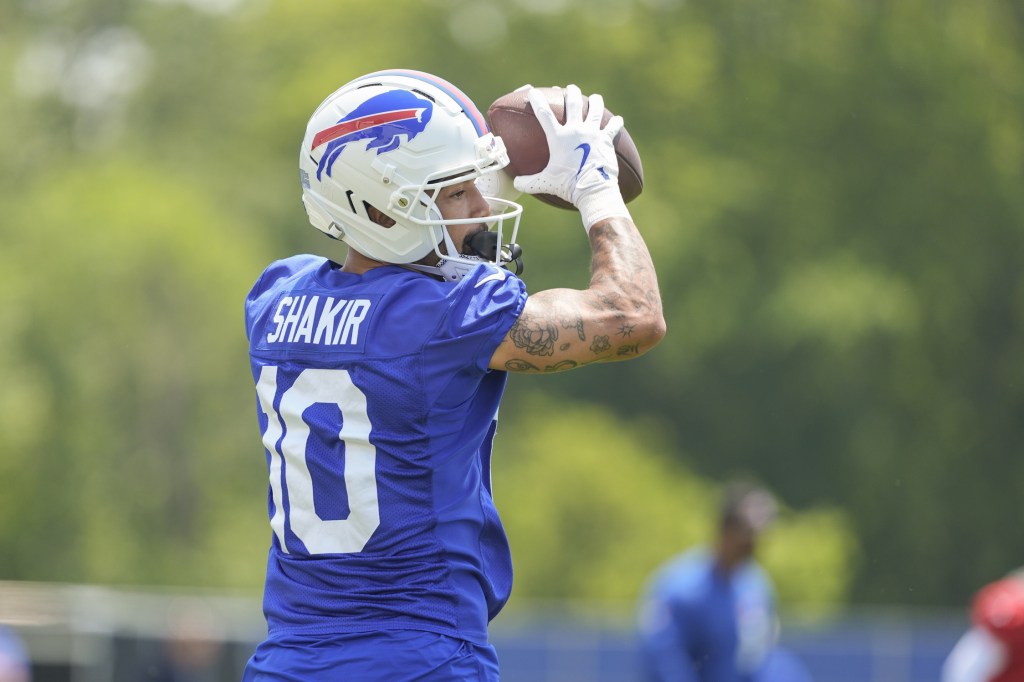
Khalil Shakir led the team with 100 targets and a 23% target share in 15 games. He was the only player to garner at least 100 targets last season. Shakir ran 70% of his routes from the slot and had a 5.5 aDOT, so he should continue being peppered with high-probability passes and lead the team in target share.
Keon Coleman had 57 targets, Mack Hollins finished with 50, Curtis Samuel garnered 46 and Amari Cooper rounded out the receiving group with 32 targets.
Samuel had an 11.2% target share in 14 games. He finished with 441 snaps, the fourth-most at the position, and will likely be the fourth wide receiver again this season.
Hollins is in New England while Cooper is a free agent.
Coleman had a 15.5% target share last season and should see a similar number this season.
Opposite him on the outside will be Joshua Palmer, who signed a three-year, $29 million deal in March. Palmer is 6’1″, 210 pounds and runs a 4.57 40-yard dash. With the Los Angeles Chargers last season, Palmer garnered a 15% target share in 15 games. He finished with 65 targets. Somewhere around 15% seems likely for Palmer in Buffalo.
Tight ends
Dalton Kincaid led the group with 75 targets and a 20.2% target share in 13 games.
Dawson Knox had 33 targets and a 7.1% target share in 16 games.
Kincaid had a 17.7% target share his rookie season and it wouldn’t be a surprise if he comes down a bit because 20% seems like a ceiling.
Running backs
Cook led the group with 38 targets and an 8.1% target share. During his rookie season, that number was 6% and it was 9.9% two seasons ago. The eight to 10 percent range seems likely. Interestingly, I would’ve assumed that Allen was among the league leaders in lowest checkdown rate, but he is not in the top 15.
Ty Johnson was second with 25 targets and a 5.1% target share.
Davis finished with 19 targets and a 3.8% target share.