2024 was the year that women’s basketball arrived on the national conscience.
In the final of that year’s NCAA tournament, Caitlin Clark’s Iowa Hawkeyes faced the South Carolina Gamecocks in front of an 18,300-person audience at Rocket Mortgage FieldHouse and another 18.9 million on television, a bigger audience than the men’s championship game between the Connecticut Huskies and the Purdue Boilermakers, the first time in history that the women’s game accomplished that feat.
2025 is the first year of the post-Clark era. The former Hawkeyes star is now lighting it up for the Indiana Fever, drawing record eyeballs to the WNBA, and with her departure, Women’s March Madness carries somewhat less intrigue.
But fans are still tuning in to women’s hoops. According to an analysis by Fox Sports, television ratings for ESPN’s nationally-televised women’s games are up 3% from last season, although ESPN didn’t carry many Clark games during her senior season. But Southern California’s JuJu Watkins and Connecticut’s Paige Bueckers are still big draws, and when they faced off on Dec. 22, an average of 2.2 million viewers tuned in to Fox’s broadcast.
Although Watkins’ Trojans and Bueckers’ Huskies are both top seeds — they’re the first and second seeds, respectively, in the Spokane 4 region — the women’s field is arguably deeper than it’s ever been before, which raises the possibility for a deep run by a double-digit seed. The NCAA’s powers that be will probably hope for an Elite Eight matchup between Watkins and Bueckers, given the huge television ratings that would likely result from such a matchup, but some of the lower-seeded teams can’t be ignored.
South Carolina is a +240 favorite to win the tournament at DraftKings Sportsbook, but there’s a fairly deep field of contenders, including six teams with 10-1 or better odds to cut down the nets on April 6.
On average, the men’s tournament includes way more upsets than its female counterpart, especially long-shots. While there have been two 16-over-1 upsets and 11 15-over-2 results in the history of the men’s tournament, only one team seeded 14th through 16th has ever won a women’s tournament game, when No. 16 Harvard shocked No. 1 Stanford in 1998. In the women’s field, 12-over-5 upsets are the most common variety, but even those happen infrequently, and none occurred last season.
While Cinderella stories are more rare in women’s basketball than men’s, they’re what college basketball fans dream of. Here are my three favorites to find that glass slipper and give their fans memories for years to come, beginning with the most famous Cinderella in Women’s March Madness history.
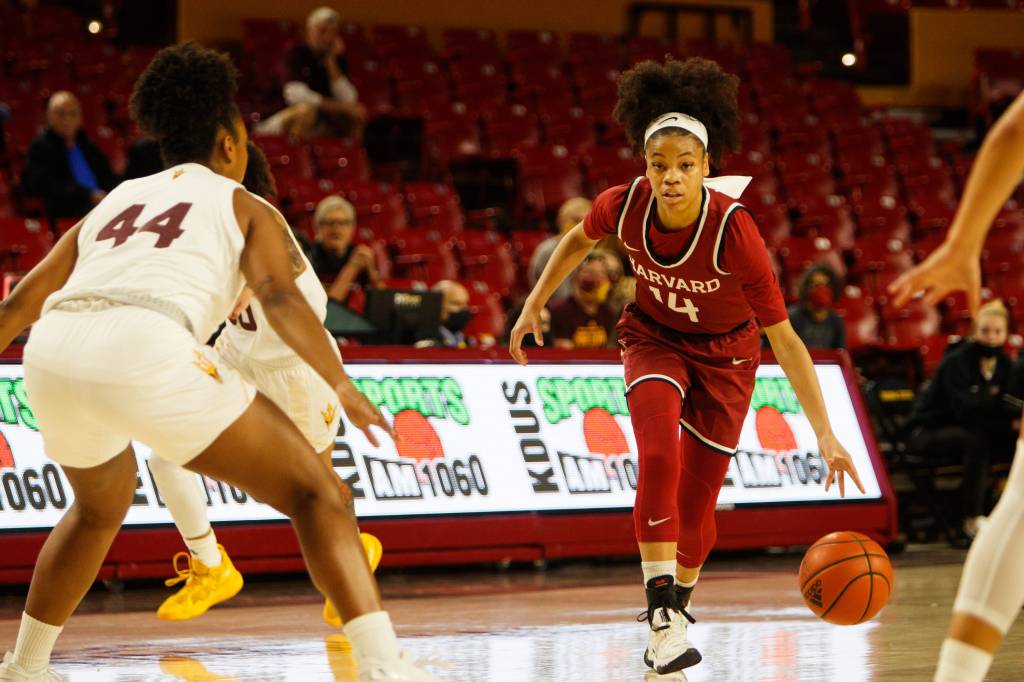
No. 10 Harvard Crimson (+180 Moneyline to beat No. 7 Michigan State Spartans, +550 to reach Sweet Sixteen, +60000 to win)
As you’d find out pretty easily by clicking on my author biography at the bottom of this article, I am a Harvard alumnus, so there’s a little bit of school pride involved in this pick. But it’s a hardly ridiculous notion; of all the teams in the tournament with double-digit seeds, the Crimson are tied for the third-shortest odds to win their first-round bout.
Harvard nearly swept its non-conference schedule, which included a 72-68 overtime win on the road against No. 25 Indiana on November 7, finishing 13-1 in non-conference play before going 11-3 within the Ancient Eight, and most of the games weren’t particularly close, with 33- and 34-point victories over Dartmouth and a 56-point win over Yale. Most critically, the Crimson learned from their mistakes, losing twice to Princeton before besting the Tigers in the first round of the Ivy League Tournament behind a 44-point performance from Harmoni Turner. Head coach Carrie Moore has done a remarkable job turning around a program that went just 13-14 in the season before she was hired, and in her third season, Harvard will make its first appearance in the NCAA Tournament since 2007.
It’s not like the Crimson have faced a particularly weak schedule, either. Harvard is ranked 34th in the NCAA’s NET rankings — the highest of any double-digit seed and higher even than seventh-seeded Louisville — and has proven that it can beat high-quality opponents, having gone 2-0 against Quad 1 teams and 3-3 against Quad 2 teams. Plus, the Ivy League as a whole is now considered the sixth-strongest women’s basketball conference, according to the RPI’s rankings, and got three teams into the tournament, with No. 11 Columbia winning its First Four game and No. 11 Princeton losing.
Michigan State went just 4-6 in its last 10 games — to be fair, against better opponents than the Crimson faced — and went just 4-8 against Quad 1 teams this season. The Spartans also haven’t played a game since crashing out of the Big 10 tournament in the second round to Iowa on March 6. In both the men’s and women’s tournaments, the Ivy League champion has typically punched above its weight, with No. 15 Princeton even advancing to the Sweet Sixteen on the men’s side two years ago. This one has upset written all over it, and the winner will likely go on to face No. 2 NC State, which has a NET ranking more commensurate with a No. 4 or No. 5 seed.
No. 10 Nebraska Cornhuskers (+120 Moneyline to beat No. 7 Louisville Cardinals, +500 to reach Sweet Sixteen, +50000 to win)
I foreshadowed this a little bit in my section about Harvard to note that Louisville has no business being a seventh seed. The Cardinals went just 2-9 against Quad 1 competition, barely edged out an extremely mediocre Clemson team in the second round of the ACC Tournament before being dumped out of the competition handily by Duke in the third round. Louisville did close out its season in fairly good form, winning five of its final seven regular-season games, but 30-plus-point losses to Connecticut and North Carolina State in December can’t be completely ignored.
The Cornhuskers’ case is interesting; they got off to an excellent start to the season, going 11-3 in non-conference play with only a six-point loss to Creighton in late November as a blemish on an otherwise good resume. But when conference play started and they had to play good opponents, they floundered, with back-to-back 20-plus-point losses to both Los Angeles teams. A 20-point road win over No. 17 Maryland — a fellow No. 7 seed with a much better NET ranking than the Cardinals — in late February was helpful, but where Nebraska really caught its stride was in the Big Ten Tournament. An 84-60 result over 11-19 Rutgers should’ve been expected, but a 74-70 win over 21-9 Illinois — who also have a better NET rating than Louisville — was a nice bonus. Then, in the third round, the Cornhuskers managed to stay within 11 points of UCLA, a 26-point improvement from the teams’ prior meeting.
Maybe Nebraska just caught lightning in a bottle in the conference championship and is over-seeded as a result, but there have been plenty of teams who have caught fire late in the season and carried excellent form into March Madness. Plus, the winner will likely face No. 2 TCU, the second-weakest of the second-seeded teams.
No. 13 Montana State (+1100 Moneyline to beat No. 4 Ohio State, +1400 to reach Sweet Sixteen, +150000 to win)
If the Crimson and the Cornhuskers can’t be considered proper sleepers, given that they both barely fit the criteria of being double-digit seeds, how about backing Montana State to possibly become the fourth ever No. 13 seed to make the Sweet Sixteen? With just four total games against teams in the top three quads of the NET Rankings, the Bobcats are quite the unknown — but in those four games, they went 2-2, so they shouldn’t be slept on entirely. Winning 30 of 33 games is never an easy task, no matter how difficult the opposition.
They’re ranked 54th in the NET rankings, easily the highest of the tournament’s No. 13 seeds. This season, they’ve held opponents to just a 28.2% three-point percentage, a figure that would’ve ranked just 284th in Division I, and they had the 16th-best scoring defense in the country. Although their star player, senior Esmeralda Morales, is only five-foot-five, she’s a lethal scorer who has dropped 20 or more points in three of her last eight games and shoots 36.8% from beyond the arc. Experience is important in the NCAA tournament, and each of the team’s top three scorers are upperclassmen.
Plus, both Kentucky and Baylor have higher NET rankings than the Buckeyes do, so Montana State got relatively lucky with its draw. This season, Ohio State got off to an incredibly hot start, winning each of its first 17 games but going just 8-6 since then. The Buckeyes required overtime to get past Minnesota and Iowa in consecutive games and lost convincingly to both UCLA and USC during the regular season before being thrashed by the Bruins in the Big Ten tournament semifinals. Overall, Ohio State was just 5-5 against Quad 1 teams this season, which isn’t super promising for a team that is in the quad itself. Plus, their second-leading scorer is Jaloni Cambridge, a first-year, and younger teams can often flame out in the tournament.
Perhaps the Bobcats’ easy competition means that they won’t be prepared for the size and strength of the Buckeyes, but while the top teams all have years of film on each other, Montana State is a relative unknown whose top players have significant college basketball experience. Ohio State would be making a mistake to write them off.