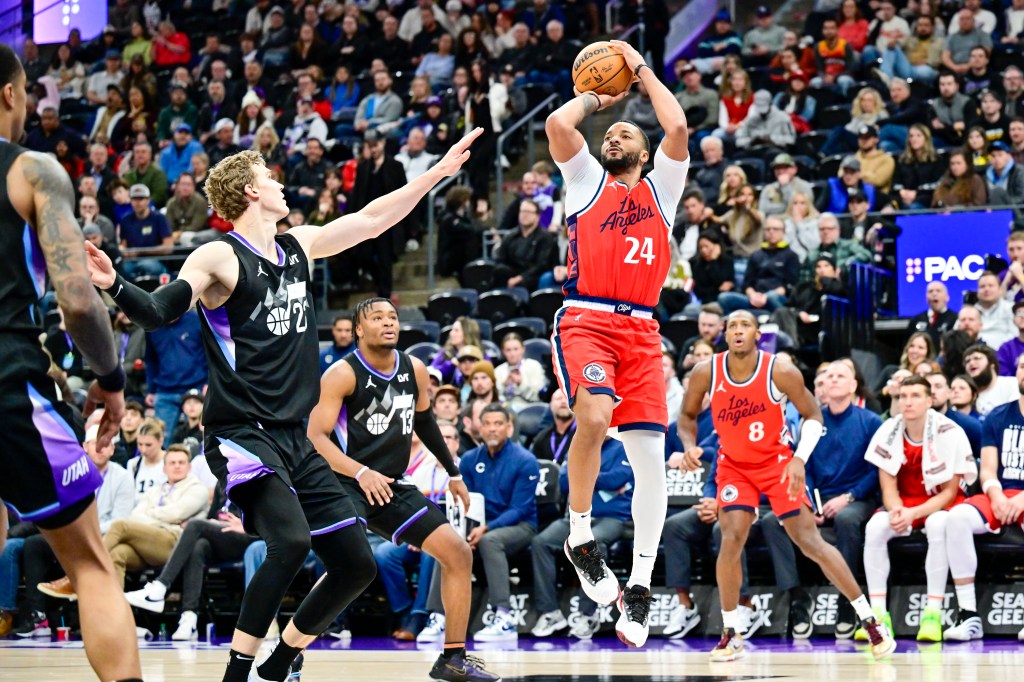
During Media Day in September, LA Clippers guard Norman Powell made headlines when asked about the offseason departure of Paul George, who signed a four-year, $212 million contract with the Philadelphia 76ers.
“I saw it as addition by subtraction,” he boldly claimed. “More guys get more opportunities, not only myself.”
Addition by subtraction, indeed. The Clippers are 31-23 despite losing George in the offseason and Kawhi Leonard not making his season debut until January 4. Through 54 games last season, LA was just five games better with Leonard playing at an All-NBA level and George averaging 22.3 points per game.
This season, Powell is averaging 24.2 points per game with a blistering 59.5% effective field goal percentage. His 0.153 win shares per 48 minutes are more than any that George recorded except in his first season with the Clippers, but given that he played just 48 games that season, it’s fair to say that Powell has been better this season than George ever was in LA.
The State of the NBA Awards Races
Powell’s career-best season means that arguably the most intriguing NBA award race is the Most Improved Player battle. Here are the current betting favorites and their odds for each of the NBA’s major awards:
- MVP: Shai Gilgeous-Alexander, Oklahoma City Thunder (-500)
- Rookie of the Year: Stephon Castle, San Antonio Spurs (+140)
- Most Improved Player: Cade Cunningham, Detroit Pistons (-125)
- Defensive Player of the Year: Victor Wembanyama, San Antonio Spurs (-2000)
- Sixth Man of the Year: Payton Pritchard, Boston Celtics (-150)
- Coach of the Year: Kenny Atkinson, Cleveland Cavaliers (-600)
- Clutch Player of the Year: Nikola Jokić, Denver Nuggets (-120)
Of the major awards, there are only four truly competitive ones; Gilgeous-Alexander, Wembanyama, and Atkinson have their awards effectively locked up. The Rookie of the Year race is probably the most wide-open, with Kel’el Ware (+230) and Zaccharie Risacher (+750) both having earned bigger roles in their teams’ offenses while San Antonio’s guard corps got deeper around Castle. The Sixth Man of the Year race will probably be decided soon, since Hunter has been a starter since being traded to the ultra-deep Cleveland Cavaliers. And while Jokic hasn’t quite locked up Clutch Player of the Year, only Trae Young (+450) even has five-to-one odds.
That leaves the Most Improved Player race as the only true two-man battle in the NBA’s awards season, as no player but Cunningham and Powell (+130) even have +1000 odds to win the award. Earlier today, my colleague Grant Afseth took a look at the MVP race. In this column, I’ll take a deep dive into both Most Improved Player contenders, starting with Powell.
Who Should Win Most Improved Player?
Norman Powell, SG/SF, LA Clippers (+130)
The Case For Norman Powell
Powell first made his name as a deep bench piece on the Toronto Raptors team that won an NBA title in the 2018-19 season, and he took on a bigger role the following season, jumping from 8.6 to 16.0 points per game for a Raptors team that was surprisingly competitive after losing Leonard in free agency. But he didn’t last long in Toronto, being dealt in the 2020-21 season to the Portland Trail Blazers and, after less than a year in Portland, to the Clippers at the 2022 deadline.
He was certainly a valuable player for LA over the last two seasons, averaging 15.3 points per game and shooting 41.9% from beyond the arc across 136 games (11 starts). Last season, he finished third in three-point shooting percentage among 63 players who played at least 65 games and attempted at least five three-pointers per night, even though his scoring average dipped to just 13.9 points per game. He also had two 20-point games in the playoffs as the Clippers fell to the Dallas Mavericks in six games.
It was obvious that his output was going to improve somewhat with George no longer on the roster, but not even the most ardent of Powell supporters expected him to suddenly jump 10.3 points per game, especially not in his age-31 season. In the past 15 years, no player has ever seen their scoring average increase by more and not won the Most Improved Player award, although Coby White jumped from 9.7 to 19.1 points per game last season, narrowly losing out to Tyrese Maxey. This season, Powell’s effective field goal percentage is the highest of his career, and he’s posting his third-lowest turnover percentage despite enjoying his highest usage rate. He’s also playing the best defense that he has since his stint with the Raptors.
The Case Against Norman Powell
For Powell, perhaps the biggest cautionary tale is that of White. White started just two games during the 2022-23 season, but he started 78 of his 79 games the following season after becoming Billy Donovan’s preferred option in a point guard rotation that featured Alex Caruso and Ayo Dosunmu. He saw a huge jump in his minutes per game, from 23.4 to 36.5, accompanied by a slight decrease in his effective field goal percentage, from 55.1% to 53.4%. However, Maxey — who jumped from 20.3 to 25.9 points per game and made his first career All-Star appearance, helping to drag the 76ers to the playoffs in a season that Joel Embiid played just 39 games — pipped White to the award.
Powell has only played 7.4 minutes more per game this season, and he has maintained his ultra-efficient shooting. In that time, he’s taken 6.9 more shots, so on a points-per-shot basis, he has only been 4.7% better as a scorer this season. Plus, he hasn’t really improved besides his scoring; he is still a relative non-factor on the boards and doesn’t dish out many assists, and he’s a below-average defender despite averaging a career-high 1.3 steals per game. He’s also not his team’s number one option — he ranks just third on the Clippers in touches per game.
Thanks to the playmaking of point guard James Harden, he has attempted 3.6 open three-pointers per game, the 22nd-most in the league and 1.7 more than he did last season. His season can also be split largely into two; in his first 22 games of the season, he shot 47.2% from deep, but in his last 23 games, his efficiency has dipped to 38.3% from beyond the arc. If he continues to put up good, but not elite, long-range shooting over LA’s final 28 games, he’ll weaken his case vis-a-vis Cunningham’s. At 31, he’s also four years older than the oldest winner in the last 15 years, Goran Dragić.
Cade Cunningham, PG, Detroit Pistons (-125)
The Case For Cade Cunningham
Unlike Powell, Cunningham has been a household name for several years, as a top recruit from Florida’s IMG Academy and a finalist for the Wooden Award in his one season at Oklahoma State. He was selected first overall by the Pistons in the 2021 NBA Draft and had a very solid rookie season, averaging 17.4 points, 5.5 rebounds, and 5.6 assists per game, ultimately finishing third in Rookie of the Year voting behind Toronto’s Scottie Barnes and the Cleveland Cavaliers’ Evan Mobley. Although his entire sophomore season was a wash after he suffered a stress fracture to his left shin, he returned last season by playing 62 games and averaging 22.7 points, 4.3 rebounds, and 7.5 assists per game. It didn’t help his team win; Detroit finished with just a 14-68 record, the worst in the league.
This season, Cunningham earned his first All-Star appearance, averaging 25.4 points, 6.3 rebounds, and 9.4 assists per game. The latter figure ranks third in the NBA, behind only Young (11.5) and Jokić (10.2). Like Powell, his defensive metrics have improved significantly, even if he still grades out as a slightly negative defender. His efficiency has slightly increased, despite having the league’s fifth-heaviest offensive burden among players who have played at least 30 games. Perhaps most importantly, the Pistons are winning, with a 29-26 record that ranks sixth in the Eastern Conference.
Cunningham is playing fundamentally the same role as he did last year, as a high-usage first option jumbo guard, but this time, he’s affecting winning. Detroit is 6.7 points better per 100 possessions when he’s on the floor than when he sits, and between his scoring and his passing, he accounts for 49.5 points per game, nearly double Powell’s 29.8 and 7.8 more than last season’s figure. He’s also demonstrated more improvement throughout the course of the season, jumping from 24.0 points in his first 25 games to 26.8 points in his last 25. The Pistons are 16-9 in those games.
The Case Against Cade Cunningham
For Cunningham, who has been among the best players at every age group he’s ever played in, the fact that he has put together as much quality as he has this season is hardly surprising. After picking in the lottery for five successive years, Detroit was widely-tapped to improve, although perhaps not as much as it did. He has jumped by only 6.8 combined points/rebounds/assists per game, far less than Powell’s 12.4, and many of the issues that have plagued him in the early parts of his career — a balky jump shot and a propensity for turnovers — still continue to be concerns.
On a points per shot basis, he has improved less than Powell has, being just 0.8% better as a scorer by that metric. His assist percentage is by far a career-high, but his turnover percentage is also the second-highest of his career. His rebound, assist, and steal rates are also career highs, but not by much. Also, his scoring leap over the second half of the season has been mostly a product of his usage rate jumping from 30.8% to 34.4%; from the first half of his season to his second half, his three-point shooting has regressed from 38.5% to 31.6% — nearly as large of a dip as Powell’s. Powell’s plus-9.4 on-off figure is better than Cunningham’s, arguably making him a more valuable player than Cunningham, not to mention more improved.
It’s also easier to attribute the Clippers’ surprising success this season to Powell’s improvement than it is to attribute Detroit’s to Cunningham. Several Pistons players have made a leap this season, with Ausar Thompson becoming more efficient on offense and becoming a game-wrecking defender and Jalen Duren increasing his effective field goal percentage by 7.7 percentage points. Detroit also added three key free agents — shooting guard Tim Hardaway Jr., power forward Tobias Harris, and sixth man Malik Beasley, all of whom have had relatively solid seasons.
Who Will Win Most Improved Player?
In my mind, the choice is clearly Powell. There’s hardly any precedent for a player on the wrong side of 30 to take the leap from role player to star, and his improvement — by virtually any objective measure — has been greater than Cunningham’s.
But since Maxey beat White to the award last season, Cunningham will probably win it over Powell.
I took at the last 15 Most Improved Player winners, starting with Aaron Brooks in the 2009-10 season, and categorized them loosely into Cunningham types (players — usually former lottery picks — who took the star-to-superstar leap and saw increased team success) or Powell types (players whose counting stats leapt because of increased opportunity). I found eight Cunningham-type winners and seven Powell-type winners, with three of the last four winners following Cunningham’s mold. Several players fit into some combination of the two players’ molds — like Maxey — but I only placed them into one.
- Aaron Brooks, 2009-10: Powell type
- Kevin Love, 2010-11: Cunningham type
- Ryan Anderson, 2011-12: Powell type
- Paul George, 2012-13: Powell type
- Goran Dragić, 2013-14: Cunningham type
- Jimmy Butler, 2014-15: Cunningham type
- CJ McCollum, 2015-16: Powell type
- Giannis Antetokounmpo, 2016-17: Cunningham type
- Victor Oladipo, 2017-18: Cunningham type
- Pascal Siakam, 2018-19: Powell type
- Brandon Ingram, 2019-20: Powell type
- Julius Randle, 2020-21: Cunningham type
- Ja Morant, 2021-22: Cunningham type
- Lauri Markkanen, 2022-23: Powell type
- Tyrese Maxey, 2023-24: Cunningham type
Given the media’s tendency to award team success, younger stars, and players who started from a high baseline, the favorite here is Cunningham. Even after losing George — who’s not helping Powell’s case by playing terribly in Philadelphia — LA’s playoff position is less surprising than the Pistons’.
Cunningham’s improvement doesn’t stand out, even among previous winners of his ilk, but Detroit’s record does. It’ll be controversial, but I think Cunningham will take home the silverware in the end.