

Deciding when to draft a running back handcuff is more art than science. Fantasy football, with all its quirks and peccadillos, is a game where “wrong” decisions can be rewarded, and the “right” move—or what seems logical—doesn’t play out how you would expect.
First, let’s explain what a fantasy football handcuff is not, and an example here would work best. A handcuff is not pairing Jaylen Warren, who I like as a fantasy football breakout candidate this year, with Najee Harris. Selecting two running backs with similar average draft positions (ADP) isn’t the wisest move. However, if you’re playing in a deeper league, Cordarrelle Patterson might be a viable handcuff for either Harris and Warren. There’s a lot to consider when thinking about running back draft strategies.
Backfields with ADPs too close together (not handcuff-able)
- CAR Jonathon Brooks & Chuba Hubbard
- CIN Zach Moss & Chase Brown
- CLE Nick Chubb & Jerome Ford
- DAL Ezekiel Elliott & Rico Dowdle
- DEN Javonte Williams & Jaleel McLaughlin
- DET Jahmyr Gibbs & David Montgomery
- LAC Gus Edwards & J.K. Dobbins
- MIA De’Von Achane & Raheem Mostert
- PIT Najee Harris & Jaylen Warren
- TEN Tony Pollard & Tyjae Spears
- WAS Brian Robinson Jr. & Austin Ekeler.
Next, this brings me to another point. Handcuffs aren’t limited to being necessary only to protect the best players. Technically, every team has a handcuff (or two). The goal of this exercise, though, is to identify the best running back handcuffs that are worth holding onto for most, if not the entire fantasy football season.
Please note that not every writeup is a full-throated endorsement. Some are filled with caveats. This is fantasy football, a nuanced game based on real life that permeates with possibilities. Not all handcuffs are created equal.
Tyler Allgeier, Atlanta Falcons (Bijan Robinson)
Last season, there were games where Allgeier saw upwards of 56% of the Falcons’ snaps. Robinson finished with 771 snaps compared to 360 for Allgeier. Many fantasy football managers expect a bigger share for Robinson this year, but last season’s 2:1 split is standard across the league.
With his ADP 153, Allgeier isn’t a great value, considering there are some backs taken around him who have late-season potential to emerge as starters over their incumbent (Jaylen Wright, Jaleel McLaughlin or MarShawn Lloyd).
The appeal with Allgeier is we may all be underestimating what Kirk Cousins can do in this offense. The down years led by Marcus Mariota and Desmond Ridder were offensively anemic. Cousins has more weapons here than he ever had in Washington or Minnesota.
The improved offensive efficiency and ability to convert third downs to stay on the field could deliver huge results.
Outlook: Allgeier isn’t the most talented. He benefitted from volume (3.6 true yards per carry, ranked 53rd), not explosion. You shouldn’t go out of your way to secure him as a handcuff. But if he falls a bit past his prescribed ADP, cuff him to Robinson.
Justice Hill, Baltimore Ravens (Derrick Henry)
The lightning to Henry’s thunder, Hill might get more work than we anticipate. Even if Henry never misses a game, Hill could provide some “between the 20s” production, especially on passing downs. His excellent burst and short-area quickness have served him well as a receiver.
The problem has more to do with the fact that Hill hasn’t been on the field enough due to injuries, and it doesn’t help that Lamar Jackson is inconsistent in checking down to create the PPR gold we fantasy managers so desire.
One big plus is Hill is steeped in value. His ADP (257) is closer to undrafted in most leagues. What may be scaring fantasy managers is the presence of Keaton Mitchell, who’s still recovering from a torn ACL sustained in Week 14 of last season.
At the very least, Hill’s price tag is so low that dropping him at any point isn’t a big loss so even if Mitchell returns and is immediately effective, it would only cost a few FAAB dollars to add the former East Carolina runner.
Outlook: Given a next-to-nothing draft capital cost, the only limiting factor would be the depth of your bench. Hill’s three-down skill set provides flex or spot-start value should he have his number called.
Blake Corum, Los Angeles Rams (Kyren Williams)
The more obvious a handcuff, the higher the draft cost. Because the Rams used a third-round choice on Corum, it’s assumed he may even challenge Williams for the starting job. That’s not a bad analysis.
The Rams have a history of finding gems. Cooper Kupp was a third-round pick. Williams and Puka Nacua were both fifth-rounders.
This high upside situation has pushed Corum’s ADP to 120, making him the 40th running back drafted. I’m not as worried about Corum overtaking Williams as I am about them becoming a split backfield.
The rookie out of Michigan doesn’t have much pass-catching upside, only collecting about 12 receptions, on average, over his last three collegiate seasons. Meanwhile, Williams has great hands and his skills more naturally fit what the Rams require as a three-down back.
Williams finished with 12 rushing touchdowns, and it’s possible Corum vultures a lot of those scores, given his better chops between the tackles. Corum is well-built with a low center of gravity (5’8”, 205 lbs); think Maurice Jones-Drew, who was a natural at the goal line.
Outlook: Corum is off my radar at the end of Round 10 because the draft cost is significantly higher than what’s comfortable in my style of roster construction. In a more shallow league, roster diversity with players on different teams is preferred. And in a deep league, handcuffs are more appropriate at least four or five rounds later.
Jordan Mason, San Francisco 49ers (Christian McCaffrey)
Elijah Mitchell has been the consensus handcuff since McCaffrey arrived in San Francisco. The price point of Mitchell’s ADP (184) isn’t bad, considering the 49ers have a balanced offense that would require their running back to see at least 15 carries and a few receptions per game as a baseline.
Before the preseason, Mitchell would’ve been the slam dunk choice to be CMC’s handcuff. However, Mason has come these past few months and may surpass Mitchell on the depth chart. While it may be beat reporter hype, where there’s smoke, there is usually fire. When it comes to handcuffs, leaning into small pockets of risk shouldn’t be a deterrent. After all, Mitchell is being drafted in Round 16. The stakes are nil at that point of your fantasy football draft.
So, instead of Mitchell, Mason is the target. Just ask Kyle Shanahan, who has sung his praises throughout training camp and preseason. Mason’s ADP (307) leaves him undrafted in most drafts. Mitchell has spent most of the training camp dinged up, so there seems to be a comfort level in having Mason available in practice. Among backs with at least 75 carries over the last two seasons, Mason’s 5.6 ypc is second-best in the NFL, behind only DeVon Achane.
Mason doesn’t have his speed or upside, but he’s worth a flier in the final round of your fantasy football draft.
Outlook: Mitchell might eventually earn his No. 2 job back if he can string together a few healthy weeks. But the preseason rumblings in Mason’s favor can’t be ignored.
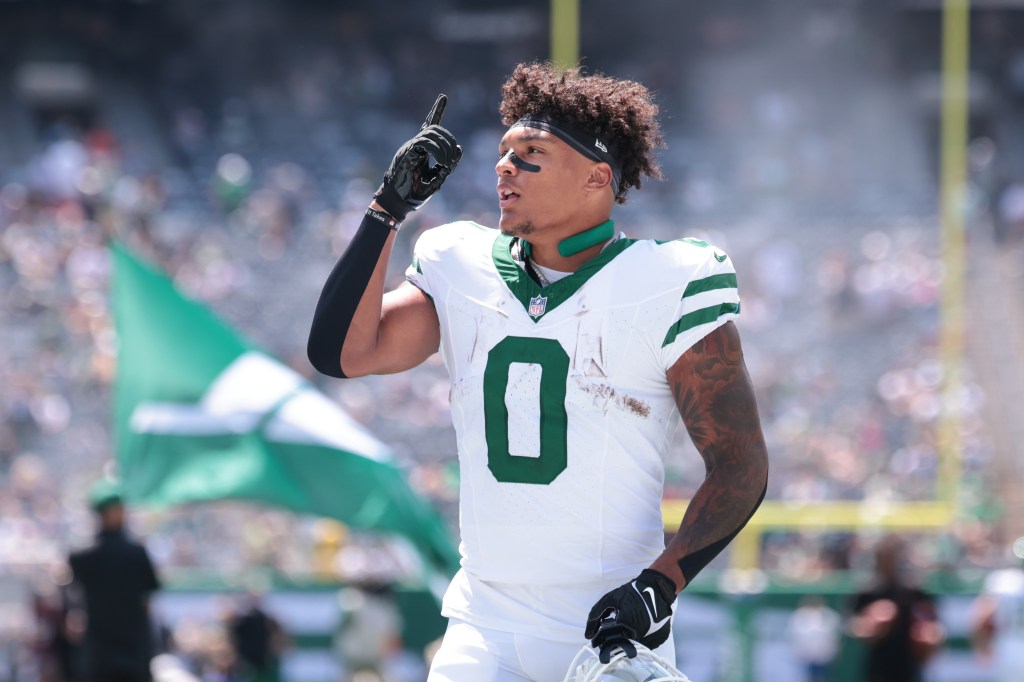
Braelon Allen, New York Jets (Breece Hall)
Allen is an interesting running back. He’s huge (6’1″, 235 lbs) and still ran a 4.51 40-yard dash. The player comp is Arian Foster, who had a special, if albeit short, career. Allen went to Wisconsin, so you’d be right to think of him as a back who can handle a high volume of touches.
What makes Allen an ideal handcuff is that there is a clear delineation here between him and Hall. Plus, the Jets don’t have another back on the depth chart pushing Allen for playing time. So if Hall were to go down, Allen steps in and gets all the snaps and touches.
Gone is Dalvin Cook, last year’s No. 2 running back. Behind Allen is fellow rookie Isaiah Davis, a fifth-rounder out of South Dakota State. Next up, Israel Abanikanda, the favorite from Hard Knocks during last year’s training camp, may get pushed onto the practice squad.
Allen has run well in the preseason, and it says a lot that the Jets didn’t give him many touches. He finishes the preseason with 81 yards on 14 carries (5.8 ypc) and two catches for 12 yards. The Jets have already seen enough to know he’s their No. 2 runner, that’s an encouraging sign.
Hall is so good, so we may not believe it, but Allen may get some playing time, especially around the goal-line. Given the rookie’s size and strength to barrel through for tough yardage, Allen can take some wear and tear away from Hall.
Outlook: Allen’s ADP (200) places him right in the sweet spot of a late-round flier. There’s little risk that late in the draft, and he’s perfectly stashable. By midseason, I wouldn’t be shocked to see a 2-to-1 split in snaps between Hall and Allen.
More Fantasy Football Handcuff Thoughts
Buffalo Bills: Ray Davis is penciled in as the backup. James Cook is so great as a pass-catcher that there’s not enough oxygen in the room. Davis is worth a stash in mega-deep leagues and little else.
Chicago Bears: It’s a toss-up between Roschon Johnson and Khalil Herbert. They both may get playing time with D’Andre Swift too. Three-headed backfields are best avoided.
Green Bay Packers: MarShawn Lloyd would be my long-term choice, but it seems impossible for the Packers to keep long-time No. 2 A.J. Dillon out of the mix. It’s another crowded backfield that may not be dominated by Josh Jacobs, given their past RB usage.
Kansas City Chiefs: Carson Steele is on the come-up and seems to have won the backup job. The rookie makes for a great stash or speculative addition off the waiver wire.
Las Vegas Raiders: Offenses that don’t appear good aren’t usually worth a handcuff. Alexander Mattison hasn’t been good enough in recent years to tempt me either.
Minnesota Vikings: Ty Chandler flashed some promise, given limited touches last season. However, cuffing Aaron Jones is only advisable in the deepest of formats.
New England Patriots: Antonio Gibson’s prime feels like a long time ago–hold firm with Rhamondre Stevenson.
New Orleans Saints: There is no clear leader for the No. 2 job between Jamaal Williams, Kendre Miller and Jordan Mims.
New York Giants: Tyrone Tracy Jr. could steal away playing time from Devin Singletary. The problem is the Giants’ offense will be atrocious this year.
Philadelphia Eagles: If Saquon Barkley goes down, a full committee will be used between Will Shipley and Kenneth Gainwell.
Seattle Seahawks: Zach Charbonnet is a popular handcuff option, but consider me a KW3 truther.
Tampa Bay Buccaneers: Bucky Irving will likely play lightning to Rachaad White’s thunder. This is a split backfield where Irving could carry enough value by midseason to be rostered in his own right.