

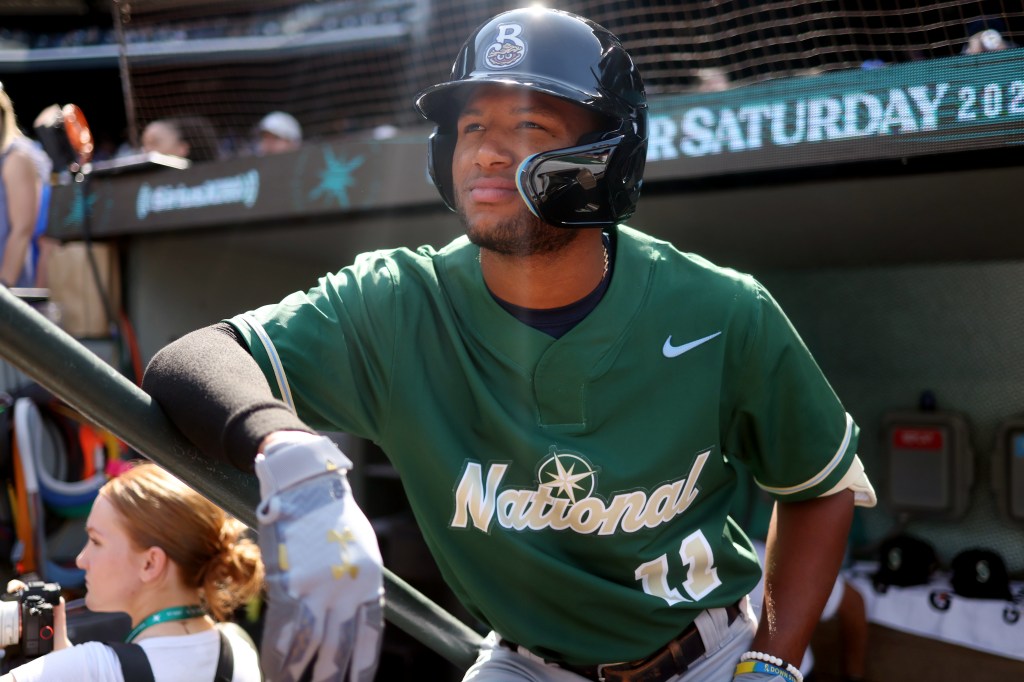
The Milwaukee Brewers made baseball history on Thursday morning, reportedly giving their top prospect, 19-year-old outfielder Jackson Chourio, an eight-year, $80 million deal — despite the fact that he’s never appeared in an MLB game and has just six at-bats above Double-A. $80 million is far and away the record for a player who’s yet to make his Major League debut, and it’s bound raise the eyebrows of casual observers everywhere. But consider this a warning: Chourio’s deal may be an outlier now, but it’s going to become the new normal in the years to come.
The Brewers are close to a deal to extend 19-year-old CF prospect Jackson Chourio
Chourio has only played 6 games above AA. This will be the richest contract ever for a player who has not reached the big leagues yet pic.twitter.com/c0Gy4MdkNb— Talkin’ Baseball (@TalkinBaseball_) November 30, 2023
Granted, Chourio is far from a normal prospect, with top-of-the-scale speed in center field and mammoth power at the plate — there’s a reason he’s currently MLB Pipeline’s No. 2 overall prospect, after all. But we’re seeing more and more young talent making an impact these days — just look at all the memorable debuts the 2023 season offered — and the league’s business model is such that these types of very early long-term extensions make sense for both sides.
The main reason why is how rookie contracts are currently structured, and how much leverage they give teams over players for the first several years of their careers. It’s a bit of a convoluted process, but here’s the basic outline: Teams have control of a given player for their first six years in the Majors, with the clock starting once a player is called up from the Minor Leagues. For their first three of those six years, the team decides what that player’s salary will be — typically something close to the league minimum, currently set at $720,000. For the final three, the player enters the arbitration process: The team chooses the amount they believe the player is worth, the player chooses the amount he thinks he’s worth, and the two sides either meet in the middle or have the matter settled by an impartial third party.
The upshot is that, for the first several years of their career, players’ salaries are tightly controlled, first by their teams and then by an arbitrator. This helps smaller-market clubs stay competitive, but it also means that the game’s young stars are severely underpaid: In 2017, for instance, the Yankees’ Aaron Judge won AL Rookie of the Year and finished second in AL MVP voting … while making just $544,500, several orders of magnitude less than what his services would have been worth on the open market. Judge had to wait five more years after that to finally cash in as a free agent — five years in which he could have suffered a serious injury, or a downturn in performance, or anything else that might have impacted his future earnings.
Which brings us back to Chourio. He certainly has the look of a future superstar, but even if he hits the ground running and wins Rookie of the Year in 2024, he won’t have the chance to cash in on that production until he becomes a free agent — in 2030. A team like the Brewers, meanwhile, know that they’ll always have a hard time convincing their best players not to leave once they hit the free market; they want as many years of team control as possible. So they come to Chourio with a deal: They’ll significantly increase his salary in the near-term in exchange for delaying his free agency, putting him under contract for the next eight years instead of the next six.
You can certainly understand why Chourio would say yes to the prospect of making $30 million over the next three years rather than the $3 million or so he’d stand to make with a normal rookie deal. But it’s important to recognize that this is also an enormous bargain for the Brewers: If Chourio does indeed become anywhere near the player he’s expected to, Milwaukee will still have him on a contract well below his market value, a contract that’s now two years longer. (And even if he doesn’t hit his considerable ceiling, Chourio’s athleticism and defensive value alone more or less ensure that he’ll be a $10 million a year player — basically the going rate for an average everyday starter.)
And it’s not just Chourio who’ll be facing this particular choice. These are the incentives that every great young player who comes after him will have to deal with, forced to choose between immediately financial security and the ability to hit the open market as soon as possible: the same choice that allowed the Braves to lock up guys like Ronald Acuna Jr. (eight years, $100 million), Spencer Strider (six years, $75 million) and Michael Harris II (eight years, $72 million) to well below market deals. Granted, those three had already established themselves with very good rookie seasons in the Majors. But the point is that Chourio’s deal is just the logical next step of an ongoing trend, one that will only become more prominent in the years to come.