

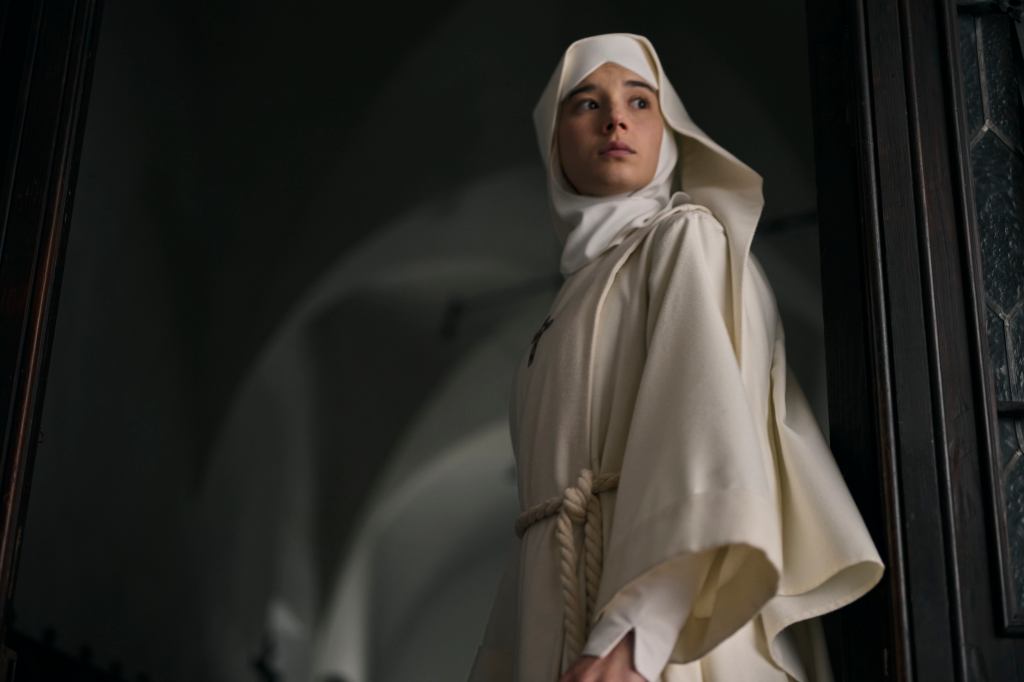
The harsh, thick air of the late 1930s Spanish Civil War makes its presence known immediately in Sister Death. A young woman named Narcisa (Aria Bedmar) makes her way to a small convent doubling as a school for underprivileged girls; the bullet holes serve as eerie reminders in the walls outside. It’s a place tucked away in the countryside, but withholds many secrets inside its holy grounds. Director Paco Plaza’s prequel to his 2017’s Veronica strives to look at faith as something that moves, shifts, and perhaps used as a tool to oppress and stifle all at the same time.
The film moves at a slower pace that may throw off the fans of the first film – as there’s a progressive buildup to the mystery that is ultimately being solved. Narcisa is looking to enjoy somewhat of a low-key, peaceful life, given her moniker as The Holy Girl of Peroblasco when she was younger. It is said that she can see visions of the Virgin Mary and obtains supernatural powers. Now older, Narcisa is having a crisis of faith. She’s unsure if her visions are because of this power bestowed upon her or just a creation of the hysteria of adults who needed something to believe in. Nevertheless, Sister Julia (Maru Valdivielso) and Mother Superior (Luisa Merelas) are thrilled to see her and are well aware of the legend that precedes her (even if Narcisa can’t quite remember all of it).
:format(webp):no_upscale()/cdn.vox-cdn.com/uploads/chorus_asset/file/25049997/HM_Dia10_220408_Sec98_DanielEscale_Stills_0009.jpg)
Narcisa is offered and accepts a teaching position, but doesn’t think she’s worthy of it. In that moment of self-doubt, that where things start to get weird. The students warn of a ghost that draws Hangman pictures on the walls – but you should never complete it for your own good. A cigarette box in Narcisa’s room holds an obituary to a previous nun – a small tip to the mystery of something not right existing within the convent. Everything happens for a reason, as they say, and Narcisa was led to this particular place for a reason.
Unlike the more possession horror landscape of Victoria, Plaza elects for a slightly quieter ghost story vibe – at least at the beginning of Sister Death. Questions of how we all experience faith are present throughout Jorge Guerricaechevarría’s story, along with getting to the bottom of what happened long before Narcisa’s arrival. There are talks of a previous nun who has played the ghost’s game and was never heard from again. Sister Julia is extremely adamant about not only not believing the girls and their macabre story, but Narcisa’s time as “the saint child.” Just why is everybody so tight-lipped about the convent’s history?
Plaza gets some legs out of this story, sprinkling some poltergeist-like setpieces ever so slightly. When the latter half of Sister Death kicks in, this is where many of the more abstract, somewhat gory, and Veronica tie-ins kicks into full gear. The sudden adrenaline infusion in the film might feel slightly jarring, given how deliberately paced the first part is. But there are unique things added to make this prequel an experience that can both be enjoyed on its own and a double feature. Daniel F. Abelló’s cinematography captures the convent in a way that makes it pulsate with beautiful and cold energy. Bedmar is given the space for her character to reason with what happened in her childhood and wonder if this path is right for her.
We all go through instances where we question our steps that we didn’t necessarily order. Imagine having a country and influential people in the faith community looking to you when you’re unsure of things yourself. Sister Death’s success and maybe its pitfalls hinged on the choice to take a different genre route rather than looking to replicate the same formula.