

One would rarely think to put together a personal reformation story with a satire of the dog-eat-dog world of the pharma industry in one film. This is exactly what David Yates attempts to do with Pain Hustlers, loosely based on the real-life story of the company Insys, which launched a spray that contained fentanyl as an active ingredient. In a capitalistic cycle, many people got rich and greedy off the backs of other people’s addictions and deaths. It becomes even more insidious when you consider how things were marketed and the dirty dealings behind the scenes concerning these companies and doctors.
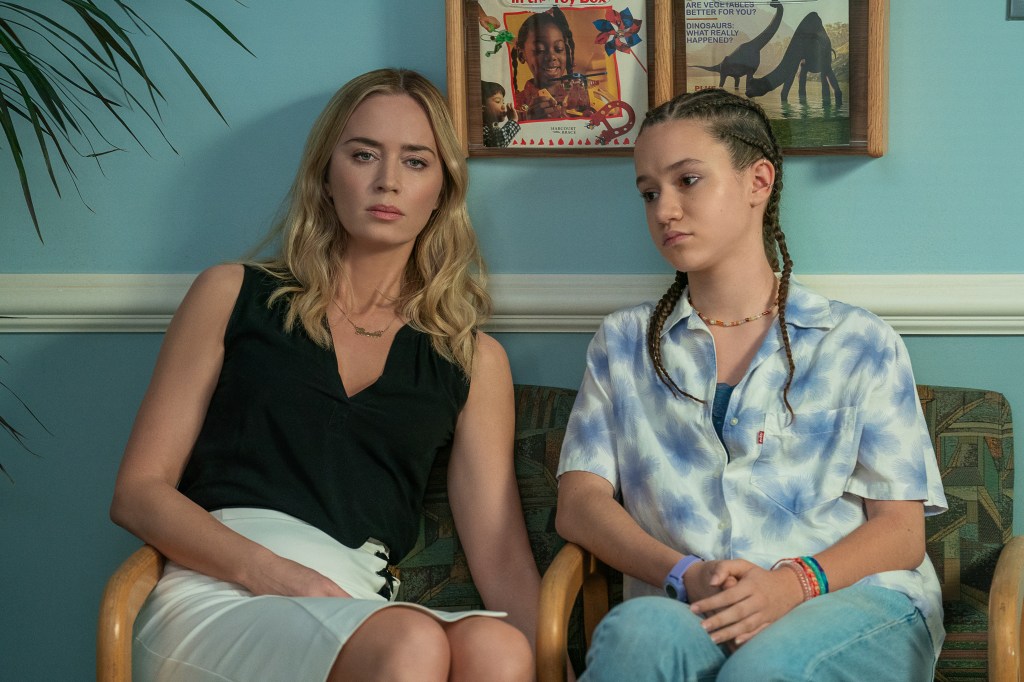
Yates and writer Wells Tower try to ground this story with a rags-to-riches character. In Florida in 2011, Liza (Emily Blunt) is at the end of her rope. She is recently divorced, and her ex-husband took the restaurant they ran together. She and her daughter Phoebe (Chloe Coleman) sleep in her sister’s garage alongside her mother. Jackie (Catherine O’Hara) temporarily. Trying to earn some income, she strips part-time at a local club. Even as things are on the high end of low for Liza, she still has the gift of gab that helps her through situations.
Liza uses it to somehow talk Phoebe’s principal into not expelling her for a firecracker prank gone wrong – then gets the ear of Pete Brenner (Chris Evans), a pharmaceutical rep whose business is trying to sell Lonafin who is a painkiller spray containing fentanyl that is supposed to kick in five minutes after usage and not be as addictive. But unfortunately, it doesn’t have any hold of the marketing share, and the overall company is low on funds even to compete. This is where the inclusion of Liza comes in. Sure, she’s determined to change her fortune, but this job isn’t exactly a guarantee. The base pay is $7.60, and if she doesn’t make a commission within a couple of weeks, she’s fired.
It’s a highly stressful job with little reward. The subtext told the audience that this medication would be a game changer for cancer patients – at least, that’s the tiny bit of morality Pain Hustlers tries to keep hold of as it ventures through its conventional narrative and documentary-like styles. Perhaps there’s a bit of nobility for this with Liza. You learn she had a previous felony charge for selling THC gummies to cancer patients previously. Good intentions are great, but eventually, the pursuit of power and wealth overtakes everybody. A reoccurring issue Pain Hustlers finds itself confronting is trying to be grounded within Liza’s story and displaying an entire culture of excess and disregard for regulations.
There’s a $40,000 per-prescription prize on the line, and everybody goes after as many as possible once Liza lands her first. From that point on, the film follows a cadence of massive celebrations, illegal dealings regarding speaking programs and hiring montages. Once “Turn Down For What” hits the backdrop of a gigantic party, it feels like all parties involved will feel any regrets for what they are doing. I mean, do they think this medication was not so addictive? Yates seeks to use Blunt’s performance to level this story by not going too far into the ridiculousness. Early all, Liza’s problems are solved – she makes loads of money, can get her daughter into a private school, finds them a beautiful new apartment to live in, and even hires her mom on board.
:format(webp):no_upscale()/cdn.vox-cdn.com/uploads/chorus_asset/file/25038906/TPH_20220912_07262_R2.jpg)
Blunt straddles the line in letting Liza enjoy it all and, at the same time, trying to have a moral compass. A subplot happens involving Phoebe developing a brain condition that leads her to have seizures. If you’re thinking that this would lead to some drug usage for it to go away, Yates and Tower thankfully turn away from that. Instead, Liza needs the money for a costly procedure, and time is of the essence. Jack Neel (Andy García), Liza and Pete’s increasingly erratic acting boss, wants more growth, which means a blanket prescription for the spray outside approved usage.
From there, you can see what’s about to happen. Pete, the excitable, somewhat sleazy salesman, wants to keep the good times rolling, and Liza has a change of heart. Towards the end of Pain Hustlers, the film perhaps tries to settle what the thesis is looking to get at is that the opioid crisis was terrible, and these companies used the afflictions of real-life people to fund excess and luxury. That’s all fine and good, but it takes so long to get that point and misdirects its main messager to instill those thoughts. Essentially, the realization isn’t as eye-opening as it should be – considering there are other films and series that have told the same story.