

This piece was written during the 2023 WGA and SAG-AFTRA strikes. Without the labor of the writers and actors currently on strike, Barbie being covered here wouldn’t exist.
If you’re going into Barbie feeling that there will be a goofiness element of a fictional character going into the real world, you would be right. Director Greta Gerwig embraces the self-referential, over-the-top silliness of the history of Mattel’s most profitable toy. It’s part of the beauty of this film, in addition to addressing the truths of both the positive and negative effects of the doll’s history and the ongoing plights of patriarchal ideals and their constant infringement on female autonomy in the real world. What could have been another piece of IP fodder is a film that’s insightful, reflective, a little sad, and comical.
The film begins in the utopic Barbie Land, where there are many dream houses aplenty and everybody seems to have a perfect life. Within this colorful and figurine-like landscape, everybody has an established routine – you wake up, eat the fake food, go to the beach to play some volleyball, and await the night to prepare for a highly choreographed party. Not to mention, this is a place exclusively run by women with an ensemble of Barbies that have an impressive assortment of occupations like president, doctor, physicist, and writer (played by Issa Rae, Hari Nef, Emma Mackey, and Alexandra Shipp, respectively).
:format(webp):no_upscale()/cdn.vox-cdn.com/uploads/chorus_asset/file/24793784/rev_1_BARBIE_TP_0003_High_Res_JPEG.jpeg)
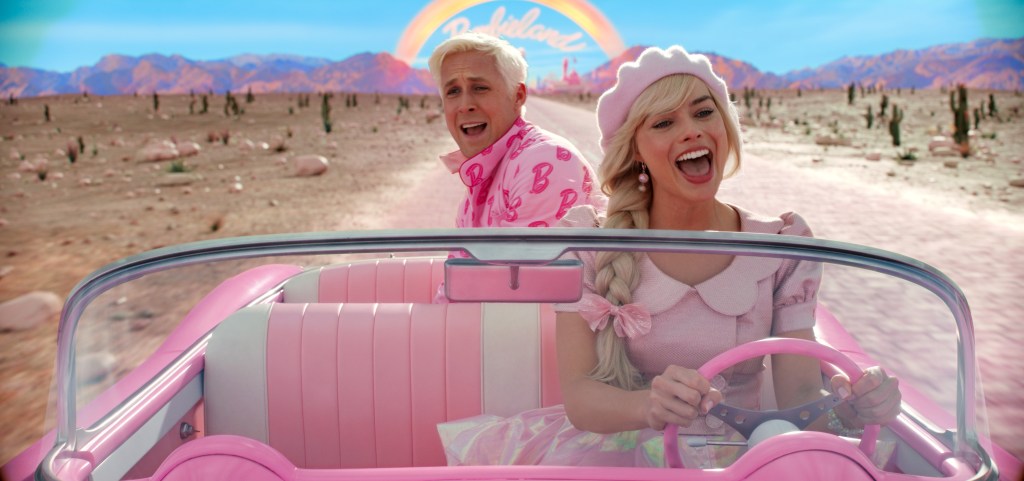
Legislation and the Supreme Court are headed by women, which plays a role reversal for the Ken dolls (Kingsley Ben-Adir, Simu Liu, Scott Evans). They are meant to play supporting roles within this society. At the heart of this tale is the Stereotypical Barbie (Margot Robbie) and what we would think would be her companion, Ken (Ryan Gosling). The Barbie that everybody is familiar with seems to have a perfect life and pushes off Ken’s advances to pair up, keeping that intact. One day, Barbie starts to have intrusive thoughts about death, has terrible breath, and walks on the ground flat foot. What is a doll to do? It’s not until she consults Weird Barbie (played by the always funny Kate McKinnon) that she discovers a journey to be had into the real world.
Suppose Barbie has any hope of restoring her euphoric life. In that case, she has to venture to California to track down the human counterpart infusing these sudden rushes of emotion inside her. This trip has some complications – Ken feels the need to impart himself in a male savior-esque role that Barbie doesn’t ask for. Then it’s the overall view that Barbie has of her world full of female empowerment, and perhaps thinking this has taken to places outside of it. Gerwig and co-writer Noah Baumbach’s awareness of Barbie’s complicated and detrimental history regarding the iconic doll and female self-image.
:format(webp):no_upscale()/cdn.vox-cdn.com/uploads/chorus_asset/file/24793787/rev_1_BARBIE_TP_0006_High_Res_JPEG.jpeg)
The real world is not the ticker tape parade Barbie expects, and it throws her for a loop – causing an awakening within her to see more outside her playland’s vibrant walls. What helps this along is the story of a mother named Gloria (America Ferrera) that works at Mattel and her daughter. Sasha (Ariana Greenblatt). They used to be closer, but the distance between the tween and her mother has made Gloria feel melancholy. Within all this is a corporate subplot with Mattel CEO (Will Ferrell) that is rather alarmed to hear the toys are out and about rollerblading in the California sunshine. He claims to act in good faith of inclusion, but it’s mainly about the bottom line.
Barbie’s ability to highlight many different body types and disabilities within its “dream” world is a great notch on its belt – this is an addition to how it looks into patriarchy, self-reliance, and asserting your identity outside of relationships. Much of this starts with the acting of Robbie and Gosling. Robbie exerts the range of being bubbly and flips a hearty emotional beat exactly when the film calls for it. Gosling is the exaggerated, macho personification of what we would envision a live Ken doll being. (complete with an entertaining musical number). Much of that is to hide his insecurities, and the film investigates more of this in its second half. America Ferrera’s character brings about an inflection point with an intelligent monologue that personifies the entire spirit of what the film is trying to say.
It’s not only to call attention to how societal mores held on to generations have been harmful to both men and women alike, but it also deconstructs what unhealthy attachment, ego, and jealousy mean when a perceived role becomes all you identify yourself with. Why does it have to be Barbie and Ken anyway? Well, it doesn’t – ultimately, people will want different things for themselves, and Gerwig gets that point across with a toy come to life. Barbie is visually alive as cinematographer Rodrigo Prieto’s style makes significant distinctions between what the real world looks like as opposed to many of the templates come to life.
Deep cuts involving a lot of discontinued Barbies play to some chuckles and some of the Mattel lore. Not everybody has bought into the prestige this generational doll has carried through generations. Barbie’s ability to lean into this notion is one of the many reasons this differentiates it from many of the cash-grab nostalgia you see in other projects. It’s not simply an “all men are bad” expose – if that’s all you see, you are missing the overall point. The film perhaps asks us all to look into many of the passed down ways we are told what gender roles are, how to act when someone is assertive with their boundaries, and why, like the role of Barbie herself, needs a new definition.