

Well, Black Mirror can’t always be about technology, right? When I’ve talked about this series with fellow fans, they’ve expressed that it may be hard for the series to have its intended effect because (motions at society right now). The sixth season still packs a punch – especially concerning the first episode, “Joan Is Awful.” We’re just now coming to terms with AI and how our media is going to be shaped by this technology. Within “Joan Is Awful,” there’s a scene where the CEO discusses viewing habits and how we will be turned off to view anything positive. It’s a classic Black Mirror moral mic drop.
However, this season has shown that storytelling is willing to veer out of the electronic space. “Loch Henry” takes on our current ghastly fascination with true crime, and “Mazey Day” is a homage to all the unhealthy ways we hound stars – both with varying degrees of effectiveness and sharing with commonalities of almost unethical consumption. The final episode of season six, “Demon 79,” is perhaps the most non-Black Mirror scenario ever. There are still some story beats that an avid series watcher would identify. But for the most part, it’s a period piece that deals with racism, a proverbial monkey’s paw of murderous intent to “save the world,” and loneliness.
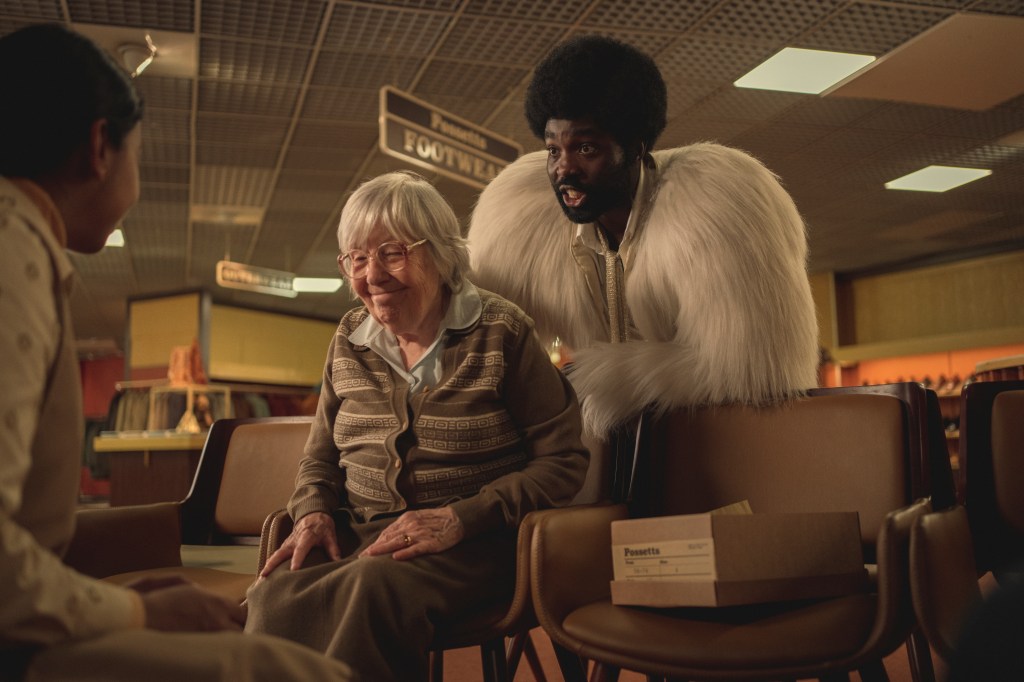
At the story’s center is a woman named Nida (Anjana Vasan) who lives in England at the tail end of the 1970s. She works as a shoe clerk in a department store and keeps to herself – mainly because her society is highly hostile to her heritage. We’re talking about a boss that tells her to eat her lunch in the basement because “it smells so bad,” an extremely rude co-worker named Vicky (Katherine Rose Morley), and a suspected murderer and customer Keith (Nicholas Burns) who hits on her. That’s just as work – with an impending election, there are not only Cold War tensions with nuclear weapons, but an anti-immigrant movement headed by a conservative candidate named Michael Smart (David Shields).
Outside of this sad state, Nida briefly fantasizes about brutally murdering each of her detractors simply because she doesn’t fight back. When Nida goes to the basement, she encounters a talisman she accidentally bleeds on. The indiscreet ritual serves almost like getting a genie out of the bottle – Nida meets a demon named Gaap (Paapa Essiedu). The task is simple, Nida has to kill three people in three days – if not, the world ends. There are some impediments to this—first, Nida’s moral compass. It’s different from daydreaming about offing your detractors rather than carrying them out in real life. The weight of saving the world versus committing acts of murder is something she actively struggles with. After all, this is a community that actively marginalizes her because of her background. Why would she want to save that world?
:format(webp):no_upscale()/cdn.vox-cdn.com/uploads/chorus_asset/file/24754252/Black_Mirror_n_S6_E5_00_52_07_06.png)
Then, as with anything, there are rules to who she can kill. This notion, in particular, throws a monkey wrench towards the end of “Demon 79.” The outside world looks at Nida as if she doesn’t belong already, but Gaap’s inclusion only being seen by her adds an extra layer to that. So, there’s a clear goal within the episode, considering there are 72 hours before the world is blown to bits. However, at the heart of “Demon 79” is a shared story of loneliness – Nida is highly isolated, and Gaap can’t fully gain his status until this task is complete. Far be it from anybody to find solace in a human/demon relationship, but director Toby Haynes and writers Charlie Brooker and Bisha K. Ali pull it off. Vasan and Essiedu combine to make a good pair.
With “Demon 79,” a detective subplot exists merely because somebody has to investigate this blood trail. In a new season where the longstanding franchise looked to tinker with its formula, this episode shows where things can go. Does it overstay its welcome? Yes. With this and “Mazey Day,” it feels as though the franchise is testing out how this new territory works. The rise of overt racism and nationalistic ideals feel eerily similar to today. In many ways, Black Mirror has served as a glimpse into our future, but perhaps this is when it warns us to heed the lessons of past mistakes.