Who can suppress all the greatest forces of competitive volatility for six outs? The juicy NRFI—a wager on sequencing, on command showing up immediately, on hitters needing just one more pitch to calibrate. Even this early in the season, the modern game is louder than ever—exit velocity, launch angle, damage on contact. But the first inning still lives in a narrower band, where timing lags just enough behind power to create silence.
With that in mind, here are my top three NRFI picks for Sunday’s full slate of MLB action.
Mets vs. Braves NRFI (+100)
Mets-Braves is the cleanest NRFI of the trio because both the team profile and starter matchup support a quiet opening inning. New York averages 0.47 first-inning runs per game overall and only 0.30 on the road. That road split matters against Atlanta because the Mets have gone NRFI in 74.16% of games and 78.26% of road games. Atlanta carries obvious first-inning power, especially at home, where it averages 0.65 first-inning runs per game. Still, the Braves’ team NRFI rate sits at 66.67% overall and 67.44% at home.
Nolan McLean gives New York the higher-impact starter side. He enters with 95.1 innings, 113 strikeouts, a 3.78 ERA, and a 1.12 WHIP. That strikeout volume plays against an Atlanta order that can get aggressive early. Current Braves hitters are 4-for-23 against McLean, all singles, with eight strikeouts and three walks. That is a useful top-order snapshot for a first-inning bet because Atlanta has not produced extra-base damage in the matchup.
Martín Pérez creates the risk pocket. His 3.27 ERA and 1.16 WHIP are steady enough, though the deeper indicators are less pristine. Pérez owns a 19.5% strikeout rate, 9.6% walk rate, 9.9% K-BB rate, 4.29 FIP, and .323 xwOBA allowed. The Mets’ first three can pressure him if he falls behind. The full environment still grades well because McLean has the swing-and-miss edge, New York’s road first-inning offense is modest, and Pérez can survive contact if he avoids walks.
Blue Jays vs. Mariners NRFI (-135)
Blue Jays-Mariners has the best ballpark fit and one of the softer combined first-inning scoring profiles on the slate. Toronto averages 0.38 first-inning runs per game overall and 0.40 away from home. Seattle averages 0.48 overall and 0.57 at T-Mobile Park. That keeps the combined road/home first-inning number under one run, which is exactly the lane this bet needs. Toronto has gone NRFI in 76.40% of games and 80.00% of road games. Seattle sits at 67.78% overall and 63.04% at home.
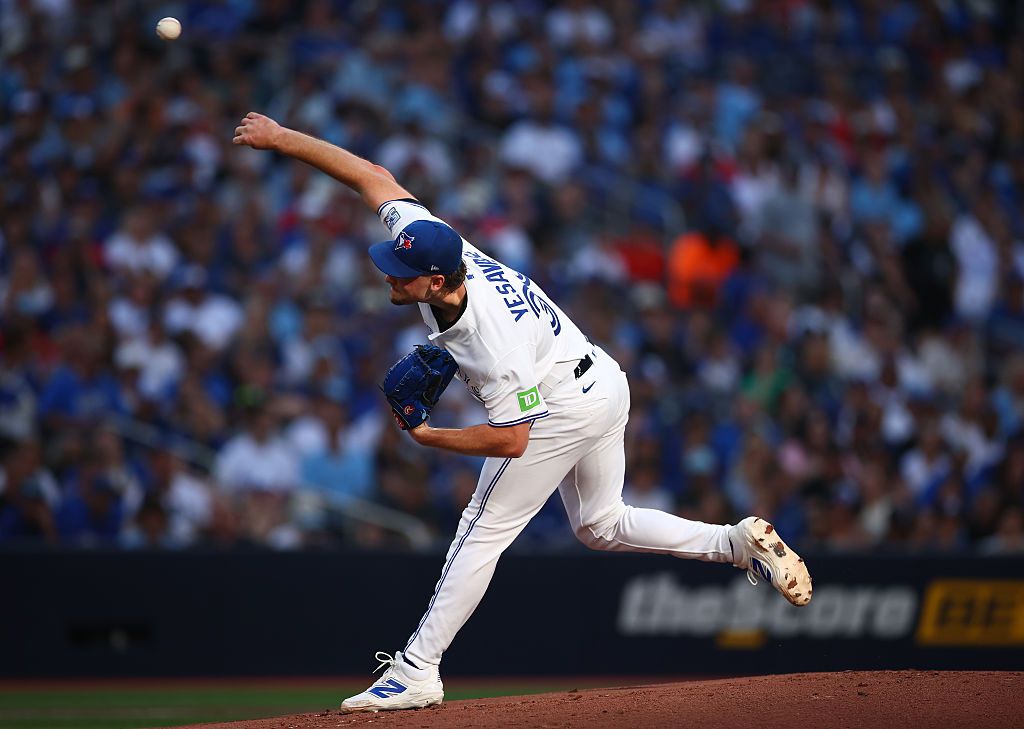
Trey Yesavage is the stronger starter fit. He enters with a 3.34 ERA, 1.10 WHIP, and 61 strikeouts across 67.1 innings. The contact profile fits a first-inning under: 88.8 mph average exit velocity allowed, 37.0% hard-hit rate, .277 wOBA, .279 xwOBA, and 5.5% barrel rate. He also comes off a 6.2-inning, one-run start with no walks. That command note matters because first-inning NRFIs die quickly when pitchers donate traffic.
Emerson Hancock is the main leak, though the profile is still playable. He owns a 3.47 ERA, 1.05 WHIP, 24.2% strikeout rate, 6.1% walk rate, 18.1% K-BB rate, and 3.77 FIP. The loud-contact numbers are shakier: 90.6 mph average exit velocity, 44.9% hard-hit rate, and 9.8% barrel rate. Toronto can punish mistakes, especially through Vladimir Guerrero Jr., but the lineup shape is less explosive with Nathan Lukes leading off. Julio Rodríguez’s absence also trims Seattle’s opening-inning thunder.
Tigers vs. Rangers NRFI (-120)
Tigers-Rangers is the most price-sensitive NRFI because Casey Mize is excellent, while the team-level first-inning profile is more dangerous. Detroit averages 0.60 first-inning runs per game overall and 0.71 on the road. Texas averages 0.58 overall and 0.72 at home. Those are the highest first-inning scoring marks among the three picks. Detroit’s overall NRFI rate is 67.42%, and Texas sits at 70.79%, but Detroit’s road NRFI mark falls to 60.00%. That makes the number matter.
Mize is the reason this remains on the board. He enters with a 2.63 ERA, 0.97 WHIP, 68 strikeouts, and 14 walks across 65 innings. His skill indicators are even better: 26.9% strikeout rate, 5.5% walk rate, 21.3% K-BB rate, 2.51 FIP, and 0.55 HR/9. The contact suppression is elite for this group. Mize has allowed an 87.8 mph average exit velocity, 34.7% hard-hit rate, .260 wOBA, and .263 xwOBA. That profile travels against a Texas lineup still searching for reliable home scoring.
Kumar Rocker makes the other half shakier. His 3.83 ERA and 1.15 WHIP are acceptable, and he has missed enough bats with 70 strikeouts across 80 innings. The deeper contact profile adds volatility: 89.4 mph average exit velocity, 42.7% hard-hit rate, .308 wOBA, .329 xwOBA, and 7.5% barrel rate. Detroit’s top order has enough first-inning scoring pop to punish a loose opener. This is a fair NRFI at plus money or short juice, but Mize should not create an inflated price.