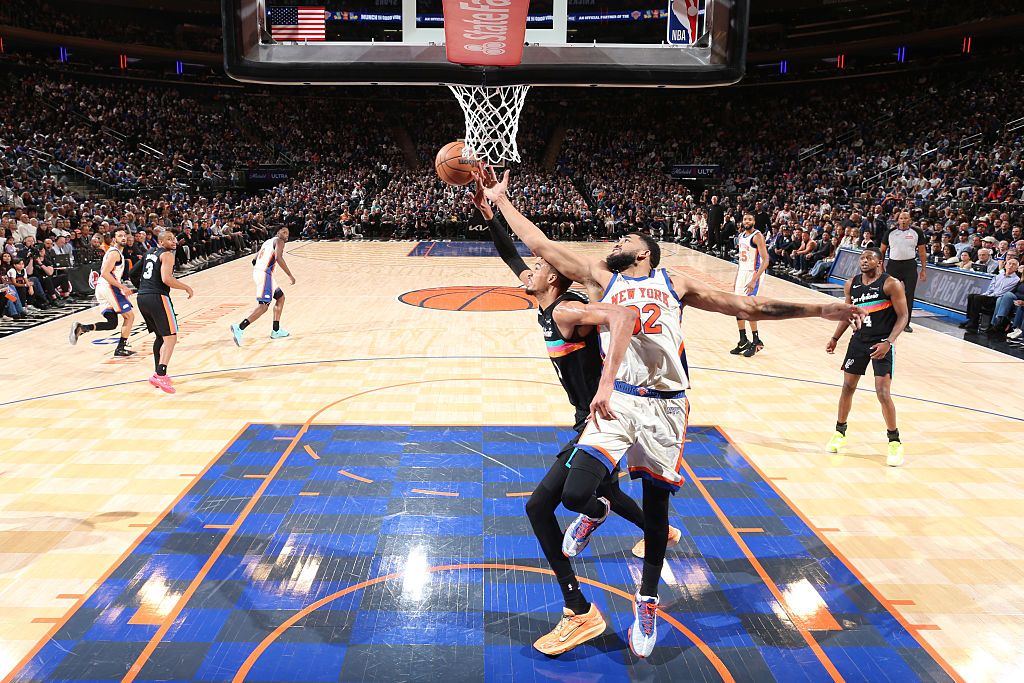
In 2014, the last time the San Antonio Spurs made the NBA Finals, Kawhi Leonard was the team’s star player, and he ended up winning Finals MVP as the Spurs beat the Miami Heat in five games. While Leonard has long since left San Antonio, his legacy as a “Board Man” (for his career, he’s averaged 9.4 rebounds per game in the Finals) remains, and it’s not a surprise that the New York Knicks and the Spurs rank first and third among playoff participants, respectively, in rebounding percentage.
Controlling the glass is one of the most consistent predictors of success in the NBA, as teams that won the rebounding battle tend to win the game some 70% of the time. The team that won the rebounding battle both of the teams’ regular season matchups, as well as the NBA Cup final.
Who Will Lead the NBA Finals in Rebounds?

Despite New York’s employing Josh Hart, arguably the best pound-for-pound rebounder in basketball, this market tends to be dominated by centers, and this series is no exception. San Antonio’s main man, Victor Wembanyama, is a -140 favorite at DraftKings Sportsbook, and Knicks center Karl-Anthony Towns is +150, with every other player at least an 11-to-1 long shot. It makes sense; Wembanyama led the league in defensive rebounding percentage and ranked fourth in rebounds per game this season, while Towns has finished second in rebounds per game in each of his seasons in the Big Apple.
Wembanyama is capable of the bigger individual rebounding performances. While Towns has topped out at 17 boards in this playoff run and only has one 15-plus-board performance, Wembanyama opened his conference finals ledger with a 41-point, 24-rebound masterpiece. However, Towns has been the more consistent rebounder, as he had double-digit rebounds in all but five of his playoff games while Wembanyama has fallen below the double-digit threshold five times in his last eight games alone.
Throughout the postseason, Wembanyama has been in position to snag slightly more boards, as he’s averaged 18.4 rebound chances per game to Towns’ 16.3, but Towns has been more effective at taking advantage of those opportunities, coming down with it 64.9% of the time to Wembanyama’s 58.7%. The teams have had a relatively similar shot diet, attempting a lot of restricted-area shots and corner threes, but because the Spurs have held opponents to a much lower percentage on close-range tries, that should slightly advantage Wembanyama. His average board these playoffs has come 0.5 feet closer to the basket than Towns’.
Unlike the Oklahoma City Thunder, who could effectively ice Wembanyama away from the paint with Isaiah Hartenstein’s combination of physicality and mobility, New York might not be able to do that as effectively with the slower-footed Towns manning the middle and Mitchell Robinson, one of few defenders capable of handling him one-on-one, iffy with a broken pinky. That would allow the Frenchman to be more effective offensively and open up more opportunities for him to grab close-range offensive boards.
Defensively, that calculus could change if Hart, who’s likely to see plenty of minutes matched up against Wembanyama, hits his threes. If Hart can force Wembanyama to challenge his triples, he could open up more easy rebounding opportunities for Towns, who sticks closer to the basket on defense than Wembanyama is because of his slower recovery time. Hart hasn’t done that so far these playoffs, but there’s plenty of reason to suggest that he could bounce back, given that he hit uncontested triples at a 43.5% clip during the regular season, the 19th-best mark among the 91 players who played at least 65 games and attempted at least two such shots per game.
Ultimately, I’ll go for Towns at +150. Any potential Robinson absence or limitations would also open up even more minutes for Towns, who had the same number of rebounds in the teams’ three matchups as Wembanyama did. Wembanyama should be highly impactful on the boards as well, but over the course of a long series, I’ll take the more consistent threat.