The word Cinderella has always been a little too delicate for what these teams actually do. It makes them sound ornamental, accidental, as if they wandered into March wearing borrowed glass slippers and happened to stay. The teams worth betting on are usually less dainty than that. They defend like pests, they run like thieves, they force better teams to play uglier than planned, and they carry themselves like they have already rehearsed the national surprise.
My two favorite Cinderella teams this year fit that older, better version of the idea. They are the kind of teams that can change the emotional weather of a region—teams with enough structure to win the opener, enough personality to make the second game feel possible, and enough stylistic bite to turn a favorite’s comfort into something much shakier. If March is going to produce one of those runs that feels less like an upset and more like a story the bracket was secretly waiting to tell, these are the two schools I would want holding the pen.
And they are most certainly not here to just decorate the tournament’s first weekend. No—they are here to shatter some glass.
Here, also, is a link to my Five 2026 March Madness upset predictions to help you win your bracket piece, the subject matter of which should speak for itself!
Here’s how I see it. I’ll be pumping out these predictions for individual games all season, with plenty of coverage here on DraftKings Network. Follow my handle @dansby_edits for more betting plays.
Dan Johnson’s two top Cinderellas for March Madness 2026
12-seed High Point Panthers
High Point, the No. 12 seed in the West, is the sort of Cinderella story people usually assemble after the fact, once the confetti of hindsight has already begun to fall. This one arrives with the script practically typeset. The Panthers are 30-4 overall, 15-1 in the Big South, 7-2 on the road, 6-1 on neutral floors, and they enter the tournament on a 14-game winning streak after becoming the first Big South team ever to win 30 games in a season. Their pedigree exists in spite of their by schedule strength—NET 75, BPI 63, KenPom 92, Torvik 93—but the team itself is too vivid to be dismissed as small-conference ornament. High Point scores 90.0 points per game and allows 70.3, shoots 49.1% from the field and 35.6% from three, makes 19.9 free throws per game, turns it over only 9.4 times a night, forces 16.4 turnovers, averages 10.9 steals, and has outscored opponents by 19.7 points per game. That’s the profile of a team that manufactures pressure, then watches the game begin to warp under it.
The late-season form is what elevates High Point from intriguing to genuinely dangerous. Across their last eight games—beginning with a 95-70 road win at USC Upstate on February 12 and extending through the Big South title game—the Panthers went 8-0 while averaging 87.0 points and allowing 71.4. The sequence itself is revealing. There was the 112-87 road dismantling of Gardner-Webb, the 74-48 suffocation of UNC Asheville, the 79-73 road win at Presbyterian that secured the outright regular-season championship, and then three tournament victories by 22, four, and 15 points: 81-59 over Gardner-Webb, 75-71 over UNC Asheville, and 91-76 over Winthrop in the final. What matters there is the range of those wins. The Panthers showed they could bury a team in pace, smother one in pressure, and survive a more jagged, less decorative semifinal once the night turned ugly. That kind of elasticity travels. It is one thing to dominate a league in a single idiom; it is another to prove, in March’s shadow, that you can win in several.
The player ecosystem gives the whole thing its actual dramatic weight. Terry Anderson is the emotional center, but also an unusually efficient one: 16.0 points and 6.0 rebounds per game on 56.4% shooting. Rob Martin gives High Point a genuine lead guard rather than a mid-major facsimile of one, averaging 15.3 points with 121 assists, 52 steals, and a 2.16 assist-to-turnover ratio. Owen Aquino is the lovely structural nuisance every Cinderella hopes to bring into the room—9.4 points, 5.9 rebounds, 82 assists, 58 blocks, and 45.5% shooting from three in selective volume, which means opposing bigs must acknowledge him in space without forgetting what he can do as a passer or rim protector. Then there is the connective tissue that keeps the whole thing from feeling like a one-man parable: Kam Craft has made 58 threes, Kimani Hamilton averages 9.5 points, and the roster as a whole has 554 assists against 318 turnovers. This is a fully articulated offensive ecosystem, with enough ball movement, floor spacing, and defensive activity to make a favorite feel the game slipping away in the margins before it fully understands that it is happening.
And the bracket, crucially, offers High Point a path that feels dangerously intelligible. First comes Wisconsin, a No. 5 seed with a grown-up résumé and one of the country’s cleaner offensive profiles: 24-10, 83.0 points per game, 400 made threes, a 12.9% turnover rate, and, since January 1, a top-three offensive efficiency mark nationally. Nick Boyd and John Blackwell combine for 39.6 points per game, Wisconsin has won at Michigan, Illinois, and Purdue, and over its last five games it beat Maryland by 33, Purdue by four, Washington by three, and Illinois by three before falling to Michigan by three in the Big Ten tournament. The case for High Point is that Wisconsin’s great virtue—order—must survive contact with a team devoted to disorder without becoming slack, rushed, or slightly self-conscious. If the Panthers can drag the opener into a turnover-and-transition game, the second round is Arkansas or Hawaii, and the Sweet 16 side of the West points toward an Arizona team whose own low three-point volume has already become a national talking point. That is why High Point feels like such a rich television pick, too. The Panthers have a style of play that lets you watch anxiety spread throughout their opponents like a poison.
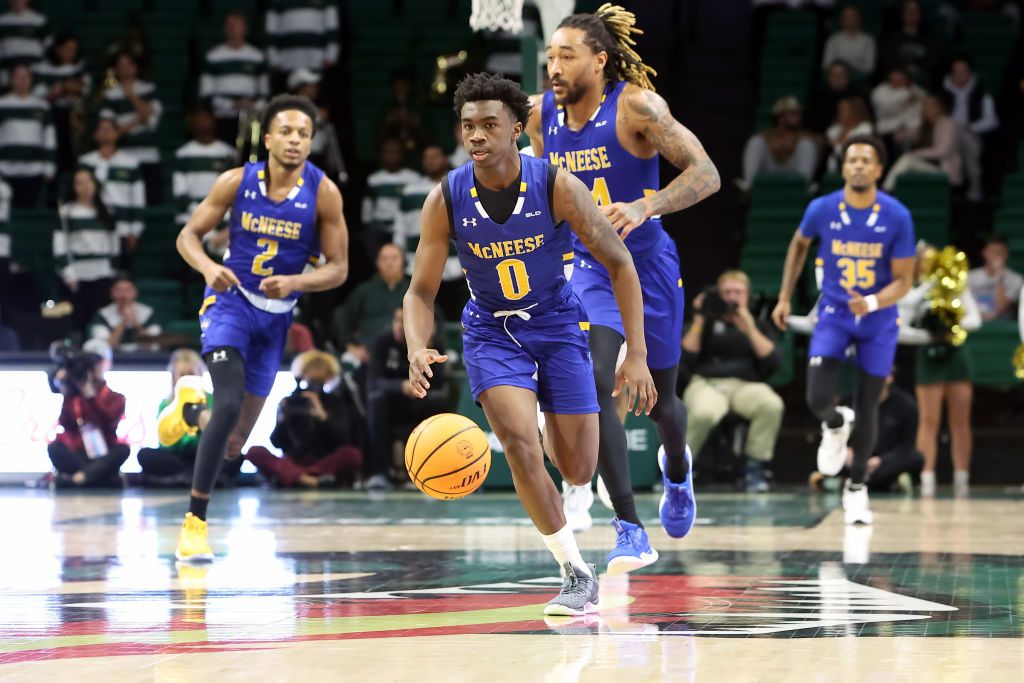
12-seed McNeese Cowboys
McNeese, the No. 12 seed in the South, belongs to a more severe species of Cinderella—the kind didn’t charm the room so much as unsettle it. The Cowboys are 28-5 overall, 19-3 in the Southland, 9-5 on the road, 5-0 on neutral floors, and they arrive on a 10-game winning streak while making their third straight NCAA appearance and fifth overall. Last March they stunned No. 5 Clemson for the program’s first NCAA tournament win; this year they return with a profile that feels even less accidental. Among Division I-only metrics, McNeese is NET 56 with a 47 SOR, 47 WAB, 60 BPI, 68 KenPom, and 73 Torvik. The team numbers make the appeal plain almost immediately: 80.0 points per game, only 66.5 allowed, 46.8% shooting, 35.2 rebounds, 9.6 turnovers per game, 16.9 forced turnovers, 22.3 points off turnovers, 10.5 steals, and 4.3 blocks. This is the shape of a team that prefers to make history through utter disorder, then goes to work manifesting its destiny.
McNeese has come tearing in with its hard edges still sharpened. Larry Johnson leads with 17.5 points and 5.5 rebounds on 50.2% shooting, giving the Cowboys a scorer who can play through contact without needing the game to become pretty. Tyshawn Archie is the cleaner late-game guard—14.3 points, 37.4% from three, 90.0% at the line, 96 assists, 56 steals—the sort of backcourt presence that can both calm a possession and vandalize the next one. Javohn Garcia, the hero of the Southland title game, gives them another live scoring blade at 12.0 points with 38 made threes, 51 steals, and 21 blocks. Even the connective tissue feels unusually important here: Garwey Dual has 142 assists, Jerrell Colbert has 41 blocks, and the roster as a whole plays with the air of a team that assumes the game will get jagged and has quietly prepared for that outcome in advance. McNeese, simply, regards mess as a competitive advantage.
That is why the bracket corridor feels so unusually legible. The opener is No. 5 Vanderbilt, a polished, under-seeded SEC team that scores 87.0 points per game, turns it over only 9.6 times a night, and owns a top-15 NET. That is a serious opponent, but it is also a very particular kind of serious opponent: a backcourt-driven offense being asked to spend 40 minutes with a defense that manufactures steals, extra possessions, and something like emotional fatigue. If the Cowboys knock out Vanderbilt, the second round is No. 4 Nebraska or No. 13 Troy—a Huskers team still chasing its first NCAA tournament win, or another mid-major comfortable with friction. Then the Sweet 16 traffic is likely Florida, Clemson, or Iowa, and even Florida’s path comes with a known stress point: the Gators’ three-point limitations helped sink them in the SEC tournament semifinal. That makes McNeese the rarer, more interesting thing: a Cinderella whose path does not require miraculous fantasy to become visible. And for a school out of Lake Charles carrying a pressure-defense identity, recent March proof, and an entire Bayou Bandits aura into the week, that is the kind of hope that makes the tournament feel like folklore in progress.