Week 9 wide receiver is a post-deadline hinge—depth charts tighten, coverages adjust, and a few defenses are flat-out dictating space. Miami’s tree stays rewritten with Jaylen Waddle as the number-one wideout, forcing coordinators to reallocate bracket rules elsewhere. New Orleans flips to rookie Tyler Shough this week, and Los Angeles just added corner Roger McCreary—two moves that directly touch Chris Olave’s reality against a top-five pass unit. Tennessee arrives under interim Mike McCoy with key names on the injury report, shaping how we frame Keenan Allen’s volume and the Chargers’ quick-game. Pittsburgh’s back end is shorthanded with DeShon Elliott out, which matters for Michael Pittman Jr.’s middle-field access and YAC lanes. Across the slate, the Falcons are still squeezing air yards to league-low levels while Houston’s defense grades out elite by EPA—two anchors for sit calls. The second-year wave—Marvin Harrison Jr., Rome Odunze, Xavier Worthy, Brian Thomas Jr., Ladd McConkey—continues to pull safety depth and force bracket answers on early downs. (No rookies here; year two speed everywhere.) And with the trade window closing Tuesday and no major wind flags on the early forecasts, usage and first-read leverage take center stage.
Follow my handle @dansby_edits for more fantasy football advice, as well as plenty of NFL and college football betting goodies.
Start ‘Em
Keenan Allen, Los Angeles Chargers (at Tennessee Titans)
Nashville sets a clean runway for volume: Keenan Allen just re-anchored this passing game and hasn’t blinked. He re-signed in August, then became the fastest player ever to 1,000 receptions on October fifth—active proof the craft still slices. Justin Herbert’s form magnifies it: 2,140 passing yards and sixteen touchdowns through Week 8, with Los Angeles winning 37–10 last Thursday. Allen’s usage is bankable WR1 math—forty-eight catches, 479 yards, and four scores on seventy targets—steady separation, efficient options routes, and red-zone trust. The environment leans pass by design; the Chargers throw on 61.4% of plays, top-five in pass rate. Allen’s aDOT sits at 8.4 yards, exactly where his option tree thrives.
Tennessee supplies the leverage. Opponents complete 72.5% against the Titans for 229.4 passing yards per game and a 104.7 rating, with twelve passing touchdowns allowed versus four interceptions. That’s a coverage room conceding clean windows and late-down conversions. The deeper efficiency says the same thing: Tennessee sits on the wrong side of expected points, allowing +0.18 EPA per pass and +0.10 EPA per play. The pass rush hasn’t consistently stressed timing—ESPN’s tracking places their pass-rush win rate at 39% (seventeenth). That’s fine for pockets; it isn’t disruptive enough for Allen’s option tree.
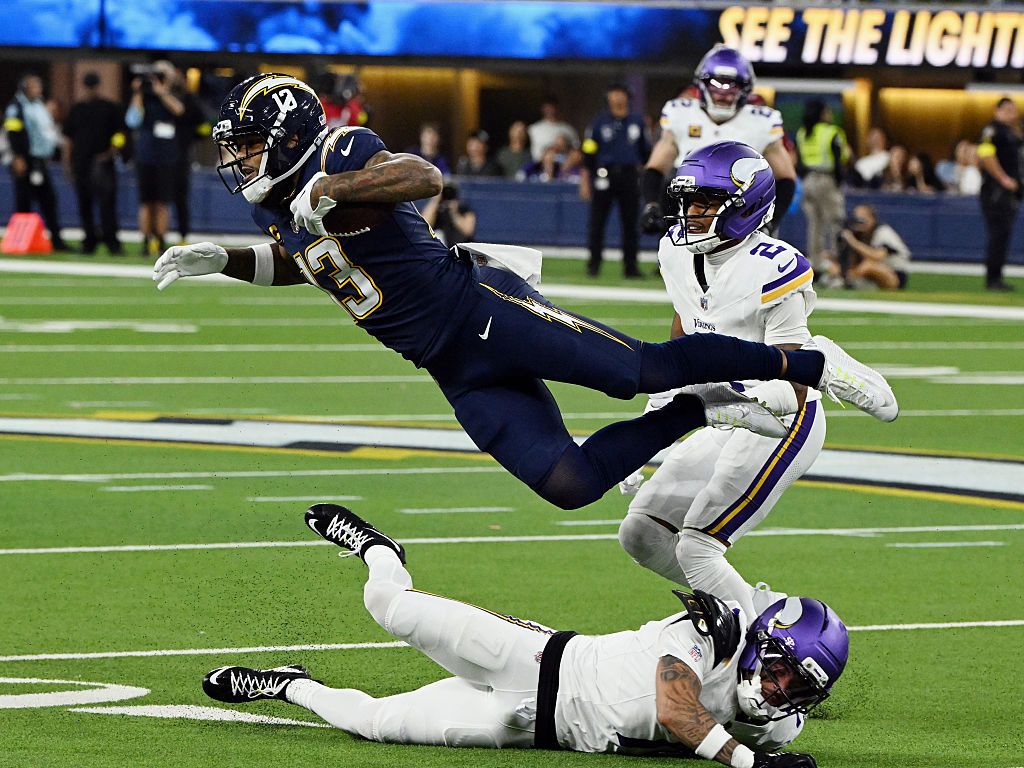
There’s also context chaos. The Titans already fired Brian Callahan; interim turbulence usually dents communication and third-level spacing. Meanwhile, Los Angeles’ route inventory hums with rhythm after the Vikings blowout, and Allen’s short-to-intermediate aDOT gets fed by Herbert’s cadence and protection answers. The footprint is straightforward: high team pass rate, a 31% first-read target share for Allen, and a defense hemorrhaging precision completions (72.5% allowed, as noted above). Start Allen with confidence for double-digit targets and a top-twelve median, with bonus equity if Tennessee’s offense forces four-quarter pace.
Michael Pittman, Indianapolis Colts (at Pittsburgh Steelers)
Indianapolis rides a 7–1 start with thirty-plus in six of eight and seventy-six across the last two, an offense humming on schedule and in rhythm. Michael Pittman Jr. keeps the chain moving and finishes drives: forty-three catches, 446 yards, and six touchdowns through Week 8. His role is sticky and defined—21.2% target share, 24.9% first-read rate, and 1.80–1.91 yards per route run depending on the source. The geometry fits his toolkit too: an 8.07-yard aDOT invites slant, glance, and dig volume that scales against soft zones and blitz replaces.
Pittsburgh’s defense has cracked. The Steelers rank last in pass defense by yardage at 273.3 per game and bottom-three overall by yardage allowed, with injuries forcing secondary shuffles. Quarterbacks complete 67.5% against them for 7.5 yards per attempt with a 97.8 rating, 13 touchdowns, and only five picks. EPA confirms the bleed: +0.07 defensive EPA/play allowed, a bottom-tier figure. They’re also living dangerously on money downs, permitting 41.8% conversions, while their pressure plan isn’t translating—39.3% blitz rate, 26.2% pressure, just three sacks in that early sample.
The Colts’ passing structure is clean—Daniel Jones’ timing, Jonathan Taylor’s gravity, and a coordinated first-read tree that feeds Pittman near the numbers. Expect quick-game answers to pressure, then shot-adjacent intermediates when Pittsburgh widens. Pittman’s usage + environment = bankable median with ceiling: eight to eleven targets, red-zone live given his six scores, and a top-twelve projection if Pittsburgh’s offense sustains pace at home. Fire him up.
Brian Thomas Jr., Jacksonville Jaguars (vs. Las Vegas Raiders)
Both teams exit the bye, and Jacksonville needs a downfield jolt after two straight losses. Trade chatter circled Brian Thomas Jr. last week, then cooled. The sophomore’s role remains stable and vertical, which is the bet here. He owns 27 catches for 365 yards and one score on 54 targets. That’s a 20.8% target share on 259 team attempts. The air-yard profile is strong: 33.2% team air yards with a 12.3-yard aDOT. Usage stays sticky with a 29.1% first-read rate and 23.1% targets-per-route. Efficiency can pop with volume; his catch rate sits at 49.1%, ripe for positive correction. Red-zone involvement is live at 15.4% of team red-zone targets.
Las Vegas invites aggression. The Raiders allow a 67.4% completion rate and sit at +0.15 EPA per pass. Third downs extend at 44.9% against them, which feeds extra plays. The pass rush hasn’t overwhelmed, posting a 5.9% sack rate with mid-tier win rates. Their coverage has leaked intermediates, and Jacksonville’s pass rate hovers near 59%. That aligns with Thomas’s intermediate-deep menu: digs, posts, and seams off play-action. Jacksonville’s staff added Tim Patrick, but Thomas still leads the room in air yards. Trevor Lawrence averages 231.4 passing yards per game, keeping two receivers viable.
I expect two or three deep shots and steady intermediate work. Thomas projects for eight to eleven targets with multiple red-zone looks. The matchup geometry tilts toward volume, explosives, and drive extension. Start him confidently as a high-variance WR2 with real top-12 ceiling this week.
Sit ‘Em
Courtland Sutton, Denver Broncos (vs. Houston Texans)
Houston’s rise is real, and the defense has set the tone every week. The Texans allow 266.9 yards per game and 14.7 points per game, both top-three. Opponents complete just 60.3% at 5.9 yards per attempt, with seven passing touchdowns against ten interceptions. Their pass rush wins on 41% of snaps with a 32% pressure rate and a 9.1% sack rate, squeezing timing and killing explosive plays (8.4% explosive-pass rate allowed).
Sutton brings volume, but the math pinches here. He sits at 33 catches for 469 yards and three touchdowns on 56 targets. That’s a 22.4% target share, 30.8% first-read rate, and a 12.1-yard aDOT that leans into contested posts, fades, and curls. Denver’s environment suppresses ceiling: −4.7% pass rate over expectation, 30.2% third-down rate, and 48.1% red-zone touchdown rate. The Broncos average 19.3 points, with 1.6 passing touchdowns per game, and they protect at a middling 6.8% sack rate. Houston’s corners have allowed a 46.7% catch rate to primary outside receivers over the last month, and they’re contesting at a 22% forced-incompletion clip. That collides with Sutton’s contested-catch diet and Denver’s preference for slower, under-center tempo.
The likely script features limited drives, compressed windows, and a field-goal-tilted red zone. You’re fading talent for environment: elite defense in form, efficiency clamps on intermediate/deep space, and a negative PROE offense. Treat Sutton as a touchdown-dependent WR3; the median lives around five to seven targets and sub-50 yards without a spike play.
Chris Olave, New Orleans Saints (at Los Angeles Rams)
The Rams’ defense has turned Sundays into math tests, and most passing attacks are failing. Los Angeles sits top-three in defensive EPA/play and top-five in dropback EPA, allowing 277.4 yards and 16.1 points per game. Quarterbacks produce 58.9% completions at 5.8 yards per attempt with a 71.2 rating, and the front generates a 34% pressure rate with a 45% pass-rush win rate. Explosive passes are scarce (7.9%), and red-zone drives convert to touchdowns only 41.7%. Chris Olave’s role remains elite—52 catches for 503 yards on 89 targets—but context has shifted.
New Orleans is handing QB1 to rookie Tyler Shough, and the offense carries a −2.9% pass rate over expectation with a 1.53 points-per-drive profile. Protection hasn’t helped: 8.4% sack rate, 34.6% pressure allowed, and a 36.8% third-down rate. Olave owns a 31.6% first-read share, 41.2% air-yard share, and a 12.2-yard aDOT, which normally creates WR1 upside. The Rams’ coverage structure—disguise to two-high, spin to late-rotated quarters—filters throws underneath and punishes outbreakers. Primary WR1s have seen only a 23–26% target share against them the past month with 1.25 yards per route run allowed. That’s where this dents him: fewer clean outbreakers, more contested sideline shots, and red-zone volume siphoned by compressed spacing.
You’re betting against efficiency, not talent. With rookie volatility, a stingy explosive-play rate, and a pressure plan that shortens routes, Olave profiles as a boom-or-bust WR3. Bench if you have a comparable WR2 in a neutral or positive matchup.