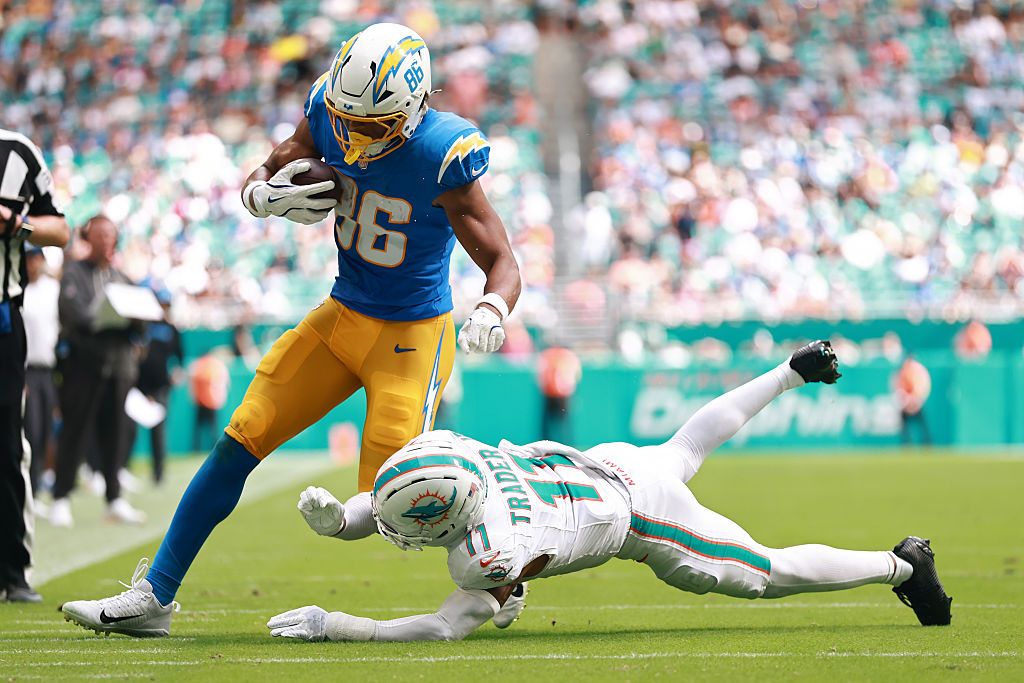
Oronde Gadsden II might just be the unlikely pressure valve the Chargers’ offense didn’t know it quite had. Syracuse trained him as a jumbo receiver with soft hands and sturdy balance; the Chargers drafted him on Day 3 to win space on schedule, choosing route craft and catch radius over an in-line mauler and signaling it when they bypassed bulk-first prototypes for a true matchup piece. Jim Harbaugh and Greg Roman stacked the room with veteran blockers, then spent the pick on a separator who could live in the big slot, find zone seams, and give Justin Herbert a high-percentage outlet when the pocket squeezed. They parked him the first two weeks to calibrate packages, then opened the door in Week 3, and the usage answered immediately—20 snaps and 15 routes out of the gate. In Week 6—after a small decimation of injuries to the Los Angeles offensive line and backfield—that jumped to 56 snaps and 31 routes, as the staff expanded the menu for Justin Herbert’s 2025 air attack.
Below, I take an in-depth look at Gadsden’s potential as a fantasy football asset in the coming weeks; his opportunities on the field will translate to production sooner than later. He didn’t quite make my Week 7 TE Start ‘Em, Sit ‘Em picks, so I wanted to give him a full profile here.
Follow my handle @dansby_edits for more fantasy football advice, as well as plenty of NFL and college football betting goodies.
Oronde Gadsden’s fantasy football outlook
Skillset & 2024 retrospective
Back at his alma mater, Syracuse didn’t ask Gadsden to simply block and disappear; it asked him to own space. They parked him in the big slot, flexed him into the boundary, and let a 6’5″, 236-pound frame move like a wideout. He ran the offense’s geometry—stick, choice, seams, dagger—then posted defenders like a power forward when leverage tightened. Corners tried to crowd him; he varied tempo, stacked shoulders, and opened his chest to the quarterback. Safeties tried to undercut; he flattened angles and used late hands so the ball arrived untouched. That’s how a college tight end became the passing game’s centerpiece without living in-line.
Syracuse also taught him to win without flair. He attacked underneath with patience, not panic. He understood that a five-yard catch with balance becomes nine when the first tackler glances off a strong base. That patience shows up now. He settles just beyond the sticks, absorbs the bump, and turns upfield without wasted steps. The Chargers lean on that economy. You can see it in the route plan: stick/option on third-and-medium, shallow cross into soft spots, glance off condensed splits, seam once linebackers widen. The skill set transfers cleanly because the job description never changed—create separation with craft, shield with size, and convert routine throws into first downs.
Potential Week 7 debut against the Jets at home
Through six games, Los Angeles throws at a pass-leaning clip (62.3%), piling 1,537 passing yards while the run game carries 724. The target economy features Keenan Allen (51 targets), Ladd McConkey (43), and Quentin Johnston (40) as the headline acts; the tight end snaps belong to the receiver in a tight end’s body. Gadsden has 19 targets and 15 catches for 144 yards, and his 78.9% catch rate tracks the eye test: he settles, presents, and stays consistent through the catch-and-run.
His role didn’t drift forward; it jumped, as mentioned above. Week 3 offered 20 snaps, 15 routes, and seven targets for five catches and 46 yards. Week 4 nudged to 33 snaps and 21 routes. Week 5 climbed to 34 and 25. The Week 6 spike (56 snaps, 31 routes) scored eight targets that produced seven catches for 68 yards. That is not background volume, folks; that is a staff deciding where the ball can flow when the pocket shortens and the coverage rotates.
Inside the room, the usage board tilts toward him. Among Chargers tight ends, he carries the highest route participation (92 routes on 139 snaps, a 66.2% route rate) and the most aggressive target-per-route rate (20.7%). Tyler Conklin sits at 60 routes on 152 snaps with a 13.3% TPRR. Will Dissly rides 39 routes on 84 snaps at 10.3% TPRR. Gadsden plays as a receiver who happens to wear a tight end label, and the coaches call it that way.
The distribution beyond the TE room tells the same story. Depending on the accounting window, he owns between roughly nine and twelve percent of team targets (8.9% vs 12.4%) while ranking behind Allen, McConkey, and Johnston. That’s fine in a streamer world, which is all Gadsden is for right now; you stream tight ends who collect purposeful looks, not empty cardio. The purposeful looks already skew high leverage. He’s seen five red-zone targets—tied for fourth on the team—and converted two into completions. The touchdown hasn’t landed yet, but the staff keeps sending him to the spot where touchdowns live.
Watch his tape. The Chargers use him in stick/option routes, short seams off play-action, and zone-finder routes that break friendly landmarks. He doesn’t chase vertical for its own sake; he anchors a drive with quiet detail. That profile synced perfectly with Week 6, when the line asked for quick answers and Justin Herbert fed the underneath.
The offensive line and backfield nudge his production path forward. With tackle health wobbling and the backfield relying on Kimani Vidal and Hassan Haskins, Los Angeles now lives in timing windows. That’s where a big-bodied splitter can tilt drives: settle against zone, turn through contact, and hand the play-caller second-and-medium instead of third-and-long. Gadsden has stacked 51 yards after the catch on his 144 total, enough to matter when the ball arrives in stride. He doesn’t need schemed explosives to justify a start; he needs five or six purposeful touches.
Bottom line
Streaming is about week-to-week truth, and his week-to-week truth is trending. The route log rose from 15 to 21 to 25 to 31. The targets peaked at eight. The red-zone trust surfaced five times already. The role sits far closer to “primary receiving tight end” than “package cameo,” which is why his floor plays in PPR even when the touchdowns lag. If you line up the tight end stacks across the league, very few rookies pull a 20.7% TPRR and a 66.2% route rate in a 62.3% pass environment—and even fewer do it while outpacing veterans on the same depth chart.
Now project forward with the same math the staff is using. If he holds around 28–32 routes in a given week and keeps that 20.7% target-per-route pulse, you’re looking at five to seven targets as the reasonable band. His catch rate sits at 78.9%, so the median expectation lands near four to six receptions. At 9.6 yards per catch to date, that yields roughly 40–60 yards when the game flows normally, with touchdown equity tied to those five red-zone looks and any two-minute drill that strands corners on islands. For streamers, that’s what you chase: bankable volume, live RZ usage, and a call sheet that points your way.
He gets the Colts on Sunday. They’ve yielded a 77.1% catch rate and 56.5 TE yards per game, plus 5.1 YAC per reception to the position, which fits Gadsden’s 78.9% hands and underneath rhythm. Indy has also coughed up eight red-zone TE targets and two TDs, and Gadsden already owns those five RZ looks on the year—live scoring equity if the Chargers script tight-area stick and seams. In PPR terms, you’re hoping for a matchup-play with 5–7 targets, 4–6 catches, and 45–60 yards, with a real chance to punch in a short score.
So—file this under actionable. In full PPR, treat him as a viable streamer right now with a path to mid-TE1 weeks when the eight-target version shows up. In half-PPR and standard, play him when you need floor through volume and accept the modest-yardage ceiling until the first score lands. If you prefer probabilities to poetry, trust the inputs: rising routes, top-TE TPRR, sustained red-zone deployment, and a coordinator who keeps the ball on time. The position rarely offers a clearer tell. Gadsden has turned the light on; the rest is snap count, patience, and pure electricity.