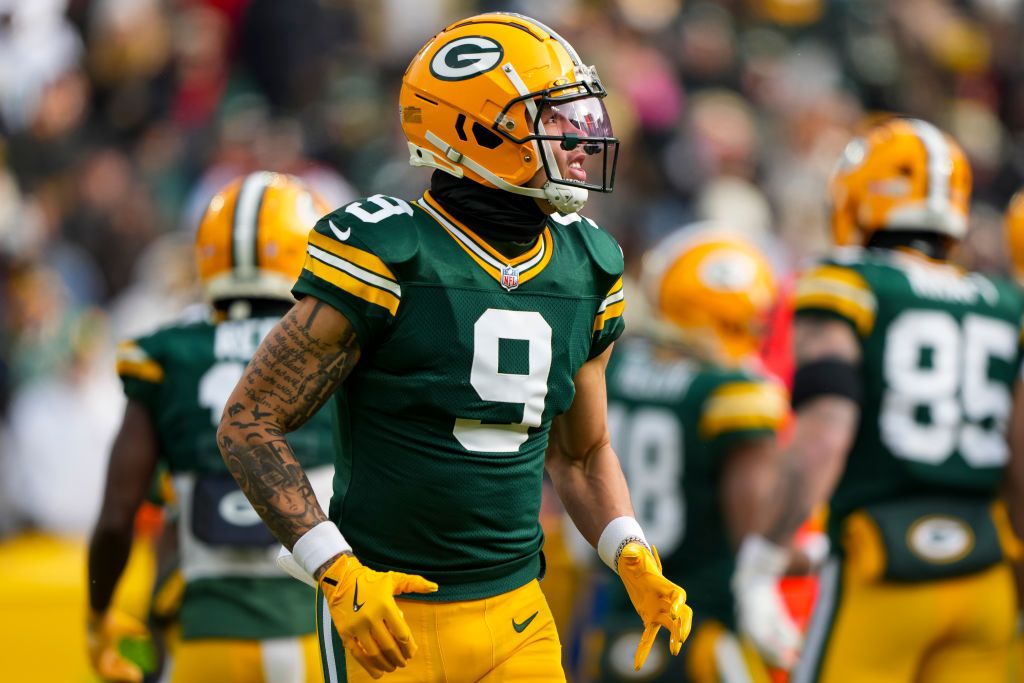
Oft-returned highlight-reel-in-green-and-gold Christian Watson is due to return to the field for the Packers soon; despite all the injuries, he still brings size that warps cushions and speed that tilts safeties. Six-four, 208, legit 4.36—he alters geometry before the ball leaves the quarterback’s hand. Green Bay just stamped belief with a one-year, $13.25 million extension in September. He tore his ACL in Week 18, then opened the return window on October 6 and logged limited sessions on October 9 and 10. He sat Week 6; as of now, Week 7 stays in play.
Below, I break down Watson’s skillset and alignment pedigrees, how he will be a rising tide that raises the needy armada that is the Green Bay passing offense, and what a debut in Week 7 against the Cardinals might look like—all from a season-long fantasy football perspective.
Follow my handle @dansby_edits for more fantasy football advice, as well as plenty of NFL and college football betting goodies.
Christian Watson’s fantasy football outlook
Skillset & 2024 retrospective
The arc is simple: restore the vertical layer, then let everything underneath accelerate.
Jordan Love benefited first then, and he will again. Watson clarifies reads. Safeties, in 2024, widened early. Corners turned sooner. Play-action sold stronger because defenses respected vertical stress. Love gained earlier tells on middle-open versus middle-closed shells. He threw in phase more often because crossing routes carried space, not traffic. First-down efficiency set Love’s tempo—Watson delivered twelve receptions for 236 yards and two touchdowns there. Second-down reliability kept Love ahead of schedule—eight receptions for 208 yards. Third-down explosives still surfaced—eight receptions for 162 yards. Those splits let Love attack with conviction instead of settling for holds and checkdowns.
Protection gained secondary value. When corners bailed and safeties parked high, edge rushers lost their quick-win freebies. The ball left on time because Watson’s stems created clean windows on schedule. Hitches and digs leveraged the threat of the crosser and the go, so Love threw with defined leverage. That sequencing also stabilized the room. Slot options saw clearer access because safeties shaded toward posts and deep crosses. Backs caught releases with fewer downhill collisions. Tight ends found seams once linebackers widened their drops to respect crossing speed. That is what a vertical spine does: it amplifies everyone without forcing volume bloat.
Watson’s alignment flexibility layered solutions. Outside snaps delivered 22 receptions and 450 yards at 20.5 per catch. Slot work added seven receptions, 170 yards, and two touchdowns at 24.3 per catch. Love used both doors. Reduced splits created free-access crossers. Boundary alignments unlocked play-action go balls and deep posts. The staff stacked those calls off the same presentations, so Love threw the same picture with different answers. Red-zone sequencing still lags—eight targets, two receptions, one score—but the route family already supplies the fix. Hitches and digs set posture. Posts and fades finish the drive once safeties widen to cap the cross.
2024 delivered a blueprint. Watson stretched landmarks, and Love attacked on time. Coverage respected altitude, so the ball left decisively. Crossers created stride throws; posts punished late help. Hitches and digs harvested the cushion those threats created. Protection benefited because defenses bailed, not squatted. Love read middle-open versus middle-closed earlier and threw with purpose. Early downs gained tempo, second downs stayed on schedule, and third downs still produced haymakers.
Alignment flexibility made the answers portable. Outside snaps produced bulk yardage; slot snaps produced explosive efficiency and touchdowns. The staff mirrored presentations and changed answers, so Love played fast without telegraphing intent. Red-zone sequencing lagged, but the tree already supplied the fix. That was the 2024 lesson: one vertical spine recalibrated structure and amplified every role without empty volume.
Potential Week 7 debut against the Cardinals
Now, if Week 7 becomes the on-ramp, Arizona offers a clean test. The Cardinals allow 63.3% completions at 6.5 yards per attempt with eight passing touchdowns and four interceptions. Depth splits invite calculated aggression: deep balls complete at 42.1% and detonate for 32.4 yards per catch. Posts land at 80.0% for 24.0 per reception; digs connect at 78.9% for 13.0 per. Go routes complete at 44.0% and still pay 27.7 per catch. Crossers sit at 55.6% completions with two touchdowns allowed. Inside, they’re softer: 68.0% completions and three touchdowns allowed to slot targets. First and second downs remain friendly—62.5% and 65.8% completions—which fits scripted openers and play-action shots.
Map that to his tape and ledger, and the debut script writes itself. Start with crossers from reduced splits to stress pursuit. Mix in a couple of posts once linebackers cheat the crosser. Steal a boundary go off play-action when the corner settles. Sprinkle slot looks to manufacture clean releases and isolate a safety. Those choices align with ten catches for 230 yards on crossers, two perfect posts for 58 and a touchdown, and 24.3 per catch from the slot last year.
Arizona’s 2025 tendencies legitimately play into Watson’s 2024 strengths. If he suits up, I expect Love to be searching for him.
Bottom line
So what should fans and fantasy managers actually expect across a season? An offense that breathes easier the moment he steps on the field. Deep threat isn’t a slogan here; it’s a structural force. Safeties retreat. Corners open hips earlier. Play-action gains bite. Crossing routes become runways, not tightropes. For fantasy, that translates to volatile weekly juice with a real path to stability as targets return. In full PPR, the floor rides first- and second-down usage that already showed efficiency. In half-PPR and standard, the splash plays carry the week—twenty-one point four yards per catch is not a rumor. The ceiling spikes if the red-zone script modernizes; one or two added looks near the paint swings outcomes. Treat him as a matchup-triggered starter early, with a trajectory toward every-week usage if health cooperates.
Fantasy managers should plan around that structural lift. In full PPR, the floor tracks early-down involvement and crosser volume. You still get splash equity because his per-catch damage remains huge. In half-PPR and standard, his profile screams leverage. One deep connection flips a matchup, and his route mix manufactures that shot. Treat the red zone as the growth valve. How’s eight red-zone targets, two receptions, and one score off limited playing time? Better sequencing converts more of those looks. Hitches and digs set the posture, posts finish it. One or two incremental red-zone conversions across a month swings leagues. He could be a crucial midseason add.
So! Manage him like a rising-share asset. Early on, deploy him as a matchup-triggered starter. Prioritize opponents that concede deep efficiency or soften inside against crosses. Use his alignment splits to frame decisions. He gave you 20.5 yards per catch outside and 24.3 from the slot with two touchdowns. If Green Bay leans on reduced splits or scripted slot looks, your path to stable usage clears. If they keep him outside to punish off-coverage, your path to spike weeks sharpens.
His profile supplies weekly leverage with real stability tailwinds. Full-PPR managers should value the crosser volume and early-down efficiency; half-PPR and standard managers should chase the deep and the post. The ceiling rises further if red-zone usage modernizes, and you already see the blueprint in his route inventory. Watson returns, spacing stretches, concepts accelerate, and Green Bay’s offense gains a vertical spine again. That’s the rising tide you ride through the middle third and into December.