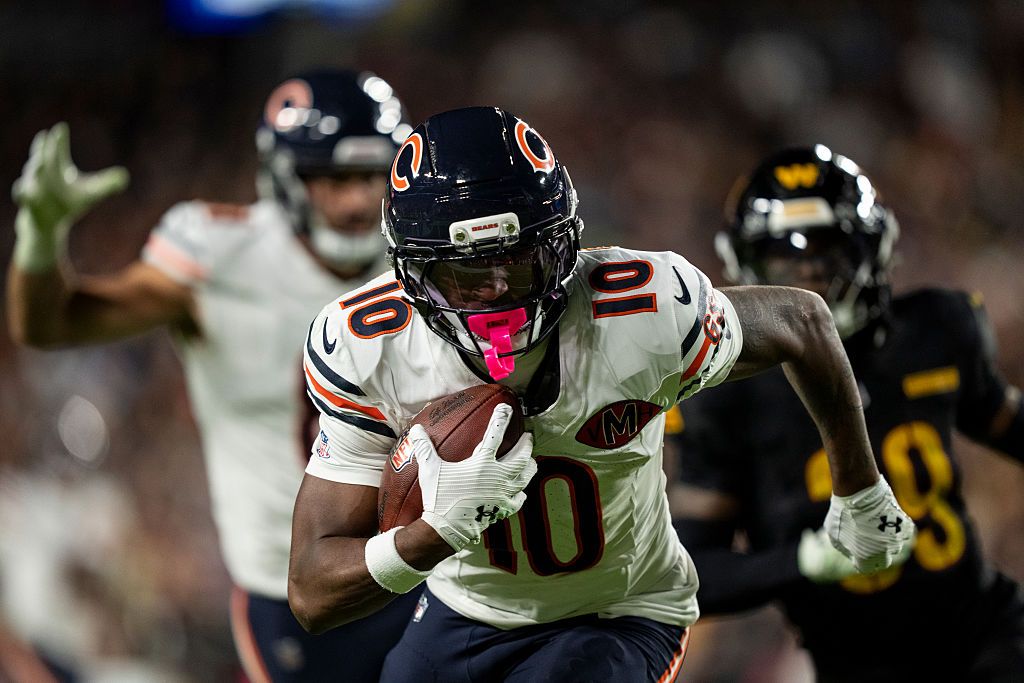
Luther Burden III arrived in Chicago with a college résumé that still carries heat, if not weight. The knock on Burden was always playing time, but the hype around him was always about his otherworldly efficiency as a Tiger at Missouri. Mizzou asked him to be both spark and ballast, and he answered with volume, precision, and the kind of after-catch torque that changes drives. He left Columbia as a two-time First-Team All-SEC pick and a 2023 Biletnikoff semifinalist, stacking 192 career receptions for 2,263 yards and 21 touchdowns while moonlighting as a runner and returner when the Tigers needed a jolt. Those aren’t empty plaques; they describe a player who wins early, wins on balance, and keeps winning once the ball’s in his hands. You may know him best from the Week 2 flea-flicker touchdown catch. You may have just gotten familiar with him as an extension of Ben Johnson’s post-BYE running game on primetime against the Commanders. Either way—formal introductions between Burden and fantasy managers are necessary, here. If he’s not on the end of your bench already, he should be.
Below, I break down DJ Moore’s injury situation, Burden’s role thus far in the 2025 Chicago Bears offense, and into just what glory his role might expand should target share from Caleb Williams necessarily start leaning more his direction.
Follow my handle @dansby_edits for more fantasy football advice, as well as plenty of NFL and college football betting goodies.
DJ Moore injury update
Chicago’s depth shrinks on offense while D.J. Moore fights a groin strain. He carries a midweek practice questionable tag for Sunday, October 19th’s game against the Saints. He spent the night in a Washington, D.C. hospital after the October 14th Monday Night Football game against the Commanders, then flew back to Chicago. Ben Johnson said the staff will track him all week and set his status late. Pencil him in, not in ink, while the groin dictates the final word. His status is very much in question.
Luther Burden III fantasy outlook
Luther Burden & the Bears pass-catchers
Chicago’s introduction wrote the same script in a new font. Burden threaded into Ben Johnson’s offense and immediately matched its cadence: punctual releases, clean landmarks, and yards that arrive in tidy chunks. The ledger paints the profile without guessing. Through Week 6, he sits at 12 targets, 11 catches, 150 yards, and one touchdown, and he hums at 3.06 yards per route run on 49 routes. He layers 7.5 yards after the catch per reception onto a 13.6-yard per-grab pace. His 6.1 aDOT lands above the team’s 4.5 aDOT without forcing depth for its own sake. He splits his alignments like a technician, about 64.5% outside and 32.9% slot, perfect on screens (four-for-four), and efficient in both heavy and spread personnel (11 personnel: 6-for-87 on seven targets; 12 personnel: one-for-65 on one target). That is how a rookie earns trust without demanding the script bend around him.
Elsewhere, Rome Odunze commands 40 targets and five touchdowns. Olamide Zaccheaus sits at 28 targets (16 catches, 143 yards). Cole Kmet holds 18 targets (8 for 116 and 1 TD). Moore resides at 26 targets (19 catches, 204 yards, one TD) with 1.28 YPRR and 4.7 YAC/rec, while Burden’s efficiency outruns that profile at 3.06 YPRR and 7.5 YAC/rec. Into that landscape walks a receiver who already turns first-read answers into eight-yard gains and converts high-percentage throws into moving chains (2-for-2 on third-down conversions in 2025). He doesn’t require ten air yards to matter. He requires timing and intent. Johnson supplies both.
Now, it’s possible the room has changed. D.J. Moore absorbed contact, left the stadium in an ambulance, and spent the night in a Washington-area hospital with a groin injury. He returned to Chicago with encouraging news and a day-to-day tag, but that status casts a shadow across the next slice of the calendar and invites a specific question: who picks up the slack if snap counts taper, even for a week?
Johnson doesn’t run a vanity show. He builds a heartbeat with motion and play-action, then keeps the ball in phase (motion 31.3%; play-action 35.2%; team pass rate 54.5%). The system prizes first-window throws, friendly angles, and receivers who manufacture yards when leverage tilts. That is where Burden specializes. Crossers lead his tree (20.4% of routes) and stretch pursuit into bad geometry (eght receptions on 10 targets; 2.71 YPRR). Digs arrive on schedule and punish widened linebackers (four-of-five for 56 yards; 3.11 YPRR). Hitches exploit cushion (three-for-three for 25), then turn with purpose. The screen sample stays perfect and profitable (12.0 yards per screen route). He doesn’t chase air for effect; he folds efficient depth into rhythm so Caleb Williams never has to hold the ball longer than the front permits.
The tight ends don’t block his access, either. The numbers make it plain. Cole Kmet and the room run more routes (Kmet ~26.8 routes/game; Loveland around 16.0 routes/game), yet they sit under 1.0 YPRR while Burden hums at 3.06. Kmet owns a slight red-zone edge in touchdowns, not in opportunity—each sits on three red-zone targets to date (Burden two RZ catches; Kmet one TD). The limiter for Burden hasn’t been competition by archetype. It’s been route participation—49 routes across five games (9.8/game)—an input that can jump easily if Moore’s workload shrinks. When volume rises, the talent doesn’t need a new neighborhood. It needs another key.
Rest of season fantasy outlook & final verdict
All of this breathes differently with Moore’s status in the foreground. “Day-to-day” reads as portentious for Moore, but it still floats a hard football truth: coaches map contingencies when a core piece takes a hit. In this contingency, the data lines up. The role fits. Caleb Williams throws on time (61.6% completions; 7.4 YPA; 8.2 aDOT). And the rookie already meets the ball like he’s been here for years.
Stash with conviction, and prepare to elevate. In full PPR, bank floor through crossers, screens, and those first-read throws Chicago already favors (team aDOT 4.5; Burden aDOT 6.1; screens four-for-four), then enjoy the bonus when a single cut turns a modest target into a 20-yard flash. In half-PPR and standard, chase the occasional dig or schemed shot (3.11 YPRR on digs; 5.56 YPRR on limited go usage), then welcome the steady yards that hold the week together when the matchup tightens. If Moore steps back quickly at full snap share, Burden still functions as the offense’s efficient hinge. If Moore’s workload lingers light, Burden’s share rises into starter territory.
This is how a season turns for a young receiver who does the small things on time. The résumé from Columbia proves the ceiling (192-2,263-21). The Bears’ structure proves the floor (54.5% pass; 31.3% motion; 35.2% play-action). The current moment provides the aperture. And if that opening stays even a little wider this month, Luther Burden III will not need many extra routes (49 → 120+) to make the box score look like the film.