When I got my first professional gig in publishing in 2016—an editorial internship at The Paris Review, one of America’s legacy literary quarterlies, known for discovering and publishing world-class literature since 1953—we were doing something with a novel I thought hadn’t been done since Charles Dickens and steampunk days. As a quarterly, The Paris Review curates and publishes four meticulously-edited issues each year (one per season). And, across a full year’s publishing run, in 2016, when I arrived as an intern, they’d partnered with W. W. Norton Publishers to serialize a novel that’d yet to be published. Which is to say: we were taking a fiction manuscript, dividing it up sensibly into four parts, and publishing the full-length story across a year’s publishing run. One per issue.
I won’t get too deep into the novelty of the serialization aspect, other than just to say—but for comics and the like, this is not really done anymore, in terms of print media. Publishing houses, agents, authors, editors—it’s common for them to work together to land an excerpt (or several) of an upcoming novel featured in big-name publications (The New Yorker, Harper’s, etc.). But it’s simply unheard of that a team would agree to have an entire novel serialized in print form and available to the public before its official hardcover release. The scheduling risks are lethal, the legalities are brambly, and the possibility for content cannibalization before the novel hits the shelves in its fully-packaged form is, frankly, terrifying. And, just generally, there’s simply not enough prestigious magazine infrastructure left to guarantee commercial success.
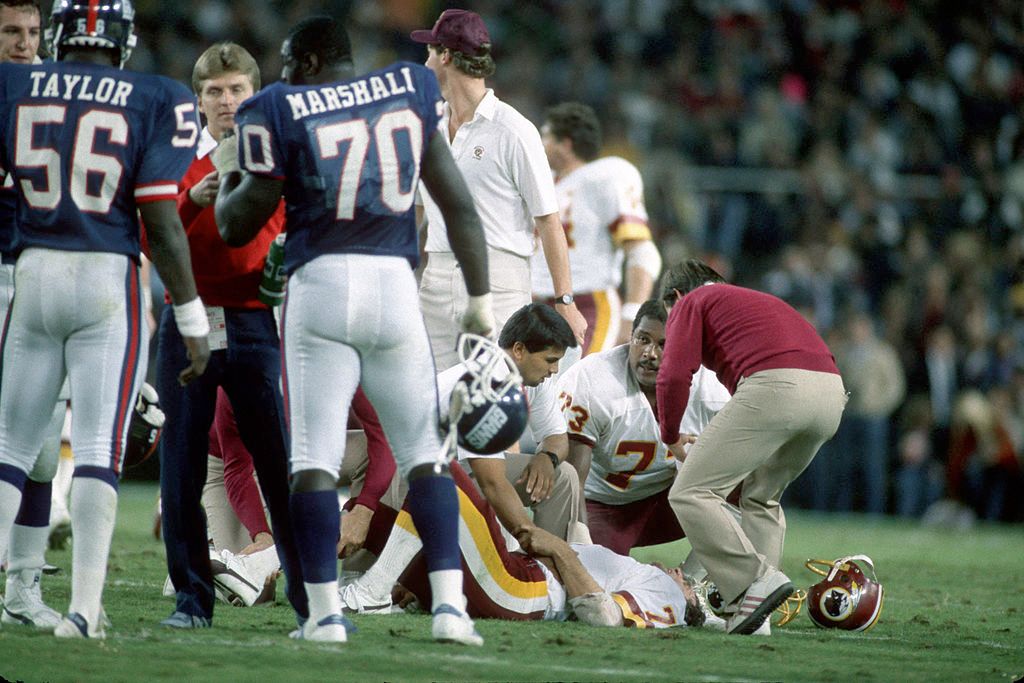
I knew then and know now none of the details of the contractual agreement between The Paris Review and Norton. All I knew was the title of the novel-to-be: The Throwback Special, by Chris Bachelder. A reference, of course, to the 1985 Monday Night Football flea-flicker play when New York Giants linebacker Lawrence Taylor shattered then-so-named Washington Redskins’ quarterback Joe Theismann’s leg on live television. The Editor of the Review was, at the time, utterly enamored by Bachelder’s prose. I would come to be, too. The fascination with the story begins, always, with the quality of the writing voice.
The premise of The Throwback Special, as later articulated by the National Book Foundation, is thus:
Every year the 22 men in Chris Bachelder’s quiet, comical masterpiece gather in the same hotel to renew their friendship and reenact one of professional football’s most gruesome moments. With tenderness and compassion, Bachelder perfectly captures the disappointments of middle-age, the solace of play, the bedtime rituals of men far from home (brush teeth, text wives), and the sacred, almost transcendent experience of the team huddle. The Throwback Special offers a heartbreaking and hysterically funny glimpse into the worried soul of the domesticated American male.
The Paris Review‘s sensibility, in terms of literature, is one I’d describe as boutique. It’s less The New Yorker and more The New York Review of Books, if that helps. Monday Night Football, of course, is the diametric opposite of boutique, especially in terms of audience. The Throwback Special represented a braiding of these cultural landmarks—titans, both, in their own respective industries—and the collaboration was fascinating to me. In terms of timing, it was, simply, felicitous and cool. My career was just beginning. I’d been running my now-sixteen-year-old hometown fantasy football League of Ordinary Dirtbags for six years when I began my internship, and the entire premise of this novel felt fantasy-football-adjacent, at the very least. And part of my first job would be hands-on editorial work with Bachelder’s fantastical football manuscript: fact-checking, proofreading, copyediting, etc.
Literary fiction about the American male psyche’s fascination with football at the stroke of mortal eventide sounded like surefire tragicomedy. Right? Even at the ripe age of 24, then, I had a sense that some of the interiority of these men who cosplay as Jim Burt and Clint Didier once a year might texture some of my own experiences ten years down the line (read: now). That it might prepare me for whatever my 30s and 40s—during which, at that time, I was certain I’d still be playing fantasy football; altogether unaware my career would then be anchored in it—had in store.
I was also unaware that The Throwback Special would go on to be one of the finest and most-decorated football novels of the 21st century so far. After a moderately-successful serialization run, The Throwback Special came out in hardcover on March 14, 2016. On April 5, not a month later, at The Paris Review Spring Gala at Cipriani on 42nd Street—where I was ushering gala donors to their tables—Chris Bachelder won The Paris Review‘s Terry Southern Prize for Humor, which was annually given to a writer who exhibited “exceptional humor, wit, and sprezzatura in work published by The Paris Review or The Paris Review Daily.”
It would go on to be a finalist for The 2016 National Book Award for Fiction later that autumn. No other such fiction with football at its thematic and central core, aside from Ben Fountain’s Billy Lynn’s Long Halftime Walk (which won the National Book Award for Fiction in 2012), has been nominated for the award since the turn of the century.
Given the serialization aspect, Throwback might have the most unlikely and enchanting trajectory for a piece of literary fiction so niche as I’ve seen in all my years for the award circuits—biased though I may be.
The story
Bachelder’s is, indeed, a slender novel—the paperback clocks in at 190 pages—which made it a dream to serialize. Its structure is also similar to the rhythms of a fantasy draft, and that made it simple to divide into discrete parts, as well. The men arrive at the nondescript hotel for the event; they all assemble in one hotel room for the lottery in which they’re assigned their 1985 Giants/Redskins player based on a strict set of legacy rules; they separate for nighttime, for individual research into the eccentricities of their character; they reassemble in the morning for continental breakfast, collective film study, and the execution of the actual play on a public football field a few miles from the hotel.
The comedy is in the collective; Bachelder’s strongest character is the whole ensemble. The fellas, as it were—all 22 of them! There’s Nate, who plays Giants’ linebacker Harry Carson, who comes to the hotel worried he’s perverted because he finds attractive the women in the childrens’ books he reads to his daughters. There’s Charles, who works as a psychologist for teenage girls with eating disorders, but is understood by the collective group of men to possess universal medical knowledge, given his title; he fields Nate’s anxieties, and plays Giants’ safety Terry Kinard. Robert, too, besieges Charles with his demons about his daughters: Robert had been worried his daughter was getting the wrong idea of the world in getting everything she wanted, as children do, so when he felt a twinge of good-for-you when his daughter broke her arm, he felt both good and evil. He hoped Charles would absolve him of and explain to him his sins, somehow. Robert plays Washington’s center, Jeff Bostic. There’s Fat Michael, whose “level of fitness made [him] a walking rebuke of everyone else’s lifestyle choices … a beautiful affront,” and whose “nickname was a typical masculine joke, a crude homemade weapon that indiscriminately sprayed hostility and insecurity in a 360-degree radius, targeting everyone within hearing range, including the speaker.” Fat Michael, the year the story takes place, gets chosen to play Joe Theismann. A role which, you can imagine, both the book and its characters treat with a tragic and rather devout hush.
And, of course, there’s George, who’s the head of his town’s local library and plays Giants linebacker Byron Hunt, and who tends to wax poetic and rhapsodic about municipal budget cuts and football theory alike. His breakdown of The Throwback Special—that is, the actual play in in 1985 when Joe Theismann’s leg broke—is as good an example as any of the book’s erudite grasp of sport, which makes the satirical nature of the premise feel utterly earned:
“So you said, what, that the fleaflicker was a horrible call. Well, yes and no. I would argue that you need to consider a play in its context, its environment. And the environment of a play is, to a large extent, the opposing team’s play. A play can take its form—and value and fitness—only within the medium, the crucible, of the adversary’s play. What we call a play in football is actually the interaction that occurs between two plays, which up to the point of the snap are just competing abstractions, just fantasies of domination. To call a play is to transmit information.
… The plays that are called from the sidelines are speculative, abstract. The line of scrimmage is the narrow barrier between those abstractions. When the ball is snapped, the barrier dissolves and the two plays begin to act upon each other. We have confluence! From two plays the play comes into being. Each team’s playbook fantasy takes on terrestrial form. The play lives a fleeting life, like certain unstable isotopes. Each play attempts to assert dominance over the other play, by force and deception. This is why football is the most scientific of sports. A game is a series of discrete experiments. Hypothesis, observation, results, analysis, conclusion.
You follow the lonesome interiority of each of these twenty-two men throughout the movements of the reenactment’s preparation. It’s within that narration that Bachelder offers us that “hysterical-funny glimpse into the worried soul of the domesticated American male,” bit from the National Book Foundation. Failed businesses, government workers running out the clock until their pensions, men who swear by one—and only one, and will expressly & vehemently defend that one—weather app on their phone, struggling marriages, men’s bathroom urinal orientation, inexplicable bloody noses and skin rashes, and even the wordless exchange between two leaguemates as they play a game of catch in the hotel room:
“The men did not need to talk because they were throwing and catching a football. Or, if they chose, they could talk about throwing and catching a football. Eventually, of course, one man sat beneath the window and tried to time his throw so that the other man, running from the door, could make a diving catch on the queen bed. They alternated positions. Both men became flushed and sweaty. Neither man cared to remember the year that Vince broke the corner off of a bedside table. Both went about the game with gravity and good-natured intensity. It was important to them to throw and catch the ball well.”
The commentary is always there, but it’s as tender as it is incisive. There’s no judgment in Bachelder’s narrator’s voice, even as it surfaces the shorthand and somewhat overserious idiosyncrasies between two men tossing a pigskin to each other. There’s a universality to most all of what the men do and think within the hotel with which so many football fans will have no trouble identifying. It’s what makes the book so full of light.
Here’s the description of the hotel room just after the lottery:
“The room, after the lottery, looked like a site of explosive violence. Pizza sauce streaked the walls, congealed bits of flesh-colored pizza lay strewn on the beds. The keg lay on its side as if, once depleted of beer, it had perished. Having never seemed alive, it now resembled nothing so much as something dead. Crumpled napkins covered the floor like peach blossoms after the Battle of Shiloh.”
Deliciously akin to the detritus of a draftroom just after the final selection, when the bodies have emptied and all that remains is the glorious mess.
Of course, the central question is—why do these men do this? Why engage in something so fleeting and frivolous and tediously-contrived every year? With a narrator’s voice so omniscient and authoritative, you’d expect it to somewhat spell it out for you. And, while I know the 22 men have trouble articulating just precisely the quintessential reason they gather every August for this ritual, I think it’s even more bewitching that I think the narration struggles to capture it, as well. The purpose of a flawless execution of this reenactment remains intangible and elusive, something that transcends language.
You eventually find out enough to piece your own conclusions together as to why each individual man might, year after year, show up. I’ll not spoil that nor the end, but I’ll just say: there’s no cruel punchline to the joke of the premise—make no mistake. Bachelder has you thinking these men are on a monastic quest most of the time. The payoff to all this pageantry becomes euphorically clear.
In playacting this brutal cultural memory, these men entirely dissociate and come back to themselves refreshed, and, in some cases, reborn. A catharsis through cosplay, choreographed meticulously through the reenactment of that cultural crucible of sports entertainment—Monday Night Football, the great autumn colossus—and the prismatic moment in which Joe Theismann’s leg shattered. A fracturing of the collective American consciousness into millions of shards, individual memories that these men—for, what, exactly? does it matter?—seek to reassemble and fracture anew for a few seconds every year.
And, always, in the background, not unlike the billboard of optometrist Dr. T.J. Eckleburg in The Great Gatsby, like the presence of something ceaseless and ever-watchful, but somehow more maddening than a clock: the lonesome vending alcove (“which clicked and hummed”) of the hotel’s second floor corridor.
Ten years later
Just this past Monday Night Football, on September 29, 2025, Dolphins wide receiver Tyreek Hill suffered a gruesome knee dislocation on a sideline tackle with 13:21 remaining in the third quarter at Hard Rock Stadium. It was clear during the live ESPN broadcast that Hill’s lower-left leg had corkscrewed at an ungodly angle as he went down. He remained on his back for several moments, during which you could see his shin bent inward at something like a 45-degree angle toward his right leg. It not only halted play; it halted the nationwide event. The broadcast smash-cut to commercial break before play-by-play man Chris Fowler (working the second game of Week 4’s MNF double-header) could lead the audience into a break.
And so—22 men had engaged in a confluence of two playcalls, the result of which was ultimately disrupted and defined by bodily devastation. (Ironically enough, Bachelder’s novel would say the “circle of anguish” was left incomplete: Hill was, in what might be a tableau as disturbing as it was reassuring, smiling and waving as he was carted to the Dolphins locker room.)
That’s not the only similarity. Poignantly enough, in the first four weeks of the 2025 NFL season, we’ve seen:
- flea flickers (both successful and un-, none more gorgeous than Bears QB Caleb Williams to Luther Burden III in Week 2);
- a lower-leg injury to the new franchise quarterback of the Washington Commanders, Jayden Daniels, that’s sidelined him for multiple games;
- devastating lower-body, multi-week-to-multi-month-recovery injuries to marquee quarterbacks around the league like Joe Burrow, Lamar Jackson, J.J. McCarthy;
- the same sorts of injuries to the kind of star players who retain season ticket holders, get the fans excited, drive revenue with their spectacular athleticism—thinking here of Malik Nabers, James Conner, Austin Ekeler, Hill, etc.
The acute and reverent violence of the Throwback Special has present each week (too much, too much) on the gridiron this year, as every year.
But, more broadly, it occurred to me that fantasy football as a commercial industry is approaching its middle age. And middle age is so eloquently observed in The Throwback Special‘s narration. And, like middle age, fantasy football, as a cultural ritual, deserves the sort of tender attention granted by Bachelder’s narration. It, like the fateful Taylor-on-Theismann sack, deserves our strange zealotry, which drives us to make various deliberate and peculiar pilgrimages.
Fantasy football really had its coming-of-age through the late ’90s, when the internet transformed a bar-league pastime into an industry. According to this 1997 press release, CBS/Sportsline began offering paid, online-managed leagues in that year, a crucial inflection point that shifted fantasy from the realm of hand-tallied box scores to a scalable service. Within a year, the Fantasy Sports Trade Association (now FSGA) was founded in 1998, formalizing the business side and signaling that this wasn’t just a hobby anymore. Then came the democratizing stroke: Yahoo’s free leagues in 1999, which opened the gates to mass participation and locked advertising revenue to player engagement. That three-year stretch established the spine of mass-market fantasy—subscription fees on one side, ad-supported free play on the other. By 2003, Wired was already reporting at least ten million U.S. players and SportsLine pulling in eight-figure fantasy revenues. What had started in Oakland bars and office pools was no longer niche. It was a commercial ecosystem, equal parts entertainment product, marketing channel, and, again, cultural ritual.
If we talk about fantasy football reaching the middle-age of Bachelder’s characters today, it’s because that late-90s internet rollout was its adolescence—the moment it left the basement and entered the public sector.
Today, I find the gray hairs everywhere. They’re there if you look. The earliest figureheads of big-publication fantasy football (ESPN, Yahoo, CBS) are now well into their 40s, 50s, even 60s. Many are longtime parents, preoccupied with many of the same anxieties as Bachelder’s fathers. I just turned 34. Mine seems to be the demographic which was really exposed to fantasy sports in those second waves of its commercial days, back when ESPN had really moved into the space as a legitimate market player. In terms of the industry media I consumed, I was following Christopher Harris’s flag-plants when he worked at ESPN; I was listening to Eric Karabell and Keith Law on Fantasy Focus: Baseball and Matthew Berry and Nate Ravitz on Fantasy Focus: Football podcasts. I still read almost all their weekly columns, as well as those of Andy Behrens and Dalton Del Don at The Deep Shot and JJ Zachariason at Late Round QB Fantasy. Like Bachelder’s monks, all the above still show up each and every year with troves of draft kit and in-season resources both.
Wayne Gallman is a waiver wire hero of mine, if that helps for a generational timestamp. Back then, PPR scoring was regarded as less a modification than a structural mutation, and abolishing kickers was stricture only the most spartan of commissioners would inflict upon his leaguemates.
The Throwback Special
Throw away (back?) all the above, and ten years is still just as good a time as any to celebrate a work of fiction as remarkable as Bachelder’s The Throwback Special. It deserves to be—and has been—regarded forever as some of the finest fiction this generation has to offer. I’m on a one-man social media crusade to get it into the stockings of as many folks as possible this holiday. If I had a curriculum for all my weekly sportswriting columns, this all-timer of a novel would be atop the required reading. Only four other authors occupy space on the favorites shelf where I keep my copy.
Before The Paris Review‘s annual Spring Revel gala in 2016, where I spoke, briefly and after he’d won the award, to Bachelder—I don’t recall our conversation, though I remember his smile was warm, and I recall the trophy in his hand—I’d been so consumed by the book that I read it twice. One of the perks of being an editorial intern at The Paris Review, at least back in 2016, was the ability to contribute to the weekly Staff Picks column on The Paris Review Daily, the quarterly’s online gazette. Reading a book twice had put me behind my schedule, but I was reluctant to let a column pass by. In the spirit of the Revel, my Managing Editor let me write up Throwback for that week’s Staff Pick:
I know the Review serialized Chris Bachelder’s The Throwback Special over the past four issues, but I’ve only just gotten to read it in full. The stage: twenty-two men gather at a hotel to reenact “the most shocking play in NFL history,” when Lawrence Taylor shattered Joe Theismann’s leg. Really, though, the novel is about the lives of these individuals outside this annual ritual: sunken businesses, spoiled children, failed marriages, loneliness. The moments of deepest empathy are so effective because they’re at once solemn and, given the book’s premise, hilariously idiosyncratic. You’d never think of a continental breakfast as something profound, but to Bachelder and his characters, it is: “Unbeknownst to the men, this was what they came here for, every year … Halfway through their lives—considerably more than halfway, in several cases—the men knew nothing of their own vast contentment.” The point, here, as is true for the entire novel, is that this tradition is hardly about football; the tradition is simply about tradition, and how it allows us to fully realize the self without needing to understand it. Just consider the cathartic moments immediately following the completed reenactment (their best yet): everyone gathered in a hotel room, embracing one another as fanatics might after a pilgrimage, all of them “wild with frantic relief.” I finished the novel on the outdoor subway platform at Broadway Junction; below me, twilight descended on the Callahan-Kelly football field, where I could still hear men shouting in the dark.
A decade later, I can see the whole of New York from above. And I understand—and I mean this universally, in all earnestness—that the man down there on the field shouting at play in the advancing twilight, and the younger man up there on the train platform finishing his book on the bench, waiting to be taken back into the beating heart of the city—they are the same. I see the space between them was always merely, like George’s line of scrimmage quoted above, nothing more than a narrow barrier between abstractions.
Can you see it, too? The way the distance folds in on itself? Collapses, crashes. Like the driving crackle of pads just after the snap, rendered not as sound, but as light, shadow, time.