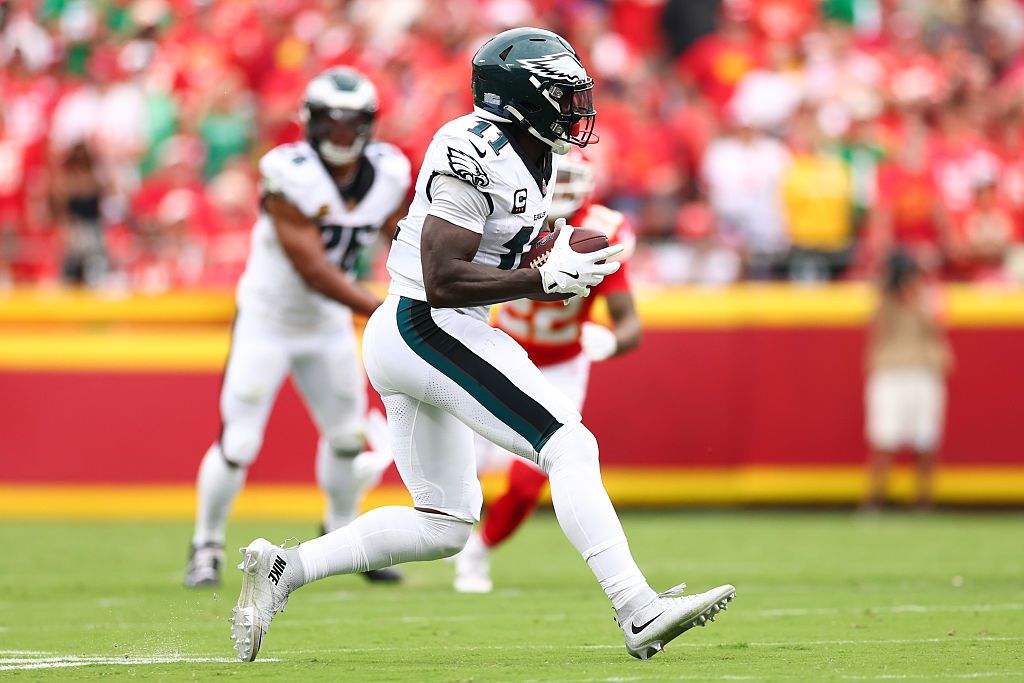
Sunday in Philadelphia delivers a clash of identities: the Eagles’ trench-driven power game meets a Rams offense built on tempo and motion. Los Angeles leans on Matthew Stafford’s precision and Kyren Williams’ one-cut patience, while Philadelphia dictates pace with Saquon Barkley downhill and Jalen Hurts’ dual-threat leverage. Both teams have started fast on the scoreboard, which sharpens the lens on individual production rather than broad totals. Check out how that fits into the prop market for the game by my analysis below.
Here are my favorite player props for this Week 3 NFL game between the Eagles and the Rams.
Eagles vs. Rams Best Prop Bets
A.J. Brown 6+ receptions (+145)
A.J. Brown 6+ receptions is a volume-and-structure bet that clears on straightforward math. If Jalen Hurts lands in a 31–36 attempt window—a reasonable range in a competitive script—then a WR1 share of 27–30% yields 8–11 targets. From there, Brown needs a 55–75% catch rate to bank 6–8 receptions; on his staple menu (RPO glances, slants, stops, quick outs), catch rates typically live in that band because the ball is out fast and thrown on-time. Quarters/Cover-6 shells can widen the nickel and safety leverage, opening those in-breakers; that’s where the Eagles spam first-read throws on 3rd-and-4 to 3rd-and-7, keeping the chains and the reception total moving between the 20s while the sneak handles the goal line. Philadelphia also insulates volume: if rhythm dips or pressure spikes, the staff manufactures easy touches via bubbles and speed outs, which function as run-game extensions and keep Brown’s floor intact.
Game-state math helps: in a one-score game through three quarters, Hurts historically holds attempts, which protects raw targets; even in short negative scripts, the two-minute and hurry-up sequences add 2–3 extra targets late. Put it together and you get an expectation of 8–10 targets, with a fair conversion band delivering 7–8 catches for ~80–95 yards and multiple first-read wins on money downs. Pathways to failure are narrower: an early pass-pro wobble that forces lower-percentage sideline shots, or a surprise heavy run script that caps attempts below 28; both are mitigated by Philadelphia’s tendency to answer heat with quick-game RPO and by Brown’s screen usage. Priced at plus money for 6+, the threshold aligns with the target math and coverage profile, giving a modest edge over a true coin-flip.
Kyren Williams 70+ total rushing yards (+140)
Kyren Williams 70+ rush yards is a role-and-scheme play with clean math behind it. At a baseline 18 carries, he needs 3.9 YPC to clear 70; at 16 carries, the threshold is 4.4 YPC; at 20 carries, it drops to 3.5 YPC. Sean McVay’s mid/inside zone and split-flow staples create those yards by design: motion widens the force player, condensed sets shrink the box, and the sift/arc looks hold the backside so Williams can press frontside then cut. In neutral scripts, McVay typically opens with early-down runs + play-action to steady protection for Matthew Stafford; in that pattern, Williams’ share of early-down RB carries trends to a workhorse range and he retains two-minute trust, which protects snaps even if pace accelerates. The target script: about 10 first-half rushing attempts, around eight second-half attempts, with first-down run success around 45% to stay on schedule.
Two explosives (10+ yards) off cutback or weak-side bounce turn a 3.8–4.0 YPC day into a 70+ finish. Protection linkage helps too: when Los Angeles leans on play-action from under center, linebackers step downhill a beat late, widening the B/C gaps Williams hits most often. Game-state sensitivities are straightforward: with a one-score game through three quarters, you get the 16–20 carry bandwidth; down two scores early, you’re more likely in a 12–15 carry lane and need 4.7–5.8 YPC or a chunk run to get home. The Eagles’ front can win with penetration, so expect tempo and horizontal stress to slow the backside pursuit and create the clean one-cut lanes this prop needs. Reasonable projection: 18 carries, 82 yards with 2–3 gains of 10+. Risk management: ladder it—60+ near even money, 70+ at plus money—to smooth out a rare negative script while keeping the ceiling live if Los Angeles controls neutral downs.
Dallas Goedert 5+ receptions (+195)
Dallas Goedert is the quiet hinge of Philadelphia’s passing design, and his volume lines up well against a Rams defense that prefers light boxes and zone shells. In two games, the Rams have allowed tight ends to command 24.5% of target share, one of the higher rates in the league, because their coverage philosophy keeps safeties high and funnels throws underneath. Goedert has already drawn 13 targets through two weeks even in low-volume passing scripts, with his routes evenly split between in-line releases and slot alignments. Expect Nick Sirianni to use him on stick, seams, and shallow crossers to stress the second level whenever Los Angeles widens for RPO looks or widens out in match quarters.
That pattern yields 6–8 targets as a median outcome, which comfortably supports a 5+ catch path. The Rams’ rush front is strong enough to create check-down situations, and Hurts often defaults to his tight end on hot reads against simulated pressure. Projection: six catches, 55–65 yards with at least two third-down conversions in the stat line. The price at plus money is appealing because the market often overcorrects to A.J. Brown and DeVonta Smith volume, but Goedert’s underneath role has independent value. Risk: if Philadelphia jumps out early and sits on a run-heavy second half, target volume could fade, but the scripted first quarter typically has 2–3 designed touches for Goedert.