

The Pittsburgh Steelers haven’t finished below .500 since 2003, when they went just 6-10 before Ben Roethlisberger 11th overall. That streak looks to be in jeopardy of ending this season, as DraftKings Sportsbook has set the Steelers’ over-under to just 8.5.
Fundamentally, Pittsburgh’s chances depend on Aaron Rodgers’ health in what is expected to be the future Hall of Famer’s final season. The 41-year-old signed a one-year, incentive-laden deal worth up to $19.5 million this summer after a season in which he completed 63.0% of his passes for 3,897 yards, 28 touchdowns, and 11 interceptions but the New York Jets went just 5-12. With four-time Defensive Player of the Year finalist T.J. Watt at outside linebacker, there’s a world in which the Steelers can make a playoff push despite a difficult division.
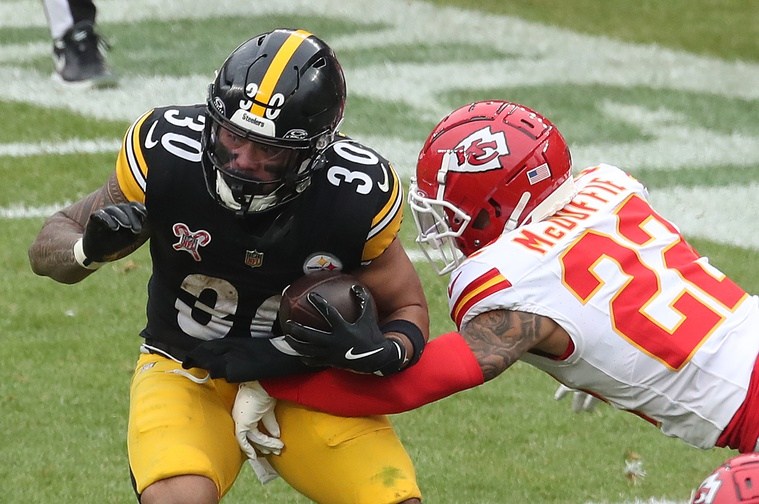
But Pittsburgh ranked in the bottom half of the league last season in rush yards per attempt and rushing touchdowns, and its running back position got worse when Najee Harris bolted for the Los Angeles Chargers. Jaylen Warren is the incumbent backfield option now, with third-round rookie Kaleb Johnson also in the mix and Kenneth Gainwell as a change-of-pace back. Below, I’ll break down Warren’s and Johnson’s fantasy prospects entering this season.
The Case for Jaylen Warren:
Warren has been a reliable option alongside Harris for his entire career, amassing 346 carries for 1,674 yards and six touchdowns across his first three seasons as a pro. He especially began to break out late in the 2024 season amid a Harris slump, seeing the field on more than half of the Steelers’ offensive snaps in five of the team’s final seven games. Across that span, his snap share was higher than that of Harris, who was on the field on just 30.1% of snaps across Pittsburgh’s two most important games of the season, Week 15 and 16 road clashes against the Philadelphia Eagles and Baltimore Ravens.
As a dual-threat back who’s also accumulated 894 receiving yards across his first three seasons, Warren has the potential to be a star in the modern game, especially playing with Rodgers, who’s historically gotten his backs involved in the passing game. Still, Pro Football Focus graded him as just the 46th-best of 58 qualified running backs last season, far behind Harris, who ranked 16th. His grade was particularly dragged down by lackluster running numbers, given that he had the 14th-highest receiving grade, as well as his poor blocking numbers. Pittsburgh might find it hard to keep him on the field on passing downs; at five-foot-eight, he doesn’t have the size to be a competent pass protector.
Still, offensive coordinator Arthur Smith seems inclined to use him as his primary back, which means that he should get the bulk of the carries in what was the league’s fourth-most run-friendly system last season. Warren made just one preseason appearance and underwhelmed, turning his two carries into three yards and his two catches into 12 yards, but it’s hard to read too much into two drives quarterbacked by Mason Rudolph. So far, he’s been just RB28, which seems like a slight under-valuation, especially with Johnson being selected 15 picks higher.
The Case for Kaleb Johnson:
Johnson’s production in the last three seasons has been more impressive than Warren’s, but that’s because he was in college at Iowa, where he led the Big Ten with 1,537 rushing yards and 21 rushing scores in 2024. He also became somewhat of a threat in the passing game, turning 22 catches into 188 yards and a pair of touchdowns last season, becoming a consensus All-American alongside Heisman Trophy runner-up and current RB7 Ashton Jeanty. With good size at six-foot-one, 224 pounds, he has the tools to out-perform Warren at the next level.
Johnson will probably pass his teammate eventually, but there are still plenty of question marks that he has to answer. Like Warren, he struggles in pass protection, although his upside is probably higher because of his size. He’s also fairly slow, with just a 4.57-second 40-yard dash, and he didn’t demonstrate the agility or body control in college to compensate. He got better in every preseason game, taking eight carries for 20 yards in Week 1, 11 carries for 50 yards in Week 2, and five carries for 24 yards in Week 3, and he caught three of his four targets for 17 yards throughout the preseason.
Though the signs are promising, producing against the Tampa Bay Buccaneers’ backups isn’t the same as producing against the Ravens’ starters, and Warren has done that to a respectable degree, taking 21 carries for 89 yards in two games against Baltimore last season. I understand the upside of drafting Johnson as RB24 — his ceiling may well be higher than Warren’s — but he’s being over-valued.
The Verdict:
Mike Tomlin, the NFL’s longest-tenured head coach, isn’t exactly known for his innovation, and neither is a franchise that was so insistent on staying competitive that it brought in Rodgers instead of signing a younger quarterback and rebuilding. Dealing for wide receiver D.K. Metcalf, entering the tail end of his peak entering his age-28 season, is another sign that the Steelers are going all-in this season. Warren isn’t an elite back, but Pittsburgh can win games with him taking a majority of the snaps.
For a team in win-now mode in a division featuring some strong rushing defenses, it was always going to be an uphill battle for Johnson to earn the RB1 slot, and he hasn’t shown quite enough explosive potential or balance in the first three preseason games to do that. He might get a more equitable share in the red zone, given Warren’s size, but I’d expect Warren to commandeer a majority of the early-down offense. Neither back will be a fantasy championship-winner, but the veteran is a safer call.

