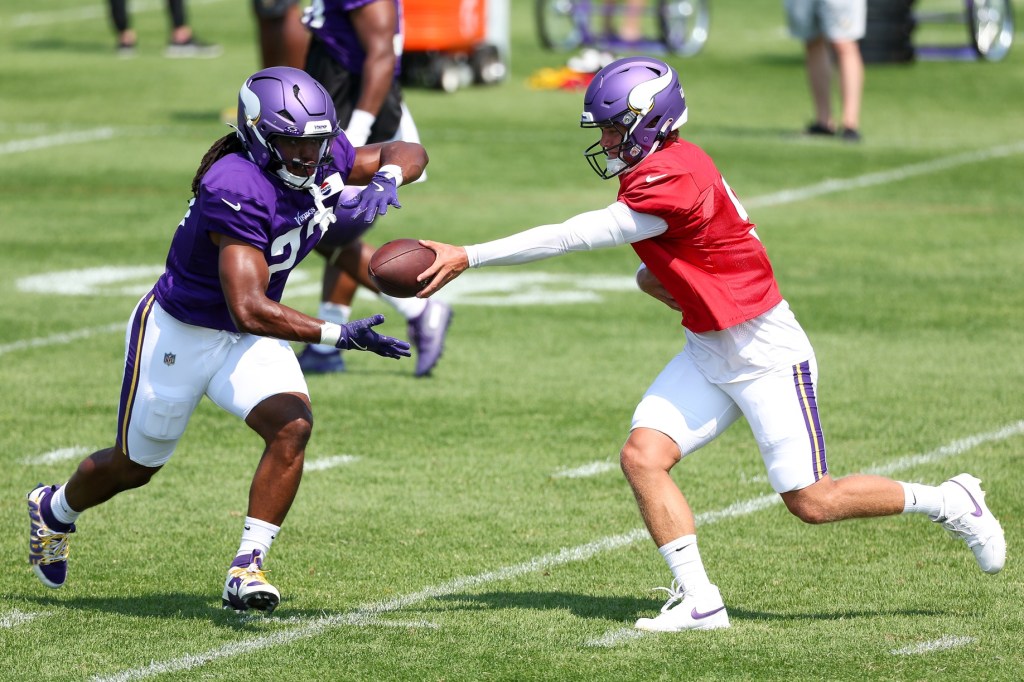
The Vikings signed Jones to a two-year, $20 million contract extension this offseason, but the organization also went out and traded for Mason from the 49ers, and then extended the back on a two-year, $10.5 million deal.
Given these moves, the Vikings’ backfield is expected to be a committee between Jones and Mason this season, and ESPN’s Kevin Seifert reported that Mason took the first snap of Minnesota’s first full-pads team drill at training camp Monday.
Furthermore, in Seifert’s piece about the Vikings’ running back situation, he quoted Minnesota’s HC Kevin O’Connell, who had this to say about Jones and Mason: “We’ve got truly a combination that will cause a lot of problems. Between having two great backs that are different body types, maybe different skill sets. But they’re complete backs”.
Last year, Jones was the Vikings’ clear top back. The veteran logged 62.7% of the snaps and averaged 15 carries per game, which was 67.1% of the running back carries for the team. Jones also handled a 11.5% target share. With this role, the 30-year-old finished 16th among running backs in FPTS. However, all signs are pointing to Jones’ role decreasing with Mason in town and this likely being a near 50/50 split between the two backs.
Mason is a very capable rusher, who is averaging 5.3 YPC for his career and is only 26-years-old. Before getting hurt in Week 8 of last season, Mason was the 49ers’ starting running back for the first seven games of the season with Christian McCaffrey sidelined and Mason was an elite fantasy asset with the role. While logging 70.1% of the snaps and garnering 19.7 carries per game during that seven-game stretch, Mason produced 16 FPTS per game and he was the No.10 running back in FPTS at the time. For perspective, Jones ranked 12th at the position in FPTS over this span.
Jones is the more capable receiver – he has 140 catches over the last three seasons, compared to only 14 for Mason – but Jones’ rushing YPC average has decreased in three consecutive seasons and he obviously has way more mileage on his body entering his ninth season in the NFL, compared to Mason, who is entering his fourth.
To open the season, both Jones and Mason should 10+ carries per game, and Jones should handle most of the passing down work, making him the better fantasy option of the two early on. However, given the discrepancy between these two players in age and mileage, it wouldn’t be a surprise in any way to see Mason become the main rusher for Minnesota in the first few months of season, ultimately making him the better fantasy producer.
In terms of ADP for Best Ball contests on DraftKings, Jones currently sits at 75.3, while Mason is at 92.6. At these ADPs, passing on Jones and waiting a little later to draft the younger Mason is a sharp call.