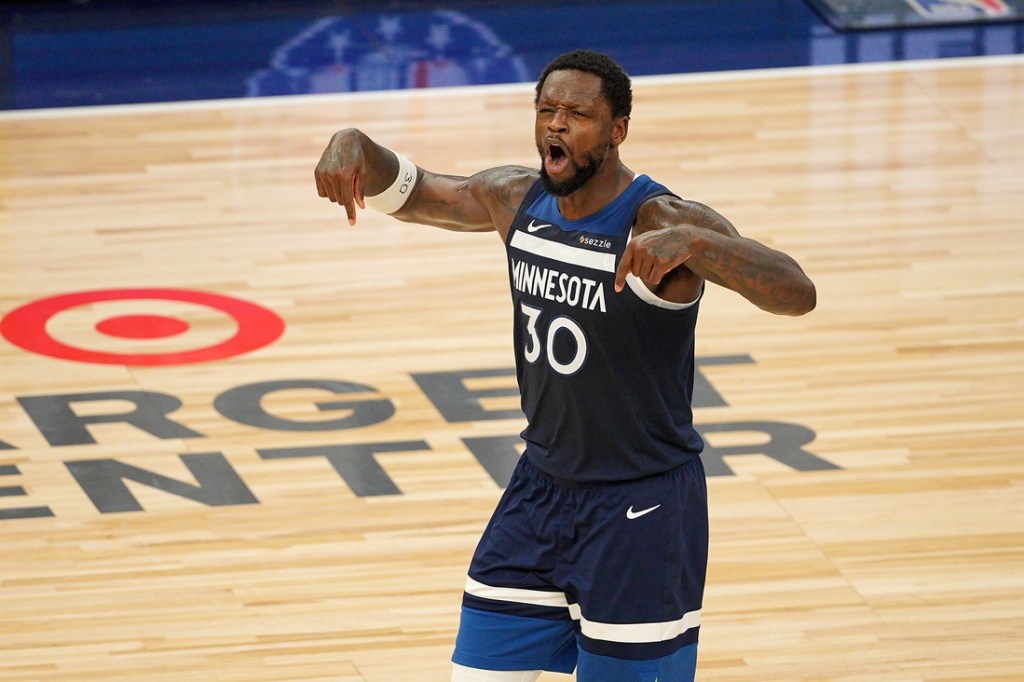
2024-25 was a season of change for the Minnesota Timberwolves, and despite losing to the Oklahoma City Thunder in five games in the Western Conference Finals, it was a rather successful one.
Minnesota’s decision to trade four-time All-Star center Karl-Anthony Towns in the dying moments of the offseason surely came as a shock to many, including Towns himself, and the return — Donte DiVincenzo and Julius Randle — came with questions. Randle appeared to be a clunky fit with franchise star Anthony Edwards, whose best skill is his slashing ability, not to mention center Rudy Gobert, and he was a pending free agent after the season.
Though it came together slowly, it all clicked. The Timberwolves ended the season by winning 17 of their last 21 games, ousted the LeBron James and Luka Dončić-led Los Angeles Lakers in five games and then did the same to the Stephen Curry-less Golden State Warriors. Minnesota’s loss to Oklahoma City is excusable because the Thunder are a juggernaut who will be favored easily over whoever comes out of the Eastern Conference. In the process, Randle had the finest playoffs of his career, averaging 21.7 points, 5.9 rebounds, and 4.9 assists per game on 50-39-88 shooting splits. He also played solid defense on both James and Jimmy Butler.
But now the season is over, and Randle has a $30.9 million player option that he’ll almost certainly decline. 2023-24 Sixth Man of the Year Naz Reid will also turn down his $15 million player option, and Nickeil Alexander-Walker, who broke out this season and played excellent defense on Shai Gilgeous-Alexander in the conference finals, is a free agent as well. If it doesn’t extend Alexander-Walker, Reid, or Randle, turns down its team options on Luka Garza and Josh Minott, and releases Leonard Miller, Minnesota will be $15 million under the salary cap, $48 million under the tax threshold, $56 million under the first apron, and $68 million under the second apron.
That might seem like a lot, but Randle and Reid alone would likely command at least $65 million, especially after the playoff performance that Randle just put up. He’s eligible for a four-year, $181 million extension this offseason — an average annual value of $45.25 million — and is expected to prioritize staying with the team. If he gets the full amount, that would instantly make the Timberwolves a tax-paying team, and they’d surely like to keep Reid and Alexander-Walker. Reid is eligible for a four-year, $87.2 million extension, and Alexander-Walker could make up to $7.9 million per season in Minnesota.
The Timberwolves will have the funds after the team’s sale to Marc Lore and Alex Rodriguez finally went through, but Lore and Rodriguez are reportedly hesitant to pay the luxury tax, which Minnesota did for the first time this season. Unless Lore and Rodriguez change their minds after seeing the team’s success over the past two seasons, the Timberwolves could be in for a fire sale that sees a starter traded.
Who could they trade, though? Edwards is untouchable and, after a playoff run in which he averaged 14.7 points, 5.6 rebounds, and 2.2 combined steals/blocks per game on nearly 50-40-90 efficiency, Jaden McDaniels should be too. Minnesota might want to trade Rudy Gobert and get off the four-time Defensive Player of the Year’s $35 million annual salary, but it’s unclear what the market would be for a soon-to-be 33-year-old with a limited offensive repertoire who took a few small steps back on defense in 2024-25. DiVincenzo is on one of the more team-friendly contracts in the league, and 37-year-old Mike Conley probably holds more value to the Timberwolves than to any other team because of his veteran leadership. If it wants to get under the tax, Minnesota has to let Randle walk.
Of the teams with cap space, only the Brooklyn Nets will have room to give Randle a raise, and it’s unlikely that he’d want to go to a rebuilding team as a 30-year-old. Brooklyn is also effectively the only team that would be able to sign Reid, so for the Timberwolves to let go of either player would probably require a sign-and-trade. Situations could change — the Nets are certain to be active this summer, likely dealing Nic Claxton and/or Cameron Johnson — but as it stands, it should be in the best interests of both player and team to pay the tax and run it back, even with how stacked the Western Conference is. If they survive the tax for another season, Conley’s deal comes off the books — whether he walks or retires — and Gobert’s becomes more tradable.
On the surface, it might make more sense for Minnesota to keep Reid. Gobert is aging, and Randle hasn’t played much center since his third full season in the NBA, so the spacing that Reid provides opens up Edwards’ game. But Randle is a better rebounder than Reid is, having averaged more than nine boards per game in each of his five seasons with the New York Knicks, and several of the Western Conference’s other contenders either have double-big lineups or dominant centers. Size will be pivotal, and Randle shot the ball well enough from deep this season to not impede Edwards’ game. In New York, he worked well with Jalen Brunson, another slashing-oriented, ball-dominant guard. Plus, Reid has indicated a desire to start, and he might not have the foot speed to operate alongside Gobert full-time.
Ultimately, I expect that the Timberwolves will re-sign Randle and let Reid thrive with the Nets before dealing Gobert next summer, when the salary cap will be higher and the Stifle Tower will have only two years left on his deal. Alexander-Walker would also have to go — he’ll likely get at least double what Minnesota can offer him — but the Timberwolves can likely replace some of his production with Terrence Shannon Jr., who showed some flashes in the conference finals.
Either way, this summer’s free agency will trickle down from the association’s second-most northerly club, and perhaps there will be surprises in store. But as things stand, Randle seems likely to stay.