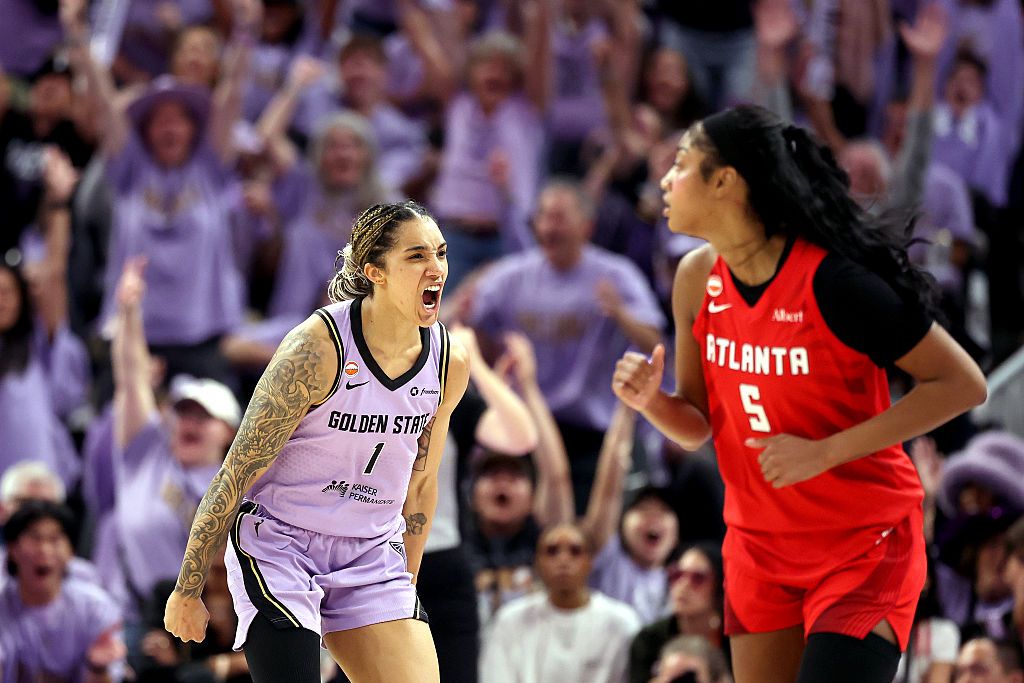
There could be as few as three games remaining in the WNBA’s longest season ever. The Golden State Valkyries, in just their second season after joining as an expansion franchise in 2025, are closing in on their inaugural title. They won Game 1 of the WNBA Finals in a thriller over the Atlanta Dream, 68-64, on Saturday.
Tonight, the Chase Center will surely be packed to the gills again (as it’s been for every game in the Valkyries’ existence) when Golden State plays host for Game 2, which is set to begin at 8:10 p.m. ET tonight.
Both teams should be at full strength. The Valkyries have a completely healthy roster for tonight’s game, while the Dream’s only name on the injury report is Brionna Jones (leg), who was diagnosed with a season-ending injury in August after playing just nine games off the bench.
Golden State is a 2.5-point favorite on DraftKings Sportsbook (-135 Moneyline), with the total set at 152.5 points. Atlanta is +114 on the Moneyline. Below, I’ll break down this marquee matchup and offer a prediction.
Dream at Valkyries Game 2 Best Bet
Golden State Valkyries to Win by 6+ (-112): The Valkyries are well-built to stop the Dream’s Plan A, as they had the league’s most dominant post defense, and Atlanta’s perimeter defense isn’t strong enough to stop Golden State from imparting damage from beyond the arc. As long as the Valkyries can stay out of foul trouble, they should be able to use their transition edge and competitiveness on the boards to build a lead, and there’s no coach I trust in the fourth quarter more than Natalie Nakase.
Dream at Valkyries Game 2 prediction, pick
The Valkyries are narrowing in on proving that defense wins championships; they finished with a league-best 99.1 defensive rating in the regular season, more than four points per 100 possessions better than any other team, and they’ve had the second-best defensive rating so far these playoffs (narrowly behind the Dream). For its part, Atlanta — led by Defensive Player of the Year Angel Reese, who pipped Golden State’s Gabby Williams to the award — had the third-best defensive rating during the regular season, including the second-best mark after the All-Star break. It’s not a surprise, then, that Game 1 was a defensive battle representing the lowest point total of the season for the Dream and the fourth-lowest for the more offensively-limited Valkyries. This series will be decided on the margins, since both teams are so tough and well-rounded.
During the regular season, Golden State stayed away from the paint, attempting a league-low 17.8 shots per game within five feet and canning such shots at just a league-average rate, while Atlanta had the opposite approach, attempting the most close-range shots but making them at the least efficient clip. However, in Game 1, the Valkryies attempted seven more close-range shots than the Dream did, and both teams were inefficient on such looks. Both teams make it difficult for opponents to score around the basket, as Golden State limited opponents to both the fewest layups and the league’s worst efficiency during the regular season and Atlanta was roughly league-average (but significantly better when Reese was in the game). Reese has had enough of a deterrent effect that opponents take relatively inefficient shots when she’s in the game.
Both of these teams were pretty good on the glass during the regular season, but the Dream were unsurprisingly better, given Reese’s presence. So far these playoffs, though, that’s switched, as the Valkyries have out-rebounded their opponents and Atlanta has been slightly out-rebounded. In fact, Golden State won the rebounding battle by six in Game 1 despite Reese’s grabbing 12 boards. The Valkyries have had a slight edge in transition throughout the season, scoring 4.4 more points per game than their opponents off of turnovers while the Dream were plus-2.9, and in Game 1, Atlanta committed four more turnovers than Golden State did. The Dream were better at getting to the foul line than the Valkyries during the regular season, and that held true in Game 1 too, as they made five more trips to the charity stripe.
Both teams can expect to shoot better in Game 2, as they attempted the most (Golden State) and fifth-most (Atlanta) threes during the regular season and connected at roughly league-average rates. In Game 1, the Dream shot just four-for-25 (16.0%) from deep and the Valkyries seven-for-33 (21.2%) in a generally ugly game in which both teams made fewer than one-third of their total tries. It’s highly unlikely that Atlanta’s Allisha Gray, a 33.8% three-point shooter during the regular season, goes one-for-eight again, just as Golden State’s Tiffany Hayes, a 40.6% three-point shooter in 2025 before struggling this season, likely won’t go one-for-five (and zero-for-seven from within the arc). In the long run, I’d give the shooting edge to the Valkyries, given that they both shot a higher percentage from deep and allowed a lower mark than the Dream during the regular season.
Ultimately, playoff basketball is about making adjustments and exploiting edges, and despite its shots not falling, Golden State simply had more answers in Game 1. The Valkyries are better-suited to stop Atlanta’s Plan A than vice versa, and their rebounding and transition edges have persisted throughout these playoffs. This postseason has seen Golden State pull out narrow, gritty victory after narrow, gritty victory, and in what could be its final game of the season at “Ballhalla”, I expect a statement.