Week 1 NFL DFS tournaments on DraftKings require more than simply finding the highest-projected players. In GPP contests, ownership, ceiling, correlation and roster construction can be just as important as identifying the most obvious plays on the slate.
That doesn’t mean we need to fade every popular option. Good chalk is still good chalk. However, we’ll also look for cheaper players with expanding roles, lower-owned options in strong scoring environments and lineup constructions that can separate from the field.
Below are my top NFL DFS tournament picks for Week 1, including a contrarian game stack and high-upside DraftKings GPP plays at quarterback, running back, wide receiver, tight end and defense/special teams.
NFL DFS Tournament Strategy for Week 1
Tournament lineups should prioritize ceiling, correlation and leverage rather than simply trying to maximize projected points. For Week 1, I’m looking for players and stacks that can outperform their salaries while potentially coming in at lower ownership than similarly projected options.
That doesn’t mean fading every popular play. Strong chalk can still belong in GPP lineups, but pairing those players with lower-owned stacks or tournament pivots can create a lineup construction capable of separating from the field.
Best Contrarian Stack for NFL DFS Tournaments in Week 1
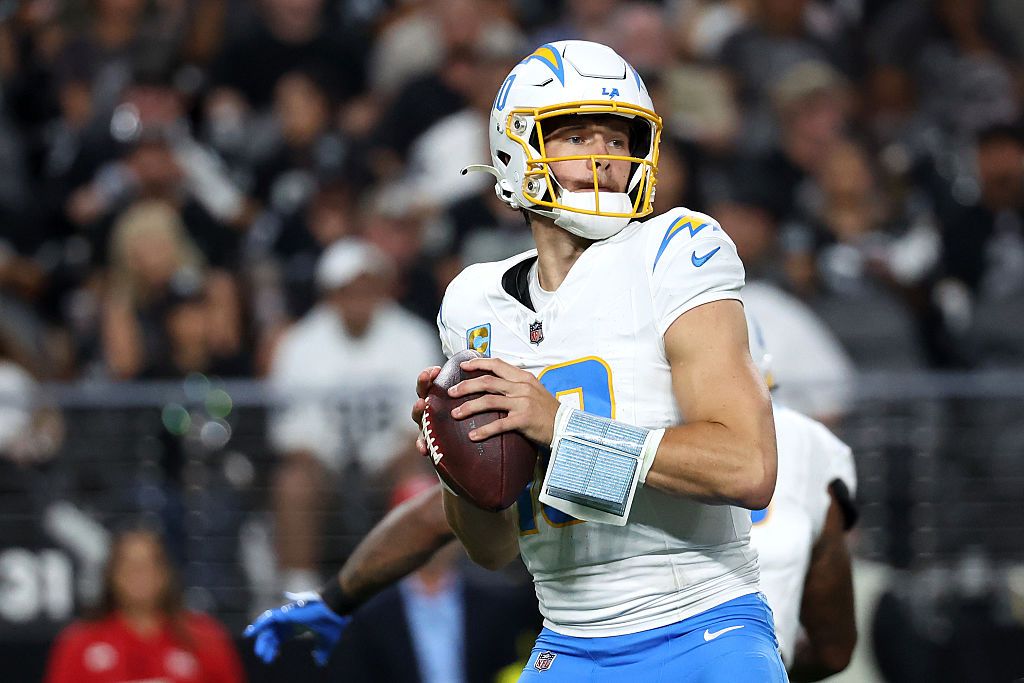
Game Stack: Los Angeles Chargers vs. Arizona Cardinals
Justin Herbert ($6,100) – Ladd McConkey ($5,900) – Quentin Johnston ($4,700) – Michael Wilson ($5,300)
There are plenty of ways to attack the Chargers in Week 1, but the passing game offers a nice mix of price and upside and should be the less popular approach, with RB Omarion Hampton ($6,800) surely being one of the most popular plays on the slate.
It’s not like the passing game doesn’t offer us great value either. Los Angeles boasts one of the highest implied team totals on Sunday at over 28 points, and Herbert is priced at just $6,100, making him just the seventh-most expensive quarterback for Sunday. Even if he does approach 10% ownership or more, he has one of the best ceilings at quarterback, and a double stack will still likely be a lower-owned approach.
That makes doubling up with him using Ladd McConkey and Johnston an intriguing way to build.
McConkey remains the safer target earner of the two, but Johnston is surely the player whose salary stands out for both value and upside. He’s only $4,700 despite coming off a 2025 season in which he averaged 12.3 DraftKings points per game and an offseason where he was regularly talked up by new OC Mike McDaniel. Arizona also allowed the fifth-most fantasy points to wide receivers last season, while the Chargers enter Week 1 with one of the slate’s highest implied totals.
The appeal of both Chargers receivers, but especially Johnston, is pretty simple. He doesn’t need 10 catches to return 4x or better in value. A couple of downfield connections or a multiple-touchdown day can push him well beyond what you’ll need from a receiver under $5,000 to rank high in GPPs.
If we’re using three Chargers, bringing the stack back with Michael Wilson ($5,300) makes the most sense. There seems to be an ingrained logic with most fantasy players that Harrison is still the best WR on the team and Arizona drastically overpaid for Wilson this offseason. All the usage and Wilson’s performance with Brissett late last year indicate that narrative is incorrect. Despite what should be a pass-heavy game script for Arizona, I’d also expect Wilson to carry low ownership this week, and likely much lower than the main pieces of the Chargers offense.
This isn’t necessarily a game we need to force into every lineup, but the salaries make it easy to stack while still leaving room for an expensive running back or receiver.
Alternatives I’m considering:
- Joe Burrow ($6,900) + Tee Higgins ($6,300) + Ja’Marr Chase ($7,800) + Bucky Irving ($5,700)
- Tyler Shough ($5,600) + Chris Olave ($6,700) + Juwan Johnson ($3,700) + Amon-Ra St. Brown ($7,500)
NFL DFS Tournament Quarterback Pick
Trevor Lawrence ($5,800)
Lawrence is a good example of salaries not quite matching fantasy potential. The Jaguars quarterback threw for 29 touchdowns last season and still has rushing upside, especially near the goal line. Lawrence added 359 rushing yards and nine rushing touchdowns on 82 attempts last year and now enters 2026 without his top RB from last season and with an unproven duo at the position. I doubt Jacksonville reins him in at all in short-yardage situations to start the year.
Jacksonville is also a sizable home favorite against Cleveland and carries an implied team total around 25 points, matching some of the top teams on the Week 1 slate. Lawrence doesn’t necessarily need a 300-yard passing game if he’s involved around the goal line again, and a three-touchdown game is certainly doable, especially with the receivers at his disposal.
Lawrence’s $5,800 salary also lets you spend elsewhere without sacrificing much upside at QB, and a two-man stack won’t require you to burn through much extra salary either. Both Brian Thomas Jr. ($5,500) and Parker Washington ($5,600) are under $6,000, with Washington being my favorite target. Most fans are still underrating his talent and upside as the leading slot receiver with a relatively accurate short-to-intermediate passer like Lawrence. Either way, I could see Jacksonville running up the score to start 2026, with Lawrence finishing as a top-three scorer at his position in Week 1.
Alternatives I’m considering:
- Justin Herbert ($6,100)
- Cam Ward ($5,100)
NFL DFS Tournament Running Back Picks
Higher End: Bucky Irving ($5,700)
Irving is one of my favorite values on the entire slate. He’s only $5,700 in a Bengals-Buccaneers game carrying one of Week 1’s highest totals. Cincinnati is favored, but that’s not a major concern for Irving because he’s already shown he can contribute as a receiver and likely will have to given the Bengals’ improved pass rush and the possibility Tampa Bay plays from behind for much of this game.
Even during an injury-shortened 2025 season, Irving caught 30 passes for 277 yards and three receiving touchdowns in 10 games. A year earlier, he caught 47 balls while rushing for 1,122 yards, and this year he won’t be losing receptions to pass-catching wizard Rachaad White, who is now in Washington.
The matchup also isn’t one I’m afraid of. Cincinnati allowed an NFL-high 147.1 rushing yards per game last season and 5.2 yards per carry. While they did improve, a positive game script with Tampa Bay leading would only help Irving. There is some risk after Irving averaged just 3.4 yards per carry last season and Tampa’s run game regressed, but that’s part of why we’re getting him at $5,700 to start the season.
Alternatives I’m considering:
- Breece Hall ($6,200)
- Jaylen Warren ($5,400)
Lower End: Jonathon Brooks ($5,000)
Brooks is more speculative, but that’s also what makes him interesting for tournaments. At $5,000, he doesn’t need a massive game to pay off, and current projections show his ownership as extremely low despite a workload that may include more than 50% of the RB touches, depending on how his end-of-week practice availability shakes out.
Brooks has been limited with a groin injury, but assuming he does play, I’m OK with some risk here. This is more about being early on a talented player whose role could end up being larger than his Week 1 salary suggests.
Carolina does have Chuba Hubbard ($5,500), but the team seems focused on giving Brooks a legitimate role this year. Overall, in what could be a higher-scoring game than expected thanks to Chicago’s faster-paced style, a handful of receptions plus 10-12 carries and some goal-line work would be enough to give him a realistic path to outperforming this price.
Alternatives I’m considering:
- Rico Dowdle ($5,200)
- Tony Pollard ($5,600)
NFL DFS Tournament Wide Receiver Picks
Higher End: Drake London ($6,500)
London isn’t necessarily overly cheap this week, but he also isn’t priced like the elite receivers at the top of the slate. Ja’Marr Chase costs $7,800, and Amon-Ra St. Brown is $7,500, leaving a meaningful discount to London at $6,500. He will continue to be the featured target in a Falcons offense that features mostly journeymen on the depth chart behind him at WR. More importantly, the projected ownership gap may be much larger than the salary gap.
Given the uncertainty around the Falcons’ QB play with Tagovailoa starting, it’s possible London comes in at well under 10% ownership in Week 1, in a game where Atlanta projects to be behind and passing late. That sort of game script, plus the potential for a better early-season connection with a new QB, means he may have similar upside to several of the slate’s most expensive receivers without the same salary or expected popularity.
Overall, London can still dominate targets and produce a winning score without requiring an extreme game environment, and DraftKings’ full-PPR scoring certainly makes him far more appealing at these levels. As long as he’s under $7,000, I’m willing to take the risk for DFS GPPs early in the year.
Alternatives I’m considering:
- Zay Flowers ($6,400)
- Tetairoa McMillan ($6,100)
Lower End: Quentin Johnston ($4,700)
Johnston is my favorite receiver under $5,000 this week. He’s only $4,700 against an Arizona defense that allowed the fifth-most fantasy points to wide receivers last season, while the Chargers carry an implied team total around 28 points.
He also doesn’t need massive reception volume to pay off this salary. Three of Johnston’s eight touchdowns last season came from 36 or more yards out, including scores of 50 and 60 yards, and he had three games with 20 or more DraftKings points in 2025. With a new OC in Mike McDaniel, it’s also plausible Johnston builds on those numbers rather than regresses. Overall, his downfield role and touchdown upside give him a realistic path to 20-plus DK points if Justin Herbert and the Chargers hit their scoring expectations.
Tre Tucker ($4,000) is the obvious alternative with Brock Bowers out, but that’s also likely to make him one of the chalkier salary-saving receivers on the slate, as the news hit midweek and gave fantasy players plenty of time to pivot. Tucker may see more targets and is $700 cheaper than Johnston, but Johnston offers an interesting tournament pivot if Tucker’s ownership climbs. Jalen Coker ($4,600) is another lower-owned option I’m considering in this range.
Alternatives I’m considering:
- Tre Tucker ($4,000)
- Jalen Coker ($4,600)
NFL DFS Tournament Tight End Pick
Michael Mayer ($2,900)
Mayer ($2,900) is going to be one of the chalkiest cheap tight ends on the slate, but this is a case where you should be mostly fine eating some ownership. With Brock Bowers out following a meniscus procedure, Mayer will step into a much larger role, helped by the Raiders’ thin WR corps, against Miami at a salary that gives you tons of flexibility everywhere else for lineup building.
There is also precedent for Mayer producing when Bowers is unavailable. Late last season against the Giants, Mayer caught 9 of 10 targets for 89 yards, showing the type of receiving involvement he can have when elevated in the Raiders’ offense. We obviously don’t need anything close to that at $2,900 for him to be useful, but his expanded role gives him plenty of upside at this salary.
Tre Tucker should benefit too, but Mayer is the direct replacement at tight end and offers a cheap path to receptions and touchdown equity. He also plays at a position where viable DFS pivots can be difficult to find, especially below $3,000. The main advantage might be roster construction, as saving this much at TE creates salary cap space to afford top-tier RBs and WRs with real potential to dominate the slate.
Alternatives I’m considering:
- Sam LaPorta ($4,400)
- Harold Fannin Jr. ($4,200)
NFL DFS Tournament Defense Pick
Miami Dolphins ($2,700)
Defense is usually where you should be most willing to embrace some uncertainty and chase salary savings or simply target a team that’s up against one of the more popular offenses for leverage purposes. Miami fits that approach to a tee this week.
The Dolphins are only $2,700 against a Las Vegas offense with one of the lower implied team totals on the slate and a QB in Kirk Cousins, who looked finished at points last season and threw an interception in four of his 10 appearances, including five picks across his final seven games. That’s an attractive matchup for upside in tournaments.
Brock Bowers’ absence also removes the Raiders’ best receiving weapon from the lineup. If Las Vegas falls behind, we could easily see Cousins start forcing throws to an inexperienced group of pass catchers, creating more opportunities for sacks and turnovers.
Miami is projected to be a bottom-five defense and isn’t likely to completely shut Las Vegas down, but at this price, a few sacks and one turnover could be enough. A defensive touchdown would obviously push the Dolphins toward the top of the position thanks to the salary savings.
Alternatives I’m considering:
- Green Bay Packers ($3,000)
NFL DFS Tournament Picks FAQ
What is a GPP in NFL DFS?
A GPP, or guaranteed prize pool tournament, is a DFS contest that generally rewards high-ceiling lineups capable of finishing near the top of a large field. Unlike safer lineup constructions, tournament lineups often place more emphasis on ceiling, correlation, ownership and leverage.
What should I look for in NFL DFS tournament picks?
Strong NFL DFS tournament plays should offer a combination of upside, salary value and a realistic path to outperforming their expected ownership. Correlated game stacks and lower-owned pivots from popular players can also help differentiate lineups in larger contests.
How are NFL DFS tournament picks different from cash-game picks?
Cash-game lineups generally prioritize projection, workload and consistency, while tournament lineups can take on more volatility in exchange for a higher ceiling. GPP players may also consider ownership and leverage more heavily when deciding between similarly projected options.
What is the best DraftKings NFL DFS tournament stack for Week 1?
My favorite Week 1 tournament stack is Justin Herbert with Ladd McConkey and Quentin Johnston, with Michael Wilson as the Arizona bring-back. The combination provides exposure to one of the slate’s higher projected scoring environments while offering several pieces that could come in at lower ownership than other popular Week 1 options.